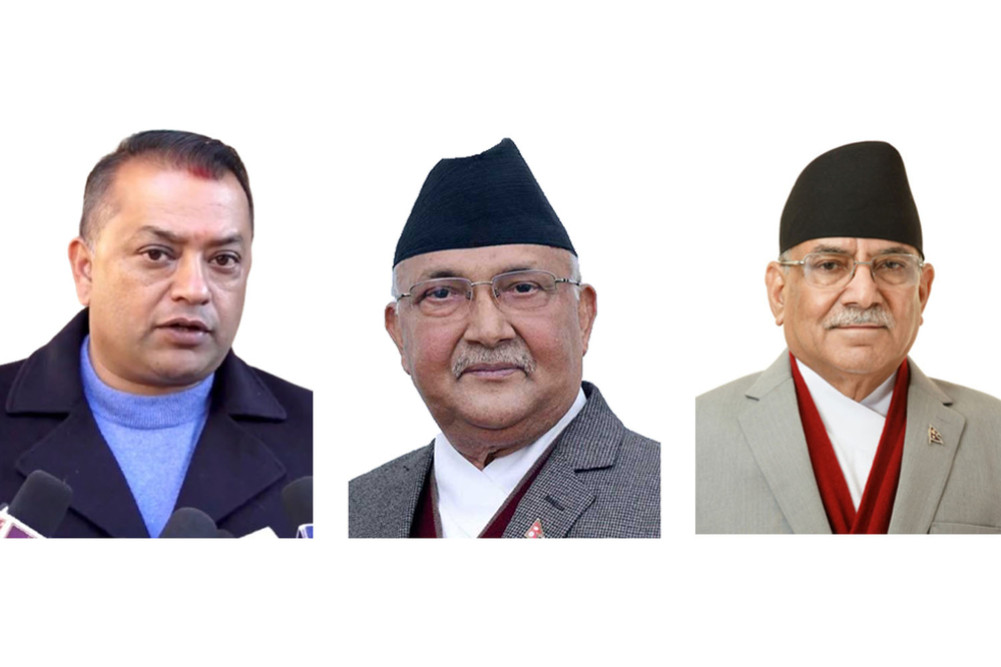
Not every damaged party is doomed. Some parties come back – more humble, ideological and organized. But for that, they have to destroy their own myths. The biggest crisis for old parties is not how many seats they have lost in parliament, but whether they have lost their soul.
We use Google Cloud Translation Services. Google requires we provide the following disclaimer relating to use of this service:
This service may contain translations powered by Google. Google disclaims all warranties related to the translations, expressed or implied, including any warranties of accuracy, reliability, and any implied warranties of merchantability, fitness for a particular purpose, and noninfringement.
‘How did the old parties suddenly collapse? Despite having such a network of beneficiaries, such a racket, and such reach and influence down to the ward level, why did they appear so helpless?’ Such questions are being raised about the condition of old parties like the Nepali Congress, CPN-UML, and Maoist Center after the Bhadaure lightning strike. However, these parties had been internally crippled long before the National Independent Party (NISP) gave an electoral blow.
They were not suddenly brought to the brink of collapse. They walked there on their own. First, I was impressed by their ideological restlessness. Then came the organizational vitality and confidence of the workers. The parties remained, but like skeletons. Finally, the people lost hope in them.
Until last Bhada 23, these parties were considered the indispensable political force. Flags were fluttering all over the country, there were groups demonstrating devotion to the divine words of the top leadership, there were resistance squads, and spokespersons were gossiping. However, on closer inspection, it was seen that the vitality within the parties was waning. These parties and their party leaders had started considering themselves the natural center of history.
Power is their right, the people are the permanent base. And, the organization is the impenetrable wall. This was their psychology. The party had become a permanent mediator between the citizen and the state. Access and identity were determined on the basis of party faces in almost all parts of the state.
As the dominance in the state increased, the owners changed but the customers remained the same. The counter remained the same, only the signboard changed. The profit-seeking workers kept moving from one party to another, from one faction to another. It polluted and fouled the entire political circle down to the ground level. This situation is a brief sociology of the party-based power structure. After 2046, the situation became such that the common people were forced to rely on the party for protection. After the Congress, the UML, then the Maoists - all of them, changing their appearance, expanded 'franchise politics'. Franchise politics is such a political structure, where the party brand, access, protection and profit network is extended to the local level more than ideas, policies and public accountability.
As the dominance in the state increased, the owner changed, but the customer remained the same, the counter remained the same, only the signboard changed. The profit-seeking workers kept clinging from one party to another, from one faction to another. It polluted and fouled the entire political circle down to the ground level. This situation is a brief sociology of the party-based power structure. The seeds of decline were sown here.
These old parties were symbols of the Nepali people's struggle. This issue is also accepted by today's ruling party. However, the political forces born from the movement gradually transformed into managers. Access took the place of ideology, convenience took the place of struggle, dialogue took the place of order, and opportunism took the place of political training. Workers began to join not for 'causes' but for 'connections'. Although the organization appeared healthy from the outside, it was rotting inside.
While in power for a long time, these parties have transformed into a network of opportunities, security, access, protection and benefits. Proximity to power acts as a 'fevicol' for activists. However, after an electoral defeat, the protection system weakens. When the guarantee of protection is lost, confidence begins to waver. That is why those who used to aggressively defend their leaders and parties until yesterday are silent or neutral today.
According to the famous social thinker Albert O. Hirschman's 'Exit, Voice and Loyalty' theory, during a crisis, activists have three paths - voice (taking sides openly), loyalty (sitting together in silence) and exit (gradually creating distance). When activists start to feel that 'the leadership can no longer protect them', then 'voice' decreases and 'exit' starts to increase. The activists who were ready to fight in television debates, social media and street squares until yesterday are silent and relaxed today.
The brutal truth of politics is that every rising power wants to make its predecessor irrelevant. The new power knows that if the old parties maintain their resources, moral influence and psychological presence, then revival is possible. So a strategy is devised to keep them in a cycle of deprivation, pressure and influence. The historical contribution of the old parties is only repeated, while the narrative of failure is ignored. Leaders are portrayed as ‘remnants of the past’. This is basically a struggle over legitimacy and memory. This is what the Nationalist Swatantra Party (NSWP) has done.
The most effective way to defeat the opposition in contemporary politics is to destabilize it from within, not from without. Therefore, the internal strife seen in the old parties is sometimes not just a natural power struggle. It can also be part of a broader strategy, where the ruling power tries to keep the rival party unstable, divided and psychologically weak from within. In a democracy, it is not enough to simply defeat the rival party in an election. If the old party remains organizationally, ideologically, or emotionally alive, it can revive again. Therefore, those institutions that can revive it are weakened. Government initiatives such as the abolition of trade unions, student organizations, and the use of bulldozers in squatter settlements are the result of such thinking and strategy.
The current new regime is trying hard, is doing so, that the old parties become a 'jamaat' of factions rather than 'organizations'. Leadership disputes, generational conflicts, ideological ambiguity, disputes over the distribution of positions, or public accusations within the old parties are further exaggerated. However, not every internal conflict is artificial.
Michel Foucault was a French social thinker who studied in depth the relationship between power, knowledge, surveillance, and institutional control. According to him, power is not only oppressive. It also 'constructs' relationships and behavior. The dictator does not always intimidate his opponents by putting them in prison. He even imprisons some. It creates an environment of distrust and insecurity in the old parties. Within the party, which looks like a single structure from the outside, suspicions and suspicions start spreading. The current 'perception management' has become extremely important. Through media narratives, leaked information, selective research and promotion of social media, such an environment is created that the opposition parties are falling apart, their leaders are finished and the old parties are now history.
Leaders who were considered the 'backbone' until yesterday, are suddenly considered to be subjects of mandatory abandonment. It is also starting to appear that the old parties themselves are under the illusion that they are involved in 'natural internal strife'. While they are working within a pressure system. Gradually, the party's energy is being spent on internal disputes, moving away from the questions of the people. As a result, the old parties are not an alternative for the people, but rather creating an image of a 'problematic institution'. The current competition is not about principles, organizations or dedicated workers, but about 'narrative control'. Here, the whole game of proving the old parties 'irrelevant' is going on on the strength of this.
In such an environment, the old parties have become defensive. Their leadership is busy justifying aggressive politics instead. Instead of protesting, the workers have started staying silent. The workers who were fearlessly speaking in favor of the leadership and the party on every platform till yesterday are scared today. This is not just fear, this is psychological defeat. They have started to feel that the direction of history has changed. And, they have become representatives of a defeated time. This mood is increasing the attraction towards the Rashtriya Swayamsevak Sangh (RSS) for some. After the announcement of the municipal and provincial elections, there may be a stampede in the old parties. This is where the fate of the 'damaged and damaged parties' begins.
However, one thing should be clear, a damaged and damaged party is not just a party that loses elections. Defeat is normal in democracy. The real crisis begins there, when the party loses the ability to understand the ideological meaning of its defeat, considers introspection unnecessary, instead of listening to the cries of the people, it goes around looking for conspiracies, and considers those who question it within the party as enemies. After that, the party becomes a political remnant, not a living institution.
However, not every damaged party is finished. Some parties come back - more humble, more ideological, and more organized. However, for this, they must destroy their own myths. They must accept this - the people do not give legitimacy to any particular party forever based on history alone. In a democracy, the people ultimately stand up for living energy. Therefore, the biggest crisis of old parties is not how many seats they have lost in parliament, but whether they have lost their soul. Because before a party is seen to be collapsing from the outside, it has already withered from within.
‘Inside-out’ manifests itself in many ways in parties – cadres remaining solely for profit, having a superficial faith in the leadership, personality worship replacing ideology, weakening internal dialogue, marginalization of dissent, increasing emotional distance from the people, and the end of the party’s combative character. However, as long as power, resources, fear, and electoral success remain, the holes in the party structure are not visible. Everything remains ‘normal’. People continue to support each other out of compulsion, opportunity, or hope. A party that begins to consider itself an invincible heir to power develops artificial stability within itself. It feels that the support of the people is permanent, the cadres are naturally loyal, and power is its natural right. This is where its downfall begins.
The old parties are only seeing external forces – not internal ‘decay.’ The most dangerous moment in politics is not defeat. Rather, it is the time when a party begins to consider itself ‘inevitable’. Because this is where introspection begins to end. Again, some lightning, some electoral defeat, revelation of corruption, leadership crisis or the strategy of the permanent power suddenly exposes the internal decay. And it seems, how did so many parties fall in one blow?
At present, the new power seems to be busy creating a new elite class using the narrative of corruption, the repetition of past failures, the discussion of 'old versus new' and the whip of fear. Elites in politics are not permanent. The emerging new elite is gradually displacing the old elite from power, resources, prestige and institutional access. The tendency to rule through ordinances by proroguing the parliament can be seen in this context.
Nepal's 'permanent power' often seems to consider weak political parties as its allies. In such a situation, 'unelected power' begins to become more influential than elected politics. When the old parties are weak, the immediate impact is on 'political mediation'.
In a democracy, parties are not just machines for fighting elections, they are bridges between the state and the citizens. When these parties weaken, the people start to depend on personalities, crowds or sudden exuberance rather than institutions. A federal democratic republic is a system that relies on strong political parties in particular.
If only one party remains like a banyan tree, the federal structure can become a place of distrust rather than coordination. Then another process may begin, a ‘political vacuum’. Old parties become weak, but new parties are not yet institutionalized. Then unelected power centers within the state become active. They can create distrust in the democratic process itself in the language of stability, national interest, good governance or control of chaos. In many countries in history, democracy has been weakened in this way. Not all at once, but gradually, making parties unreliable. Therefore, although criticism of old parties is necessary, their complete institutional collapse may be risky for the federal democratic republic for now. Because the void never remains empty. It is either filled by a new democratic force or by an invisible permanent force.
The old parties must stand together to maintain democratic control over the unruly Balendra Shah. And, a common political vision must be created about the pace and opinions of the current government. But, ironically! They are turning a blind eye to this very urgent task at hand. Closing their eyes will not stop the storm. Why do the parties that fought the Rana and the king look so scared today?