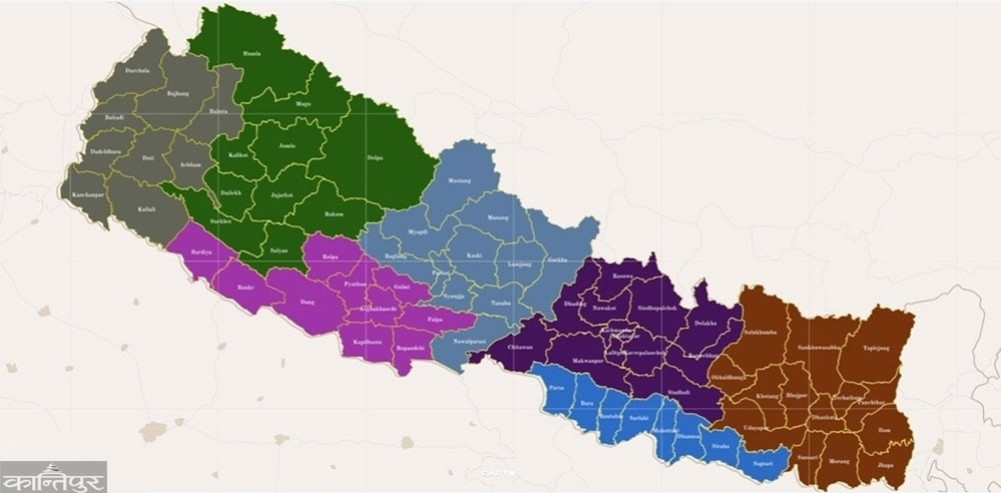
In the past, there were/are problems with local level delimitation and nomination. Now the door to correct delimitation and nomination has opened. But there should be an objective study of the basis of identity, geographical, cultural, historical, ethnic majority, linguistic, accessibility, etc.
We use Google Cloud Translation Services. Google requires we provide the following disclaimer relating to use of this service:
This service may contain translations powered by Google. Google disclaims all warranties related to the translations, expressed or implied, including any warranties of accuracy, reliability, and any implied warranties of merchantability, fitness for a particular purpose, and noninfringement.
With the formation of the new government, the issue of constitutional amendment has started to arise . The constitution itself is a dynamic document . Its scientific amendment according to the times is necessary . The restructuring of the local level should also be seen in connection with the constitutional amendment .
The government has now sought opinions/suggestions from all seven provinces for the number of wards of rural municipalities and municipalities, boundary changes and review . With this, the debate on the issue of local level delimitation and nomination has started once again . The suggestions will definitely help make the local level delimitation more scientific . In the past, there was/is a problem in the local level delimitation and nomination . Now the door for correct delimitation and nomination has opened . But for that, an objective study of the basis including identity, geographical, cultural, historical, ethnic majority, linguistic, accessibility is necessary
After the country went into federalism, political and geographical decentralization was done However, decentralization could not be done in a way that retained the identity and scientific meaning of some local levels. Decentralization is not just about establishing a structure. It is also about representing its various dimensions. The issue of identity is equally important with the restructuring and decentralization of the local level. It is especially necessary to demarcate and nominate local levels in a way that reflects the identity of the indigenous and minority communities. Identity is also a basis for the current restructuring. Minorities created by federalism
The Chepang community is in the majority in the five former VDCs of Gorkha (Ghyalchowk, Bhumlichowk, Tanglichowk, Makaising and Taklung). The local level structure divided Taklung into Shahid Lakhan Rural Municipality and the others into Gandaki Rural Municipality. Geographically, the Chepang majority area, which is also located on the Trishuli slope, was divided by the federalization demarcation. In the beginning, the Chepangs' homeland was attacked in the name of federalization. The Chepang community, which was the majority, was transformed into a minority due to the political demarcation of federalization. Due to the
Due to the delimitation, the Chepang community could not become politically above the voters. Politics is not only about presence and representation, but also decision-makers. After dividing its territory geographically, it is natural to be weak in representation. demarcation, the Chepang community could not become politically above the voters. Politics is not only about presence and representation, but also decision-making. It is natural to be weak in representation after geographically dividing one's homeland. The second term of the local government is underway after the implementation of federalization. Looking at the statistics, there is no record of more than one person from the Chepang community becoming ward chair (in the first term) in Gandaki and Shahid Lakhan rural municipalities. Without political presence, the issues and identity of the concerned community automatically fade away. Community-based programs conceived by others cannot achieve effectiveness.
Will the upcoming amendment address such problems? Will there be a local level with identity or not? Should we live as a minority in our own territory or not? Will the new government and the constitutional amendment redelimit and rename the local level at the initiative of the concerned community? Is the beauty of our constitution and federalism to establish the identity of minority communities or not? The next constitutional amendment will be within the scope of all these questions.
Our federalism has not been able to move forward in rhythm due to failure to resolve such issues. There has been more visible and spoken development, including pitched roads and physical infrastructure, than yesterday. But, has the concerned community been able to take advantage of it or not? Has the standard of living of the community risen higher than yesterday? The local government does not have an account of it. If the condition of the citizens does not improve from yesterday, what is the meaning of physical development alone?
Govindaram Chepang, the central president of the Nepal Chepang Association, who is also a member of the Constituent Assembly, argues that they proposed to form a 'Jhoralang' rural municipality by incorporating the Chepang-dominated areas of Dhading, Chitwan and Makawanpur for the sake of identity. The association has already prepared a preliminary blueprint to declare the former 12 VDCs and 29 wards of Chitwan, Makawanpur, Dhading and Gorkha as Chepang Protected Areas.
The commentary on federalism and development
A commentary is firmly established in Nepali society. When leaders go to villages, what did development bring? It is customary to ask. Development is not something to be taken or given. Here, the government has a tendency to give development and the people to accept it. The inability to localize and localize development is another weakness of our federalism. Development should be done by the community by analyzing its local characteristics.
Experts should not show the path to development. The process of showing the villagers by those who have studied here, and of developed countries showing the underdeveloped countries is wrong in itself. Development cannot be achieved by showing the World Bank, donor agencies, or experts. Development should be sought by the locals themselves. Attention should be paid to its originality. The trend of copying has damaged our development model. Federalism could not destroy that model either.
From the perspective of local level demarcation, our federalism developed from the dilemma of not breaking eggs and eating omelettes. A forced local level was created by merging the former VDCs. From the perspective of local level demarcation, the development of our federalism took place due to the dilemma of not breaking eggs and eating omelettes. A forced local level was created by merging the former VDCs. Another example is the Ichchakamana Rural Municipality Ward No. Citizens of the 7th rural municipality are forced to travel through Kalika Municipality, Ratnanagar Municipality and Bharatpur Metropolitan City to reach Kurintar. Such constraints should be resolved by the current redemargination. It is necessary to form local levels in a way that is easy and convenient. Because the government closest to the citizens is the local government. It is also called the visible government.
According to federal affairs expert Somat Ghimire, first, redemargination must take place, but the process of forming a municipality by merging VDCs was itself anti-federal. Second, on what basis? The process of suggestions sought by the government is itself weak. For that, a study should be conducted by forming a multi-stakeholder commission of the province including the rural municipality/municipal federation under the leadership of experts. Third, what should be considered as the basis for redelimitation? He argues that it should be done by combining indicators such as identity, non-distribution of indigenous peoples, minorities, management of natural resources, accessibility, connectivity.
Where is the practice of coordination?
Article 232 of the Constitution clearly states that the relationship between the union, provinces and local levels shall be based on the principles of cooperation, coexistence and coordination. The Constitution has given special emphasis to the relationship between the three levels of government. However, the relationship between the local levels has not been emphasized. The Constitution has interpreted the relationship only in a vertical (vertical) form.
If local government is to be strengthened, the concept of a horizontal (horizontal) constitution is also equally necessary. Due to the vertical constitution, if there is a legal problem between local levels, there is a compulsion to go to the center. Even today, if there are disputes between some local levels on issues such as borders, taxes, etc., there is a compulsion in our constitution to go to the center.
It does not seem that Gandaki and Shahid Lakhan rural municipalities of Gorkha have coordinated and worked together on the Chepang issue. Even though they are different local levels, it would have been a relief to some extent if they had collaborated on the multifaceted issues of the Chepang community. However, so far, neither municipality has data on such coordination.
It is necessary to clarify the cooperation and coordination between local levels in the upcoming constitutional amendment. By collaborating in this way, some problems can be solved at the local level. It also strengthens the local government.
Similarly, the Trishuli River flows through the border of Dhading, Gorkha and Chitwan. Trishuli is mostly used for perennial rafting. Benighat Rorang in Dhading, Ichhakamana in Chitwan, Gandaki in Gorkha and Shahid Lakhan rural municipalities can benefit from it. However, there is confusion among local governments about this. The main reason for this is the lack of coordination and cooperation.
There are many such problems across the country. It is necessary to identify it scientifically and redelineate and nominate the local level by including indicators such as the identity of various aspects, indigenous peoples, minorities, management of natural resources, accessibility, connectivity and others.