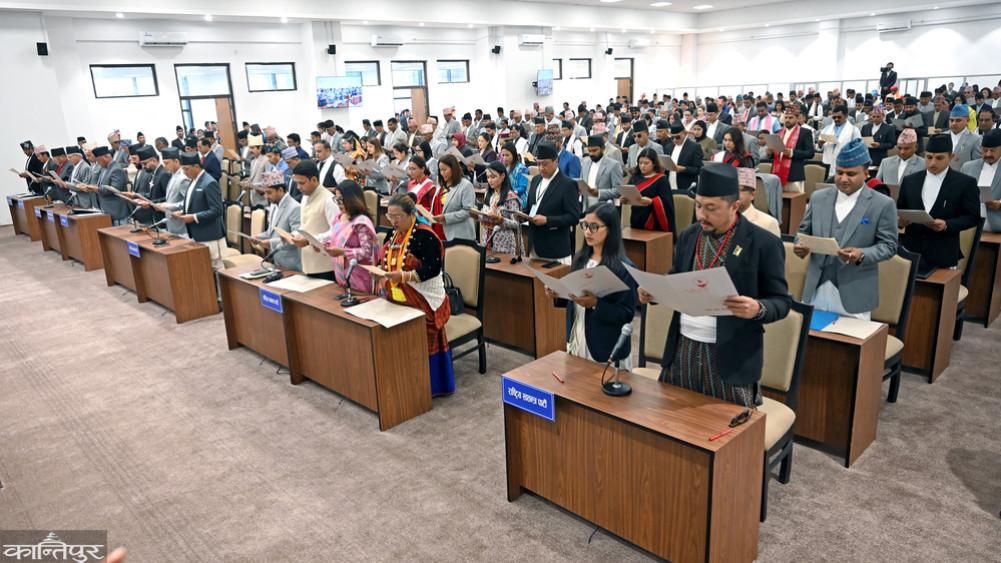
The opposition party of today should not operate in a traditional manner. It seems necessary to abandon the parliamentary obstructionist strategy of the past and become constructive and creative.
We use Google Cloud Translation Services. Google requires we provide the following disclaimer relating to use of this service:
This service may contain translations powered by Google. Google disclaims all warranties related to the translations, expressed or implied, including any warranties of accuracy, reliability, and any implied warranties of merchantability, fitness for a particular purpose, and noninfringement.
British lawyer Ivor Jennings said that a functioning democracy needs a strong opposition to act as an alternative government and a voice of public discontent . Without an opposition, the government lacks accountability, which pushes democracy towards tyranny . In his work ‘Cabinet Government’ (1936), he described the role of the opposition not only as a parliamentary obstructionist but also as an important, constructive and legitimate component of democratic government .
is said that the government belongs to the ruling party, while the streets and the House belong to the opposition . The role played by the opposition in democratic and parliamentary practice is viewed with importance . The role of the opposition in parliament is not only to oppose and criticize, but also to prevent the government from going the wrong way . It is also to provide constructive support to good efforts . Questions have also been raised about the role played by the opposition in Nepal’s parliamentary history . It is found that the parliament is obstructed in the name of disagreement and priority is given to accusations and counter-accusations . They work hard to find weaknesses only in the party in power. Therefore, the responsibility of the opposition is not to always criticize. Even when criticizing, it should be done in a constructive manner. Constructive criticism and shortcomings should be warned.
The opposition party in parliament is an essential component of democracy. The more influence the opposition has in parliament, the more effective the government becomes.
The government should also identify the different opinions and ideas raised in the parliament. Which makes the work of the government more effective. The government should be able to create an environment in which it can provide alternatives to the weaknesses of the bills and other proposals it has brought and express its views. The government should create an environment in which the opposition feels that it has an easy opportunity to voice its voice in the parliament in parliamentary debate. The opposition party should be in a position to raise questions about every decision made by the government and make it more accountable. The government can misuse its power, and the role of the opposition is to balance this.
It is not said that every action taken by the government is in the interest of the common people and democracy. Sometimes, even if the policies, rules, and laws brought by the government are in accordance with them, they are not in the interest of the citizens. There is a need for the opposition party to discuss such policies with experts and propose an alternative path. They can create pressure on the government to be accountable and maintain zero tolerance for corruption by raising their voice against corruption, irregularities, and non-transparency. This can improve their image among the citizens.
The opposition is very weak in terms of numbers in the current parliament. The Rashtriya Swayamsevak Sangh (RSS) has almost two-thirds of the seats in the House of Representatives. Therefore, the RSSS has got the opportunity to rule in a comfortable manner. The government should understand how to respect the minority when it has a majority. When the opposition's opinion is taken into account in the decision-making process and their views are included and adjusted, the possibility of differences between the government and the opposition is also reduced.
If the ruling party and the opposition can maintain cooperation in the law-making process, the possibility of one party's interests dominating is reduced. Opposition party members can present non-governmental bills in parliament. The opposition party can also block the bill presented by the government and conduct further research on it. They can also submit amendment proposals to the bill and try to prevent the bill from being passed. The opposition party can also propose alternative bills, alternative policies and programs in parliament. This is why the main opposition in the parliamentary system is called the alternative government.
The tendency of the opposition to continuously oppose the government, obstruct the parliament but not show any alternative path leaves an important part of the parliamentary system. Obstruction is considered right for a certain period of time, but obstructing the parliament by constantly obstructing and holding slogan rallies is not considered right. Therefore, dialogue, debate and discussion within the parliament should be prioritized. Solutions to the problem should be found from there. If that can be done, it can be understood that the opposition has fulfilled its responsibility and the government has fulfilled its responsibility.
The current opposition party should not operate in a traditional manner. There is a need to abandon the parliamentary obstruction strategy of the past and be creative and inventive. The government should also identify the different opinions and ideas raised in the House. This will make the government's work more effective.
If we look at international practice, the role of the opposition party in the developed democracies of the world is not limited to criticizing the government, but is seen as a powerful institutional means of defending democracy. Since the number of opposition parties is currently very small, all opposition parties can form a mechanism together and fulfill the role of the opposition. In a democracy, the courage and commitment shown by the minority is viewed with more importance than the majority. Therefore, the general opposition party should fulfill its responsibility to protect democratic values by presenting itself in a mature and responsible manner in the parliament.
If we look at international practice, the role of the opposition party in the developed democracies of the world is not limited to criticizing the government, but is seen as a powerful institutional means of defending democracy. For example, the Watergate scandal can be taken, in the United States, the opposition party forced the president to resign by creating continuous parliamentary investigation, debate and public pressure against the then President Richard Nixon. This incident shows that a strong opposition not only questions the government, but also punishes abuse of power if necessary.
Similarly, in the European country of Germany, the role of the opposition still seems to be institutionally strong. There, parliamentary committees are very effective and members of the opposition party get the opportunity to lead important committees. This helps to maintain close monitoring of the government's activities. Such a system would not limit the power of the opposition to parliamentary debates, but could have a long-term impact through institutional structures.
In conclusion, the current opposition must move forward from the traditional style. It should not only raise questions, but also provide answers, not only criticize, but also present alternatives. It should not only oppose, but play a constructive role by adopting a strategy of showing the way to solutions. When the opposition is strong, responsible and policy-oriented, only then will the government become effective. Therefore, one of the main criteria for measuring the quality of democracy is the level of the opposition.