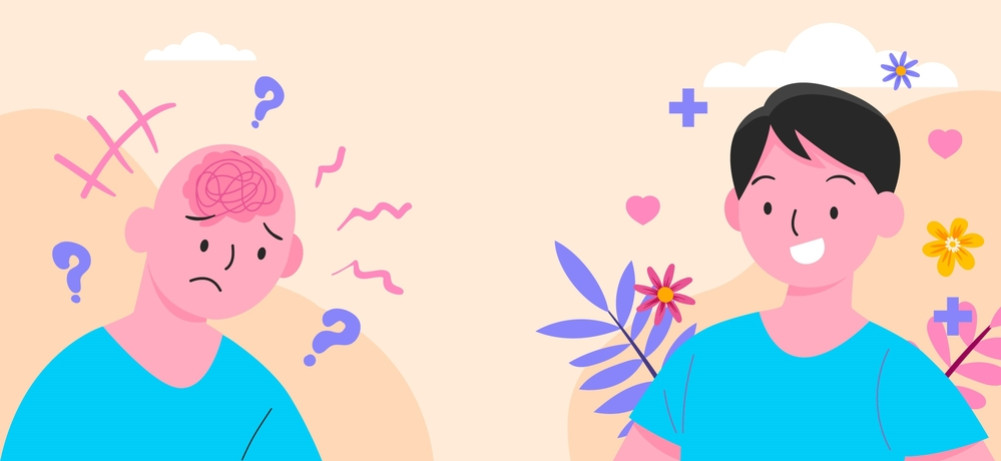
What is mental health? What are the symptoms? What kind of counseling is needed if a mental problem is detected? It is very important to provide education on such topics from the school level.
We use Google Cloud Translation Services. Google requires we provide the following disclaimer relating to use of this service:
This service may contain translations powered by Google. Google disclaims all warranties related to the translations, expressed or implied, including any warranties of accuracy, reliability, and any implied warranties of merchantability, fitness for a particular purpose, and noninfringement.
Mental illness is still a subject of ridicule in Nepali society. People with mental health problems are addressed with derogatory terms like ‘brain-dead’, ‘stupid’, ‘crazy’. This type of naming not only causes mental stress to the patient but also socially isolates them. People suffering from mental illness have to endure more humiliation, neglect and discrimination from society than from the disease.
In recent years, anxiety and depression have become a growing problem worldwide. Work pressure, financial problems, family conflicts, social expectations and uncertainty about the future are having a profound impact on people’s mental health. However, in Nepal, public awareness programs on mental health are not enough. Mental health services and information are even more limited in rural areas.
It is important for everyone to understand that mental health is as important as physical health. Mental illness is not a weakness or madness, it is a health problem that requires treatment and support. Therefore, creating an environment of open dialogue, accurate information, empathy and support regarding mental health is the need of the day.
Today's youth are under serious mental pressure due to academic competition, unemployment, comparisons on social media and uncertainty about the future. Such challenges are negatively affecting the confidence, emotional balance and decision-making ability of the youth. But sadly, the mental health support system at the school and college level is still weak.
What is mental health? What are its symptoms? What kind of counseling is required if a mental problem is seen? It is necessary to provide education on such topics from the school level. Since childhood and adolescence are sensitive stages of mental development, getting the right information and support at this time can prevent serious problems in the future.
Today we hear about tragic incidents like suicides, fathers killing their own daughters, or mothers harming their own children. Such incidents do not happen suddenly. Such people have often been struggling with mental health problems for a long time and are more likely to not receive proper counseling and treatment on time. These increasing incidents make it clear how important and serious mental health is in Nepali society.
Mental health problems are not a crime, weakness, or shame. Just as we take medicine and go to the hospital when we suffer from physical injuries or illnesses, counseling or taking necessary psychiatric medication is a normal part of treatment when we have mental problems.
Unfortunately, there is still a misconception in our society that ‘taking counseling means going crazy’. Also, having to take mental medication regularly after counseling is viewed as a huge and negative thing. Due to such misconceptions, many people do not receive the necessary treatment in time, which makes their mental problems more serious.
Therefore, the need today is to make mental health education, public awareness programs, counseling services, and treatment easy and acceptable from school to society. Only by developing a culture that understands mental health as normal, necessary, and respectful as physical health will it be possible to build a healthy, safe, and humane Nepali society. It seems that it will take some time for the culture of accepting such issues and seeking treatment to develop in the society we come from.
In the generation of our grandparents, Nepali society was mostly based on the joint family system. At that time, the impact of modern technology such as mobile phones and television was less. It is believed that people were relatively less affected by loneliness because there was more mutual harmony, cooperation, and direct social relations between family members. It is said that mental health problems such as anxiety and depression were less common at that time.
However, today's Nepali society is changing rapidly. Due to political instability, economic challenges and the increasing trend of foreign employment, many families are divided. Not only villages and cities, but also members of the same family are forced to live in different countries. This has not only increased distance in family relationships, but also increased emotional isolation.
The young generation is facing mental stress due to the situation of living alone abroad, lack of social support, pressure to adapt to a new environment and uncertainty about the future. Despite regular contact with family, many people feel lonely due to lack of direct support and emotional support.
This change in the social structure has seen an increase in mental health problems in today's Nepali community. Today, it is very important to understand mental health more seriously than before, identify it in time and provide necessary support and treatment.
In the race for economic prosperity, today's Nepalis and their families are paying a huge price not only financially but also mentally. Today, although people appear wealthy on the outside, they are affected by mental problems such as stress, anxiety and depression on the inside.
If anyone in your family, neighborhood or relatives is mentally troubled, let's not make them a laughing stock. Instead, let's encourage them to seek counseling with love, support and assistance. This will help the affected person get a new life and a family can be happy again. This kind of positive thinking and behavior can really make a big difference in a person's life. It makes the affected person confident and also spreads positive energy in the society. In this way, positive thinking and behavior make a big contribution to building a positive society.
Another important issue is that even if a person has gone through mental suffering and has completely recovered after receiving proper counseling and medication, our society still views them differently. Such an approach not only hurts the self-esteem of the person, but also creates unnecessary discrimination and distance within the society.
In fact, mental health problems are as common as other physical illnesses . And, if treated on time, they can be completely cured . Therefore, it is very important to accept recovered people as normal again, treat them with respect and equality .
Only then will mutual understanding, trust and help build a positive and healthy society .