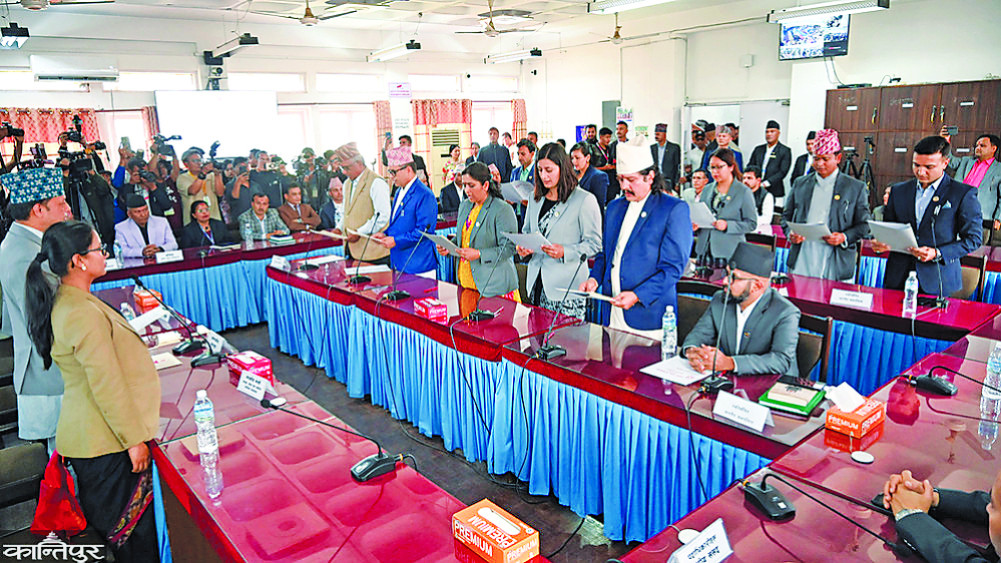
If the 'mini parliament', or parliamentary committees, are inactive, parliament risks becoming a mere formality. However, if they can be strengthened, parliament can truly become an institution that speaks to the people and holds the government in check.
We use Google Cloud Translation Services. Google requires we provide the following disclaimer relating to use of this service:
This service may contain translations powered by Google. Google disclaims all warranties related to the translations, expressed or implied, including any warranties of accuracy, reliability, and any implied warranties of merchantability, fitness for a particular purpose, and noninfringement.
Just as excessive proximity between the executive and the judiciary in a parliamentary system is considered unnatural and unhealthy, excessive proximity between the executive and MPs is also not appropriate for democracy . After the formation of the government, the role of MPs is not to be close to the government, but to constantly question, monitor and hold it accountable .
The current ruling party is supporting the minister by creating a crowd of MPs behind each ministry, which is not the job of MPs . This reduces the necessary distance between the parliament and the executive, creating the risk of raising questions in the monitoring capacity of the parliament . The core essence of the Westminster system is that the government is born from the parliament, but remains continuously accountable to the same parliament . For the parliament to be effective, MPs must continuously raise questions, participate in deep and fact-based debates, and fulfill the responsibility of keeping the government in check . If the culture of questioning is weak, there is a risk that the parliament will automatically transform into a place of approval .
When discussing the effectiveness of parliament, much attention is often focused on the plenary session. However, the real test of democratic practice also occurs in parliamentary committees. That is why these committees are also called ‘mini parliaments’. The main responsibility for meticulous study of bills, monitoring of policy programs, and ensuring accountability of public bodies falls on these committees. While there is a possibility of numerical superiority in the plenary session, committees can become a place for relatively more in-depth and fact-based debate. Therefore, the role of committees is even more decisive in a parliament with a strong majority. In fact, the more the majority-centered the parliament is, the more the committees have to play a role as a balancing structure. Parliamentary culture is that committees maintain a balance of power by keeping a close and continuous watch on the executive.
However, past practice has shown that parliamentary committees in Nepal are often limited to formalities. The influence of party-based directives, the tendency for committee reports not to be implemented, and poor interaction with experts and stakeholders have reduced the effectiveness of committees. In the past, even the selection of committee chairpersons was delayed due to party affiliation. Therefore, if the new parliament is to truly start a different practice, it is imperative to make committees active, independent, and accountable. The role of parliament will have real meaning only if a system is developed to make committee discussions public, hold the ministers and officials concerned accountable on a regular basis, and monitor the implementation of committee recommendations. Otherwise, the risk of committees remaining mere procedural formalities and real power being concentrated in the executive increases.
Committees and their functions
When discussing the effectiveness of parliament, much attention is often focused on the plenary session. However, the real test of democratic practice also occurs in parliamentary committees. There are 16 committees in the Federal Parliament, including the Lower House and the Upper House, and two committees are joint. These committees monitor the functioning of the government, question the government, and discuss the clauses of bills introduced in parliament. However, if the committees are not active, neither the bills can be good nor the government accountable. We have experienced this fate in the past. Both the quality of the law and the transparency of governance are directly linked to the activity of committees. In other words, only if committees are effective can parliament be transformed from a place of debate into a decision-making institution.
As studies on parliamentary practice have shown, committees are considered the workshop of parliament, where the work of meticulously studying bills, monitoring government spending, and holding public bodies accountable is carried out. Among the committees, the Public Accounts Committee, which is particularly keenly watched, should play an important role in financial discipline and transparency, the State Administration Committee in administrative reform, and other thematic committees in policy and operational monitoring of the relevant ministries. However, in the past, committees often made weak decisions or gave popular directives without deep study, research, and consultation with stakeholders, which raised questions about their effectiveness. If committees become a place to convey political messages more than facts, their institutional credibility will automatically weaken. And, it will weaken parliamentary supremacy.
Committees can become effective and fearless
Some past experiences also show that parliamentary committees can have a good impact when they are active. Let's look at some examples of the work done by the Public Accounts Committee in the past:
The case of the powerful Congress government formed after 2048, where the Accounts Committee raised questions about the government. When the Congress government announced mid-term elections and entered the elections, the CPN-UML made that case a powerful election issue.
Another famous case was the purchase and rental of Lauda aircraft. The Accounts Committee had directed the Corporation to punish all those involved in the decision to lease an aircraft from Lauda Air as it was irregular and malicious. The Accounts Committee had asked the Army to justify its purchase of some equipment in 2058 BS. The Sudan scam case conducted by the State Affairs Committee after the establishment of the Republic is another famous work of the Parliamentary Committee. After the committee's investigation, the Authority filed a case and many people, including three former Inspector Generals of Police, went to jail. Similarly, the on-site visits made by the International Relations Committee and the suggestions given to the government have also been considered effective. Whether it is raising questions about the delays and irregularities in Melamchi or creating pressure on the government to provide clarification on tax disputes of large companies, such interventions have shown how effective the committee can be. However, such examples have become exceptions, not regular practices. This shows that the problem lies not only in the structure, but also in practice and political will.
In the context of Nepal, it seems that some institutional reforms are needed to make parliamentary committees effective. First, the tradition of giving leadership to major oversight committees such as the Public Accounts Committee to the opposition party should be institutionalized. This will enhance impartiality and trust, and increase the relevance of the major opposition party.
Second, a clear mechanism needs to be developed to monitor whether the recommendations of the committees have been implemented. In the absence of a tracking system for the implementation of recommendations, the problem of committee decisions being limited to paper persists. When decisions are not implemented, the credibility of the committee weakens.
Third, it is necessary to make the work of the committee factual by coordinating with experts, research institutions, and civil society. If the practice of public hearings and open consultations can be expanded, committees can also become a means of direct connection with the public. This will help transform the committee from a political venue to a platform for decision-making based on information and evidence.
Role of MPs
In today's context, almost all committees are dominated by a single party, which is likely to extend to the shadow of the majority in the mini parliament. However, the essence of parliamentary committees is not numerical dominance, but independent and fact-based monitoring. Therefore, only if the committees can maintain their autonomy and balance even in the presence of a majority can the real role of parliament be preserved.
There are many examples of committees not holding meetings without a quorum and the meeting not taking any decisions. Therefore, committee members should not ignore this. Moreover, there is a record of top party leaders not being present in the committee when they are members.
Also, the practice of MPs focusing on the area in which they are elected needs to end. The job of MPs is not to develop. They may initiate development, but the main role of MPs is to make laws. For that, MPs should not only be present in parliament but also play an effective role in parliamentary committees. The level of parliament can only be raised if parliamentarians can devote more time and energy to policy and legal debates than local plans.
For parliamentary committees to be effective, parliamentarians must develop the ability to scrutinize bills, policies, and budgets. The most important issue is that parliamentary committees are the place to effectively perform this role. Therefore, making the 'mini parliament' active, capable, and accountable is a prerequisite for the overall effectiveness of parliament. If the committees are inactive, parliament risks becoming a mere formality, but if they can be strengthened, parliament can truly be established as an institution that speaks the voice of the people and keeps the government in check. Ultimately, the success of parliament is measured not by the majority, but by the discretion of the parliamentarians and the effectiveness of the committees. This is also the main basis for measuring a mature parliamentary democracy.
Ultimately, to strengthen the parliament, the need today is to strengthen the parliamentary committees, which are considered its backbone, with resources, expertise, and institutional support.