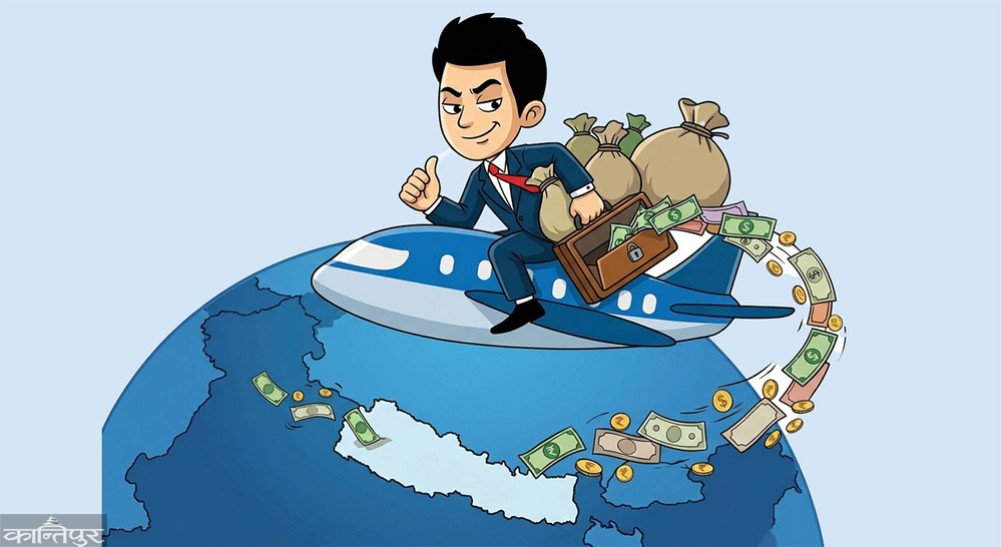
The process of returning assets illegally taken abroad from Nepal is extremely complex. It is fraught with structural and institutional challenges. There is a lack of treaties on mutual legal assistance. The basic process of tracing and recovering assets taken abroad in Nepal has not even begun.
We use Google Cloud Translation Services. Google requires we provide the following disclaimer relating to use of this service:
This service may contain translations powered by Google. Google disclaims all warranties related to the translations, expressed or implied, including any warranties of accuracy, reliability, and any implied warranties of merchantability, fitness for a particular purpose, and noninfringement.
On Chaitra 10, outgoing Home Minister Sudhan Gurung met Swiss Ambassador to Nepal Daniel Maivali. During that meeting, Gurung requested Maivali to assist in the investigation into the illegal money deposited by Nepalis in Swiss banks. During the meeting, Gurung requested the ambassador to take necessary steps to return the money deposited by Nepalis in Swiss banks.
Similarly, the functions, duties and powers of the Property Investigation Commission formed by the Government of Nepal on Baisakh 20 have also been assigned the responsibility of investigating the issue of property hidden or sent abroad. It is also mentioned that while investigating suspicious property hidden abroad, it can contact and coordinate with Nepali diplomatic missions abroad, Interpol and other investigative bodies under the prevailing law. Along with this, the debate on illegally exported capital is intensifying. However, some seem to be taking the issue of bringing back illegally exported property lightly. Some seem to be under the impression that illegally transferred assets can be brought back through diplomatic meetings. In fact, if we carefully study the existing legal framework and international experience, the process of recovering illegally transferred assets is extremely complex.
Foreign experiences
The issue of bringing back illegal assets that had been taken abroad is not just a political slogan or a popular agenda. It is a test of the state's overall institutional capacity, legal credibility and international cooperation capacity. Nepal can learn important lessons from the experiences of Bangladesh, the Philippines, and Indonesia in terms of bringing back illegally transferred assets. In August 2024, street protests in Bangladesh toppled the decade-and-a-half-long government of Sheikh Hasina. Then, the interim government formed under the leadership of Mohammad Yunus discovered that people close to Hasina had illegally transferred billions of dollars abroad during her rule. After this, the government assigned the Central Bank Governor Dr. Ahsan H. Mansoor the responsibility of searching for assets that had been illegally transferred abroad during the Hasina regime. 11 groups were formed to assist in the investigation. The group conducted a year-long investigation. It showed a frightening picture of money illegally taken abroad by 11 aristocratic families during the Hasina regime. One family alone was found to have illegally taken out more than $15 billion from Bangladesh. Governor Mansoor himself went to the UK in March 2025 to investigate. And, he identified about $25 billion that had been illegally taken out of Bangladesh. Then he coordinated and discussed with the British Foreign Office and experts to seize it.
The asset tracing group is working to track down assets that have been taken abroad illegally through the banking system of Bangladesh. During the investigation, it was discovered that the then Land Minister of Bangladesh, Faifuzzaman Chowdhury, had bought properties worth more than $500 million in Dubai and London. However, such money has not been able to be returned. According to a study conducted by Bangladesh itself, the process of returning illegally transferred money abroad is complicated. And, research has shown that it takes at least five years to recover such money.
Similarly, the process of returning assets illegally transferred abroad by former President Ferdinand Marcos in the Philippines is one of the most famous examples in the world. In 1986, the dictator Marcos regime fell. After that, the Philippine government formed the Presidential Commission on Good Government (PCGG) with the aim of searching for and recovering assets that were illegally transferred abroad during his rule. The main objective of the body was to identify and recover assets that Marcos and his close associates had illegally transferred abroad and hidden.
In the process of returning such illegally transferred money, the PCGG specifically investigated assets kept in Swiss banks. Despite the strict Swiss banking secrecy laws, the Philippines filed a case in Swiss courts under a bilateral legal assistance treaty. In 1997, the Swiss Federal Supreme Court ruled in favor of the Philippines. The Philippines was then able to repatriate more than $600 million. This success was not immediate. The Philippine government struggled for a decade to achieve this.
The incident illustrates how complex and time-consuming the process of recovering illegally transferred assets is. According to a study published by the World Bank and the United Nations Office on Drugs and Crime, the process of repatriating illegally transferred assets is a long and legally complex process. Without a combination of international cooperation, adequate evidence, strong domestic laws, and political will, it is not possible to recover stolen assets.
The dictator Suharto, who ruled Indonesia from March 1967 to May 1998, is known as the world's most corrupt ruler. He is said to have committed more than $10 billion in corruption during his reign. After his fall, the Indonesian government tried to recover assets that had been illegally taken abroad during that period. Indonesia cooperated in particular with the Stolen Asset Recovery Initiative, a joint initiative of the World Bank and the United Nations Office on Drugs and Crime.
Indonesia tried to recover assets using the provisions of various international treaties, including the United Nations Convention against Corruption. In this process, the Indonesian government emphasized international technical cooperation, developing investigative capacity, and strengthening the financial monitoring system. However, Indonesia was not as successful as the Philippines. According to a book by Kevin Stephenson et al., Barriers to Asset Recovery, the main reasons for this were poor evidence management, the complexity of the international legal process, and domestic political interference. The examples of Bangladesh, the Philippines, and Indonesia show that recovering illicit assets does not happen overnight.
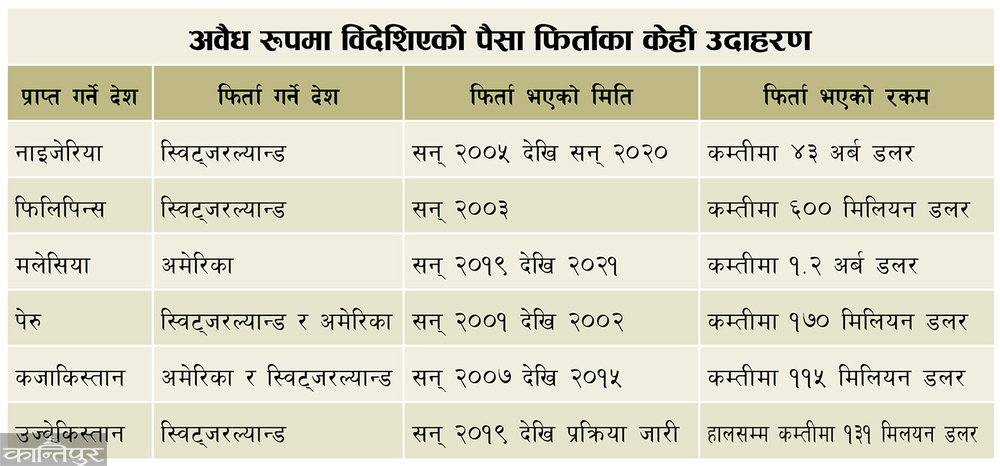
Some examples of the return of money that went abroad illegally
No. Receiving country Returning country Date of return Amount returned
1 Nigeria Switzerland 2005 to 2020 At least $43 billion
2 Philippines Switzerland 2003 At least $600 million
3 Malaysia USA 2019 to 2021 At least $1.2 billion
4 Peru Switzerland and USA 2001 to 2002 At least $170 million
5 Kazakhstan USA and Switzerland 2007 to 2015 At least $115 million
6 Uzbekistan Switzerland Process ongoing since 2019 At least $131 million till now
7 Ecuador America 2021 At least $18.9 million
Source: Study of various reference materials
Prerequisites for asset recovery
The first and basic prerequisite for the recovery of illegally transferred assets is political will . The process does not begin until a country takes a formal decision to take strict action against corruption and return illegal assets abroad . However, willpower alone does not ensure results . Initiatives through diplomatic meetings can create an environment for bilateral dialogue, but asset recovery cannot be achieved . Banks in countries like Switzerland, in particular, do not disclose account details without solid legal basis, evidence, and a court order . According to a study by the Basel Institute on Governance, banking secrecy laws are complicating the process of tracking illicit assets.
Second, a strong legal mechanism with mutual legal assistance agreements and judicial verification. The mutual legal assistance system is at the heart of the recovery of illegally transferred assets. Such assistance treaties between two countries provide legal recognition for the collection of evidence, exchange of bank details, investigative cooperation, and the process of confiscating or returning assets. According to the United Nations Office on Drugs and Crime, without such mutual legal assistance agreements, it is not possible to conduct effective international financial crime investigations. Until a legally proven basis is prepared, no foreign agency can assist in this work.
Third, the effectiveness of the domestic legal system depends on the level of investigative capacity and judicial credibility. In the context of Nepal, significant work needs to be done on this issue, in which concrete evidence must be presented that the transferred funds were acquired through corruption, tax evasion, or other criminal activities. This must be proven by a judicial decision. The international process of asset recovery cannot proceed until the Nepalese courts declare the assets that have been stolen illegally. The principle of dual criminality applies to such issues. Accordingly, an act that is considered a crime in Nepal must also be considered a crime in the relevant foreign country. Some studies say that many cases have failed at the international level due to the lack of dual criminality.
Fourth, there is an international legal basis. The United Nations Convention against Corruption has established asset recovery as an international legal obligation for the first time. This convention, which was issued in 2004, provides clear guidelines for member states to return assets acquired through corruption. Article 51 of the convention states that member states have a mandatory obligation to cooperate in the recovery of illicit assets. Similarly, Article 53 gives the victim state the right to file a case in foreign courts, while Article 57 clearly stipulates that confiscated assets must be returned to the country of origin. These provisions of the Convention have institutionalized and legally strengthened asset recovery at the international level.
However, the Convention only provides a legal framework. Its effective implementation depends on the national legal, technical and institutional capacity of each country. The provisions of the Convention will not be implemented in practice unless the country concerned has adequate investigative capacity, an efficient prosecution system and an institutional structure that can manage international cooperation.
Challenges for Nepal
The process of returning assets illegally taken abroad from Nepal is very complex. Behind this are structural and institutional challenges. First, there is a lack of treaties on mutual legal assistance. Nepal has not signed such bilateral treaties for financial crime investigation and asset recovery at the international level. Therefore, there are complications in issues such as evidence exchange, banking information retrieval and investigative cooperation. The basic process of tracing and recovering assets that have been stolen abroad has not yet begun.
Second, Nepal's investigative capacity regarding illicit earnings is weak. The Commission for the Investigation of Abuse of Authority, the Money Laundering Investigation Department and other agencies lack the technical expertise, digital forensic equipment and expert manpower required to deal with the complex nature of financial crimes. Since modern financial crimes are often multinational and multi-layered, their investigation requires modern technology and analytical capacity, which Nepal does not have or is weak in.
Third, judicial delay is also a serious challenge. Corruption-related cases in Nepal tend to drag on for years. Such a national trend affects the process of recovering assets that have been stolen abroad. The investigation into the assets cannot begin until a final decision is made by the domestic court. According to a study by Transparency International, judicial delays have shown that serious obstacles to the process of returning illegally transferred assets exist. Fourth, political interference. Political influence in the investigation and prosecution process weakens impartiality and credibility. This also reduces the country's credibility internationally. If constitutional bodies are pressured illegally, foreign bodies are reluctant to cooperate. Therefore, the process of returning assets is almost impossible unless the autonomy of domestic corruption control bodies is ensured. Fifth, the weakness of the asset management system. Nepal does not have a strong legal and institutional structure for the protection, use and management of confiscated assets. This causes economic losses and affects the overall credibility of asset recovery. Nepal does not yet have such a legal and institutional arrangement.
The way forward
If the current government is to bring back illegally exported assets from Nepal, it must make necessary policy, legal and institutional reforms. For this, first of all, it must immediately sign a mutual legal assistance treaty with Singapore, Switzerland, Dubai, India and other major financial trading countries of Nepal.
Second, it must work on institutional strengthening. Agencies such as the Authority, the Money Laundering Investigation Department, and Nepal Rastra Bank must be made technically capable, well-resourced, and functionally independent. Skills in digital forensics, data analysis, and international financial tracking systems must be developed.
Third, to ensure fast, fair, and reliable resolution of corruption-related cases, the special court and the Supreme Court must be strengthened, the process of adjudicating corruption cases must be simplified, and its time limit must be determined.
Fourth, Nepal must strengthen international cooperation. Coordination and cooperation with various international financial intelligence agencies must be activated and the pace of financial information exchange must be increased. We should utilize international experience, technical assistance, and capacity building opportunities by increasing cooperation with bodies like Interpol and Stolen Asset Recovery Initiatives.
The issue of returning stolen assets is not just a political slogan or a popular agenda. It is a test of the state's overall institutional capacity, legal credibility, and international cooperation capacity. Therefore, if the current government wants to return stolen assets, it must actively work on strengthening the legal framework, developing investigative capacity, judicial reform, and expanding international cooperation.