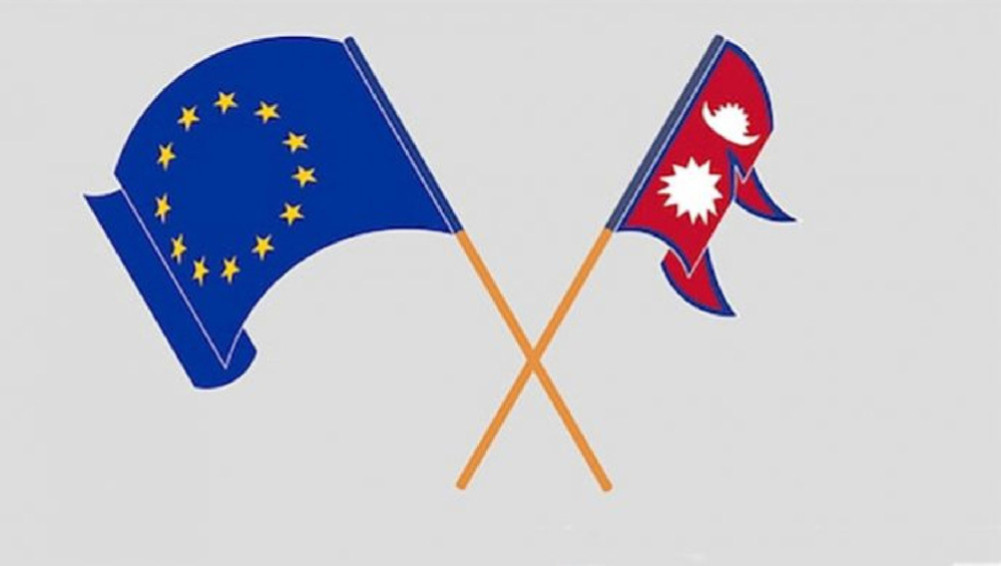
Europe Day is a reminder that peace should never be taken for granted. On this day, we celebrate the idea that cooperation is possible even in adverse circumstances. Together with Nepal, we are transforming challenges into shared solutions.
We use Google Cloud Translation Services. Google requires we provide the following disclaimer relating to use of this service:
This service may contain translations powered by Google. Google disclaims all warranties related to the translations, expressed or implied, including any warranties of accuracy, reliability, and any implied warranties of merchantability, fitness for a particular purpose, and noninfringement.
The foundation of Europe was laid on May 9, 1950, in the aftermath of World War II. The then French Foreign Minister Robert Schuman had an unusual proposal: that France and Germany, once enemies, would merge their coal and steel industries under common control. This collaboration made the possibility of war between the two countries “not only unthinkable, but practically impossible.” This attempt to lay the foundation for the European Union eventually became known as the Schuman Declaration. Tomorrow, May 9, is the anniversary of this day.
Europeans commemorate this day as ‘Europe Day’. After 76 years, the European Union now has 27 member states. And 450 million citizens are enjoying unparalleled peace, stability and prosperity.
Yet these fundamental values and the multilateral system that promotes them are now under threat – due to war and flagrant violations of international law. Russia has been waging an unprovoked war against Ukraine for five years. This war is not only an attack on Ukraine’s territorial integrity, but also a threat to the international norms we have worked so hard to build. If the world returns to the norm of ‘might determines truth’, no country, big or small, will be safe within its borders. The European Union’s position is clear – we will stand by Ukraine for as long as necessary to build a just and lasting peace. The EU’s recently announced €90 billion aid package will help Ukraine defend its territory, protect its citizens and rebuild the critical infrastructure and structures destroyed by Russia. In addition, our recently adopted 20th round of sanctions against Russia will continue, with the aim of undermining the war machine.
Success in regional integration, the emergence of the EU as a major political and economic power, has been made possible by our promotion of values of democracy, human rights and the rule of law. Respect for these values and rules-based international standards has earned us the trust of our friends and partners, including Nepal.
Nepal has promoted these values even as it has faced challenging years. Observing the recent elections to the House of Representatives will remain an integral part of my tenure as Ambassador to Nepal. What impressed me most on the peaceful and orderly election day was the dynamic participation of voters of all ages and their faith in Nepal’s democracy. The elections have given the National Independent Party a historic mandate. They have also signaled the Nepalese people’s desire for change and a government that works for the people.
The European Union stands ready to support Nepal in its priority areas as the new government implements this referendum. I am pleased to announce that ambassadors from more than 20 EU member states in New Delhi will visit Nepal later this month to express their support in person. We do not have the answers to all the questions, but we do have experience in building strong and inclusive institutions, promoting prosperity and empowering young people. The European Union has been a reliable partner of Nepal for over 50 years. We will be trusted to work with Nepal not only on Nepal’s priorities, but also on the global crises that affect us all.
The Global Gateway has become the EU’s main tool to address these challenges and support its prosperity agenda. The Global Gateway, together with EU member states, EU Development Finance Institutions and the private sector, will help bridge the gap between aid and investment in Nepal’s progress through smart, clean and secure investments in quality infrastructure and networks. It can also accelerate the green and digital transformation.
Our Global Gateway is the most relevant tool to address the ongoing energy crisis, focusing on renewable energy investments. To this end, Team Europe is working with the Government of Nepal to invest in leading-edge work in energy generation, transmission and distribution, as well as energy efficiency and new carbon technologies. Similarly, the sectoral integration of energy markets is at the heart of Europe’s successful energy transition. We believe that our ‘Energy Connectivity in South Asia’ programme will benefit Nepal and its neighbouring countries.
Investing in youth determines the future of societies. That is why youth are at the heart of the European Union’s priorities. Nepal has a young generation with a strong desire for change, skilled in using digital tools and committed to building a prosperous Nepal. We are proud to maintain a continuous dialogue with young people from all parts and regions of Nepal. We are also happy to collaborate with civil society groups in areas such as cultural entrepreneurship, digital innovation and sports, which are essential for youth to succeed.
As Team Europe in the field of education, we will remain a strong partner in supporting the government’s efforts to strengthen learning outcomes and the overall delivery of the education system. Nepal’s young generation is increasingly connected, forward-thinking and eager to contribute. The education system must address the aspirations of young people. At the same time, we are supporting efforts to improve educational quality, modernise curricula and integrate digital and practical skills. In this way, education prepares young people to face the opportunities and challenges of today’s world.
We are focused on strengthening the link between education and employment. Skills need to be tailored to the needs of future employers. Skills are needed to improve the employment prospects and entrepreneurship opportunities of Nepali youth, from increasing the participation of the private sector to strengthening Nepal’s graduation from the Least Developed Country (LDC) list.
Nepal’s graduation from the LDC list is still uncertain. The economic turmoil in the Middle East, compounded by pressure on energy prices and remittances, has led to the end of duty-free access to the European market. This has created a trade deficit for Nepal and a legitimate concern about its compliance with WTO rules. Whether or not Nepal is upgraded this year, it should use trade competition as an opportunity to improve in the coming years. Ultimately, Nepal will need continued access to the EU market to participate in the EU Generalised Scheme of Preferences Plus (GSP+) and to ensure compliance with international standards on labour rights and environmental protection, among other things. The European Union remains committed to supporting Nepal in this regard to ensure a smooth transition process.
Europe Day reminds us that peace should never be taken for granted. On this day, we also celebrate the idea that cooperation is possible even in adverse circumstances. Together with Nepal, we are transforming challenges into shared solutions. Every day we will work towards a future where we can prosper in a clean and sustainable world.