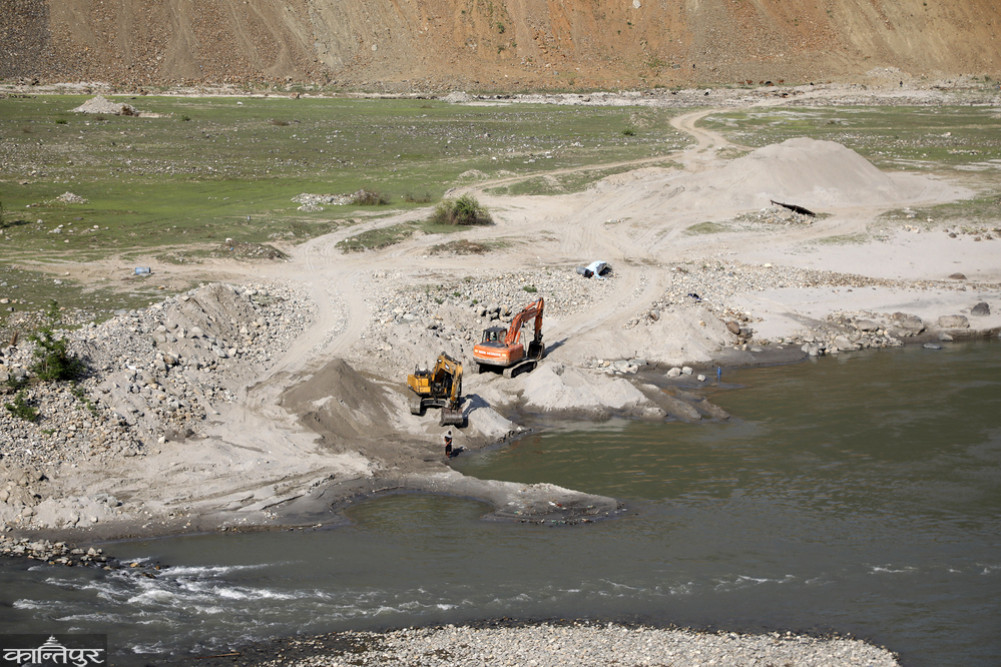
The destruction and exploitation of the Chure region has led to various risks in the Terai-Madhesh region. Because, as the water absorption capacity decreases, heavy rains lead to major floods and loss of property and lives. Land erosion occurs.
We use Google Cloud Translation Services. Google requires we provide the following disclaimer relating to use of this service:
This service may contain translations powered by Google. Google disclaims all warranties related to the translations, expressed or implied, including any warranties of accuracy, reliability, and any implied warranties of merchantability, fitness for a particular purpose, and noninfringement.
Half of Nepal's population lives in the Terai-Madhesh region. This region is also known as a reservoir of agriculture. Forests also cover a significant area, which is also the habitat of a large number of wild animals. The basic need of all of these is water. And, this region is dependent on the Chure for the water it needs. In recent decades, the destruction of the Chure region has been increasing. As human activities and exploitation of natural resources increase in the Chure, which itself has a weak structure, there has been concern that the Terai-Madhesh region is becoming a 'desert'.
The water shortage that has already begun to be seen may increase further in the coming days. That may lead to a multifaceted crisis in the region. Therefore, since it is a naturally sensitive area, it is necessary to immediately start additional conservation work on the Chure. The conservation of the Chure should not be limited to government programs alone but should be carried forward as a campaign by local citizens.
The Chure range is a completely unexplored area made up of loose, unconsolidated rock. It is considered a naturally sensitive area. Therefore, increasing external influences in this area will have immediate and long-term negative effects. But in the last few decades, road access and urbanization have also been increasing in the Chure area. Human activity is also increasing. As the population increases, more excavation for livelihood purposes has become natural.
Even rivers that used to flow throughout the year have started drying up for a long time these days. For example, the Dudhaura, Pasaha, Bakaiya rivers in Bara, and the Dhansar, Chadi and Paurai rivers in Rautahat, which originate from the Chure, no water is flowing now. Rivers like Kamala in Dhanusha, Ghurmi Khola in Siraha, and Bataha have started drying up in the last decade. Locals have experienced that these rivers only flow in large quantities when it rains at the head of the Chure. Encroachment increased, and stone and gravel excavation and import also became uncontrolled. The stones, sand, and gravel of the Chure area used to absorb and store water, but as their excavation intensified, the Chure lost its ability to absorb water. This has had a negative impact on the people and wildlife living in the area. At the same time, the people of the Terai-Madhesh region have also had to experience 'desertification'. Indirect impacts have been felt in all regions of the country.
The destruction and exploitation of the Chure region has caused various risks in the Terai-Madhesh region. Because, as the water absorption capacity decreases, large floods occur and damage to property occurs with heavy rains. Land erosion occurs. On the other hand, as the water was absorbed, over time, the same water would flow into rivers and streams. Ponds would form. From there, water would be available on the upper surface of the land. People and animals would benefit. But as the Chure lost its ability to absorb water, the risk of floods during the rainy season and droughts at other times has increased.
Rivers that used to flow throughout the year have also started drying up for a long time these days. For example, the Dudhaura, Pasaha, Bakaiya rivers in Bara, and the Dhansar, Chadi and Paurai rivers in Rautahat, which originate from the Chure, no water is flowing now. Rivers like Kamala in Dhanusha, Ghurmi Khola in Siraha, and Bataha have started drying up for the last decade. Locals have the experience that these rivers only flow in large quantities when it rains at the head of the Chure.
When the water flowing in the rivers and streams dries up, there is also a shortage of drinking water. The citizens of Tarai-Madhesh are basically dependent on taps for drinking water. However, earlier, water would come from digging a little, nowadays it has to be dug much deeper. While water was found underground after burying 20/25 feet of pipes, now many feel that they have to go down to 110 feet.
Due to dependence and habituation to taps, there is no strong drinking water system in the Tarai-Madhesh region, and even if there is, there is no situation where water that is not in the rivers and streams can reach every house through taps. Due to the severe shortage of drinking water, water had to be distributed from tankers in Ashar last year. Not only people, but also animals and birds have not been able to get water easily when the lakes and rivers in the forests and streams have dried up. This has had a negative impact on the overall environment.
Another impact has been seen in agriculture. Due to water shortage, it has become difficult to sow crops on time. Last year, the lack of rain in Ashar delayed the planting of rice in the Terai-Madhesh region. This negatively affected rice production. Since the Terai-Madhesh region is a reservoir of agriculture, the disruption of the rice or other crop planting cycle here may lead to a decrease in production, which may increase the risk of a food crisis.
As the decrease in grain production leads to an increase in prices, people across Nepal may have to face shortages and high prices. This will indirectly affect economic behavior. Therefore, the destruction of Chure and minimizing its impact is a matter for the entire Nepal. The activism of people across the country is indispensable for the protection of the area. The government should also spread such a message more and launch a joint campaign for its protection.
At this time, the protection of Chure has become an essential task. Only that can prevent the increasing drought in the Terai-Madhesh region. For that, the 'recharging' of Chure is mandatory. A campaign should be launched to reduce human interference in Chure, discourage uncontrolled construction of structures, stop uncontrolled exploitation, plant trees and protect trees, and protect water sources. Recharge ponds should be built. Indeed, the government has been running the 'President's Chure Conservation Program' since the fiscal year 2066/67 to do many such works. A large amount of money has been spent through this every year.
A budget of 249 million has been allocated for the current fiscal year. But the effectiveness of this program is low. Therefore, in addition to such programs adopted by the federal government, effective programs are expected to be run by the local level and local citizens. Governments at all levels should take the initiative to involve citizens in this campaign.
Similarly, not only Nepal, but India also has to suffer and has been suffering from the destruction of Chure and the negative impact it has caused. Therefore, we can collaborate and create a common goal of Chure conservation, utilizing his experience and technology.