Nepal is a country with social, cultural, linguistic, class, gender and regional diversity and plurality. All the contradictions, interrelations and problems associated with them are there, and addressing them judicially is the main responsibility of the Constitution.
We use Google Cloud Translation Services. Google requires we provide the following disclaimer relating to use of this service:
This service may contain translations powered by Google. Google disclaims all warranties related to the translations, expressed or implied, including any warranties of accuracy, reliability, and any implied warranties of merchantability, fitness for a particular purpose, and noninfringement.
Continuity in constitutional development is an indicator of democratic political vitality. It prolongs the life of democracy and helps to make its foundations sustainable. But Nepal has a different experience in the course of constitutional development. Seven constitutions have been formulated till date, including the 2004 ‘Government of Nepal Statutory Law’. Among them, except for the non-party constitution imposed by King Mahendra, the others have remained progressive in accordance with the times. Comparatively, the latest constitutions have gradually become reform-oriented. However, none of them were a continuation of the previous constitution and attempts to improve the provisions within it, but rather were the displacement of one another. All of the constitutions were short-lived and abandoned. Which is a serious issue. The
question is, why could no constitution in Nepal achieve stability? What are the reasons behind this? Nepalis do create constitutions, but they end up in the trash after a while. Why are national laws, which have been invested in labor, time, and capital, one after another, suffering the tragedy of remaining in archives?
Generally, the easy answer to this is that the historical and social structure of Nepal, which is written as national laws, should have been reflected in the ground reality, but it was not. Along with social, cultural, religious, and linguistic plurality, geographical diversity is the original form of the Nepalese state. Accordingly, there are human groups here, with different cultures, traditions, and beliefs that give them independent identity, as well as their native geography and history. These are the national characteristics of Nepal. But in the autocracy and feudal system, diversity and plurality were made the basis of discrimination. On the basis of single-caste dominance and arrogance, the history of the community, culture, tradition, language, religion, class, etc. outside the ruling power continued to be prohibited. They were excluded for centuries. They were not even allowed to live as respectable citizens.
Due to the various codes, laws, statutes and practices of the state, they were kept in a marginalized state for a long time. Those communities and classes became extremely oppressed, poor and weak economically, educationally and politically. In addition to the correct identification of these communities/classes within the state, the main need today is to end and strengthen their historical oppression. The correct political solution to this is to radically transform the basic law into an inclusive form so that the ground reality is reflected in it in order to end the discriminatory social structure.
However, the failure to properly address the national political need is actually the failure to represent the ground truth. Therefore, any attempt to amend the constitution in defiance of the fundamental national issues will ultimately prove to be nothing more than political entertainment. It will not properly address the complex national problem.
What can we say about the medieval times? At that time, the ruler's wishes and words were called hukum. That was the decisive factor in the operation of the government. The ruler was considered a divine part. Others were called raiti. In the feudal state system of that time, the only purpose of the code, law/statute was to protect the rulers and defend their interests. Therefore, from Chanakya to Machiavelli, the belief is that if you want to rule, the policy of equality, reward, punishment, and discrimination should be followed. Whether in the name of the code or in the form of law/statute, their only concern was the maximum interest of the ruling class. Discrimination, division, and exclusion were the basic forms of the state system at that time. On this basis, the theory that the state is autocratic and oppressive was formed. When John Locke came in the early seventeenth century and put forward the theoretical issue that the state should be responsible to the citizens for the protection of life, property, and freedom, a new debate began in the world regarding the form of government and the formation of a constitution. A century later, the ‘social contract’ propounded by the French philosopher Rousseau with its features such as the recognition of public opinion, citizen supremacy, and the rule of law became a unanimous belief in the code of state governance over time.
The concept of ‘social contract’ came to the fore in search of a balanced management of responsibility and duty to control the anarchy of the citizens while also controlling the autocracy of the state. Dialogue, cooperation, and agreement with all stakeholders remained the essence of the ‘social contract’. These concepts are suitable for managing social conflict by ensuring that no party is marginalized and minimizing the possibility of disagreement and non-cooperation.
In particular, its progressive aspect is that the state is not the monopoly of any particular class, as opposed to the discrimination of kings and ranks. The French Revolution was a product of this political philosophy. Over time, this belief transformed the form of the state in other countries of Europe and around the world. The values of the 'social contract' were followed in the creation of codes and laws as the minimum method for running the state. This is a universally accepted democratic method that makes all citizens feel a sense of belonging to the state. In a society with diversity and pluralism, the 'social contract' is even more necessary.
But Nepal's experience has been different. From the 2004 constitution to the non-partisan constitution of 2019, the rulers were the center of concern. According to the values of the 'social contract', the consent and participation of all parties in the country was not considered necessary. In fact, the two constitution-making processes of the last period were slightly different, and the participation of stakeholders was sought. Extensive suggestions were also taken. Moreover, the Constituent Assembly elected on the basis of popular vote was made the medium for the creation of the current constitution. Two Constituent Assembly elections were also held for this. Nearly seven years were spent.
Irony! After the devastating earthquake of 2072, Nepali society was in a state of extreme distress due to natural disasters, panic, insecurity, and uncertainty. It was natural that the common people were confused about saving their lives in the face of natural disasters. The constitution issued during a very difficult period did not have to face such intense resistance immediately. However, there was strong disagreement from the Madhesh, and the occasion of the constitution being issued was protested as a 'black day'. There was strong dissatisfaction with the restructuring of the state by ignoring the issues of indigenous peoples who favored identity. The Tharu and other minority communities also did not find their issues properly addressed in the new constitution. The essence of federalism is - a common structure in the central government and a system of self-governance with autonomy at the local level - but none of these aspects were guaranteed in the new constitution. Inclusivity was not only taken superficially, but also in the wrong way. The principle of proportionality was not arranged in proportion to the population of the community. The national reality that has been in a state of diversity, plurality and discrimination in the social structure and geographical form of Nepal, was not even attempted to be reflected in the course of constitution-making. In addition, none of the agreements, agreements and commitments made by the state itself with the stakeholders in various developments and movements were adhered to.
The diversity, plurality and discrimination that Nepal's social structure and geographical form have been experiencing, were not tried to reflect the national reality in the course of constitution-making. In addition, none of the agreements, agreements and commitments made by the state itself with the stakeholders in various developments and movements were adhered to. The 12-point agreement, the provisions of the interim constitution, as well as the recommendations of the State Restructuring and Power Sharing Committee of the first Constituent Assembly, and the High-Level Constitutional State Restructuring Commission were ignored. In a sense, the Constitution of 2072 was neither a social contract prepared through national consensus, nor was it a legal document that could reflect the feelings and essence of the pluralistic and diverse Nepali society. It could not be unanimous and universally accepted since its formulation. At the same time, the work of state restructuring was also flawed, and the issue of guaranteeing rights did not seem effective. The form of government, judicial structure and electoral system were not correct . Within the first decade of implementation, public questions arose on the legitimacy of this constitution .
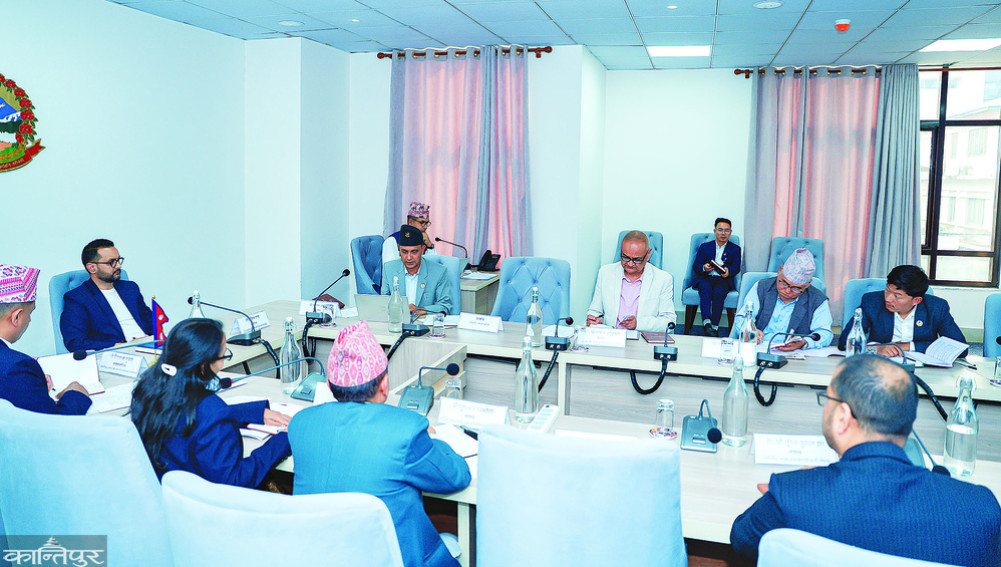
National politics today is focused on this constitution and is being discussed from various angles . The government itself has put forward the issue of amending the constitution . The government wants to prepare the basis for constitutional reform by creating an authorized mechanism . There are also issues that need to be agreed upon by all parties . Public discussion has begun on issues related to constitutional amendment such as directly elected executive, fully proportional electoral system, inclusive state structure, etc. . From the current structure of the legislature and its mathematical perspective, amending/revising the constitution is not impossible . But these are not the key points .
The universal belief of today's advanced democratic era says that the need for a constitution is not only for state management and strengthening control over citizens . The fundamental issues raised by thinkers from Hobbes, John Locke, Rousseau, Adam Smith, John Rowe to Kant are freedom, equality, citizen supremacy, the rule of law, as well as the establishment of an egalitarian and representative state structure. Objective reality is that Nepal is diverse and pluralistic in terms of gender and region, in addition to social, cultural, linguistic, and class. All the contradictions, interrelations, and problems associated with them are the main responsibility of the constitution to address them judicially.
And for that, it is the need of the hour to ensure/ensure autonomous and self-governing rights based on community identity, historical geography, and economic potential in accordance with international values. The current constitutional amendment effort should be a search for the acceptance of the common Nepali people based on past shortcomings, weaknesses, and experiences. For that, direct participation of the concerned communities and their issues should be addressed at the constitutional level. For that, collaboration, dialogue, and consensus with the community are the minimum basis. The process is not a problem, it can be decided according to the need .
Otherwise, a constitution brought through a different process cannot accurately represent the feelings, desires and contemporary consciousness of the stakeholders . Such a legal document cannot represent the national social structure and entirety of Nepal . There will be no affiliation with it . The issue of amending/reforming the constitution should not once again prove to be just a political pastime . Let it be considered a worthwhile endeavor .