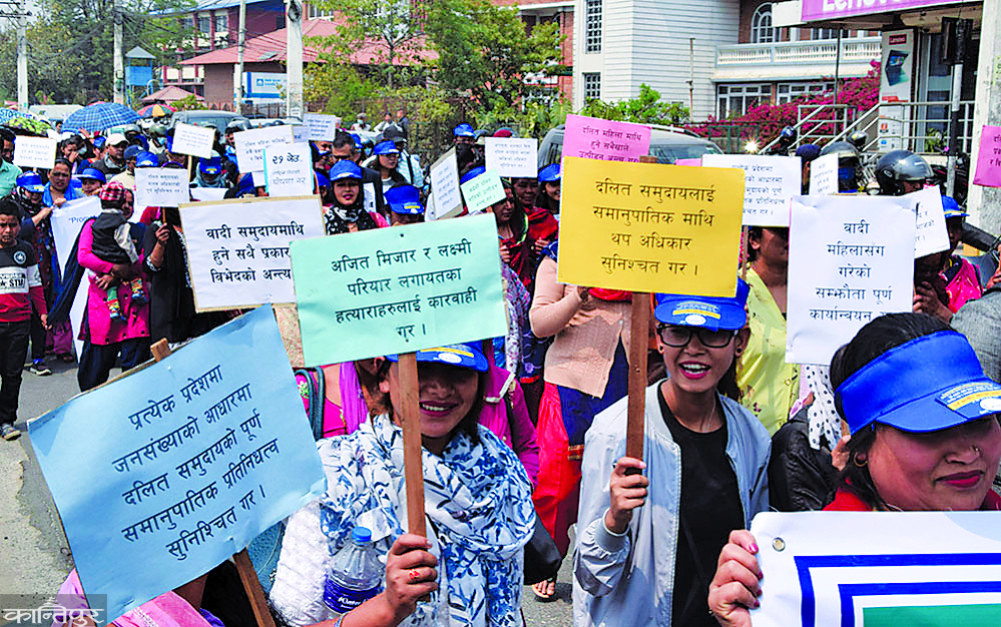
The question today is not simply ‘What happened?’ but ‘Why do incidents of harassment of Dalits keep recurring?’ Unless we accept the cause, solutions are not possible.
We use Google Cloud Translation Services. Google requires we provide the following disclaimer relating to use of this service:
This service may contain translations powered by Google. Google disclaims all warranties related to the translations, expressed or implied, including any warranties of accuracy, reliability, and any implied warranties of merchantability, fitness for a particular purpose, and noninfringement.
Many have called the government's decision to 'apologize to Dalits' historic. But the question begins here - can an apology erase structural injustice? Is the apology sought by the government sufficient? Will all the problems of the Dalit community be solved by the government's apology?
A small Dalit boy was beaten up in an inhuman and brutal manner in Rolpa on the pretext of 'entering a Khatri's house'. In Sindhuli, 22-year-old Krishna Bik was arrested in a rape case due to inter-caste relations and died suspiciously there. Not only that, in Jumla, the practice of publicly insulting people by calling them 'dum' still persists. Neither a voice is raised at a large level against such incidents, nor is strict action taken. This is a reflection of our Nepali society. These are some of the topics that have been discussed on social media recently. But how many more such incidents have taken place, of which there is no account .
The incidents of Rolpa, Sindhuli and Jumla are representative . They are from different districts . However, the truth they expose is the same, Nepal's democracy is still weak on the basic question of social justice . Article 24 of the Constitution of Nepal has guaranteed the 'right against untouchability and discrimination' as a fundamental right . Which clearly states, 'No person shall be subjected to any kind of untouchability or discrimination in any private or public place on the basis of his origin, caste, ethnicity, community, profession, business or physical condition .' But in practice, caste is still determining the value of life . The gap between this promise of the Constitution and the cruelty of behavior proves the moral failure of the state and society .
According to the report of the Nepal Census 2078, the Dalit community constitutes about 13-14 percent of the population in Nepal . Article 40 of the Constitution, under the ‘Rights of Dalits’, has given them special rights such as participation in all state bodies on the basis of proportional inclusion principle, free education and provision of land to landless Dalits. But their access to representation, education, land ownership and employment is still low. This inequality is not only economic, but also the result of social exclusion. A community has been kept away from resources, opportunities and respect for generations and even now, ‘we do not discriminate’ but the Brahminical mindset that excludes Dalits is prevalent in every section of society and state.
Most importantly, the mindset of limiting Dalit issues to 'Dalit issues only' should be changed. This problem is not only Dalit's. This is our 'social disease'. Therefore, its treatment is the responsibility of all of us. In Rukum West, there have been reports of the murder of young people including Nawaraj BK due to inter-caste marriage, the practice of not touching public taps in various places, ban on entry to temples, mistreatment of teachers on the basis of caste, and even in Kathmandu, there have been reports of people not being able to find a room on the basis of caste. What is clear from all this is that the end of caste discrimination is limited only on paper. Therefore, it is a wrong analysis to view the incidents of Rolpa, Sindhuli and Jumla as separate incidents. This is the culmination of the state's failure to implement the rights written in the constitution.
The role of the state is decisive here. The government's apology means admitting a mistake, but when the mistake is structural, the solution must also be structural. Article 24 (5) of the constitution recognizes untouchability and discrimination as serious social crimes and also gives the victim the right to compensation. But when the state tries to limit such incidents as ‘personal disputes’ or ‘accidents’, then the implementation of the law becomes weak and the perpetrators get away with it.
Most importantly, the mindset of limiting Dalit cases to ‘Dalit cases only’ needs to be changed. This problem is not just a Dalit problem. It is our ‘social disease’. Therefore, its treatment is the responsibility of all of us. If a citizen is insecure because of his identity, it is the failure of the entire nation. Democracy is not measured by elections, but by the protection of the weakest, most marginalized and deprived citizens. Now the solution to the problem is clear, but political will and a change in the consciousness of every individual are needed.
A special ‘fast track’ judicial mechanism is needed for cases related to caste discrimination. Delayed justice not only disappoints the victim, but also discourages them. Similarly, the police system needs a deep reform. Investigations should be free and impartial, and any death in custody should be subject to a judicial inquiry.
The Constitution and the ‘Caste Discrimination and Untouchability (Offences and Punishment) Act, 2068’ and other laws should be strictly implemented. The mere existence of the law is not enough, its implementation and realization of justice are the most important issues.
Education and public dialogue should be prioritized for social transformation. From the curriculum to the media, the values of equality and respect should be put into practice. Social justice is not possible without the economic empowerment of the Dalit community. Their meaningful access to land, education, employment and state structures should be ensured.
Today’s question is not just ‘what happened?’, but ‘why do incidents that harass Dalits repeat?’. Unless we accept the cause, solutions are not possible. The government knows the cause, the result and the solution, so now it is time to do surgery.
The government must now understand that forgiveness alone is not enough. Justice must be served, the system must be changed and society must be transformed. Otherwise, after every new incident, the cycle of debates on social media, reconciliation, forgetting again and repeating itself will continue.
This is not just a fight for the Dalit community, it is a fight for the constitution of Nepal, democracy and humanity. And, remaining neutral in such a fight means standing on the side of injustice.