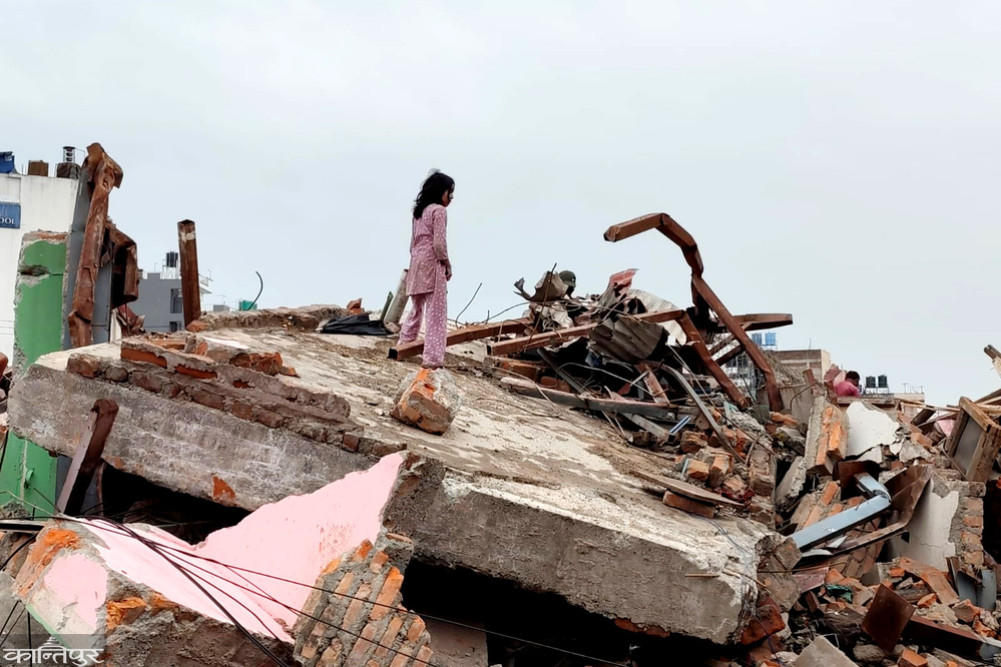
The government could have done the fiftieth thing to make the people feel good about governance. But Balen chose to demonstrate his existence, the uprising of the poor and landless.
We use Google Cloud Translation Services. Google requires we provide the following disclaimer relating to use of this service:
This service may contain translations powered by Google. Google disclaims all warranties related to the translations, expressed or implied, including any warranties of accuracy, reliability, and any implied warranties of merchantability, fitness for a particular purpose, and noninfringement.
The cow is tied to the stone, there is no one who will speak the jasmine of the poor, there is no one who will speak the jasmine of the poor,
This is the refrain of the song created by the old musical group Ralpha, created to create public awareness about how the autocratic monarchy was exploiting the poor during the Panchayat period. This song was used in the Nepali movie 'Balidan' in 1997. Four years ago, this song came to the surface once again after today's Prime Minister Balen Shah filed his candidacy for the post of mayor of Kathmandu Metropolitan City. Before appearing in the political scene of Nepal, Balen Shah had used this refrain of the song as the chorus in his rap song 'Malai Boln De Sarkar...'. But Balen, who contested the mayoral election with the phrase 'Garibko Chameli Boldin' as the theme of his rap song, has not shown his attitude towards the poor since he became mayor. Four years later, he became the current Prime Minister of Nepal, and the tragic contradiction of the ‘poor man’ has been seen many times in Nepali society. Balen, the youngest and most modern Prime Minister of the democratic republic, probably did not listen carefully to the last line of this old song when he created this rap, which says:
‘Everyone should be equal...
Chameli should be equal for everyone...’
‘I am the state’
Before chasing away the landless people who had been living in the shacks on the banks of various rivers in Kathmandu for years, Balen did not let them speak or open their minds. Instead, he surrounded a few hundred landless people with more than a thousand security personnel, and not only stripped them of their clothes, lives and homes, but also their minds and dignity.
This famous saying of King Louis XIV of France is often heard and read. Balen, who sings in his rap, ‘Let the government speak, it’s not a crime, let the government open its mind’, has shown a glimpse of his alleged good governance by not allowing anyone to speak or open their minds within less than a month of coming to power. The fiftieth thing the government can do is to make the people feel good governance. But Balen chose to demonstrate his existence by the uprising of the poor landless. Before chasing away the landless people who have been living in the shacks on the banks of various rivers in Kathmandu for years, Balen did not let them speak or open their minds. Instead, he surrounded a few hundred landless people with more than a thousand security personnel, and not only robbed them of their clothes, lives and homes, but also their minds and dignity. He made them run around with his security personnel and, when they woke up, transported them in a more insensitive manner than carrying sacks of soil, taking them to some corner of the city and dumping them. Neither did he consult with the leaders of the landless, nor did he consult with scholars on this matter. So much so that even the previous day, the ministers of his own government were saying that no decision had been made in the Council of Ministers regarding the evacuation of the squatters. In the style of Louis XIV, Balen did not even bring this issue to the parliament and cabinet, which had a clear majority of his own party, but directly ordered the security chiefs. The houses of people who had made a corner of a city in his own country their home were brutally demolished, their livestock was abandoned, and the people themselves were dragged to another corner of the city. They were taken to the city playground to have a 'swastika' stamped on their heads to see if they were 'true' squatters. In the style of Louis XIV, Balen did not even bring this issue to the parliament and cabinet, which had a clear majority of his own party, but directly ordered the security chiefs.
The cruelty of Nepal's middle class, which is making fun of this upheaval and violation of the dignity of the poor and the helpless, has already been discussed in many places. If there is anyone who thinks that this upheaval, lamentation, tears, misery and even death is right at this time, then there are two types of population. On the one hand, the majority of the middle class population of Nepal, who themselves are struggling to make a living for themselves and their families in this very poor country without any basic facilities and security that the government should ensure, are under the illusion that Balen is the only 'savior' who can overcome this situation. On the other hand, there is a group of Nepalis living abroad, who kept praising the RSP and especially Balen before the elections, whose struggle to make a living abroad is very difficult, their status is that of 'second-class citizens', that is, immigrants, and they are living with a fearful mindset day and night, wondering when the dictators and apartheid rulers there will order them to 'vacate their country'. A separate psychological or sociological study could be conducted on how a large part of Nepali society has become so cruel towards people who have cheated their own country and state more than they have been cheated by. Why do those who build cities, establish civilizations, and enjoy the cleanliness of the cities they have built have such hatred for the architects who contribute to keeping the cities clean by being 'dirty'? This smart city vision does not include ample public toilets, security of water sources, the municipality does not have to build clean water taps with the intention of ensuring that thirsty passersby in the city do not have to buy water to drink, the responsibility of bringing abundant and clean water to the taps of citizens' homes does not have to be fulfilled, and the city dwellers do not have to learn to walk on the roadside without spitting phlegm from the time they wake up in the morning until they enter their homes in the evening. It does not include public vehicles that provide convenience by running in every corner of the city without crowds, until a little later, and with complete safety, it does not include well-organized airports, and safe sidewalks with unbroken drain covers. It is not the municipality's duty to tell people living in big houses not to throw garbage bags into the river, it is not the municipality's responsibility not to buy or sell land within ten meters of the river, it is not necessary to plant native flowers and fruit trees along the city's roads, and it is not even necessary to show the minimum humanity of not building dumping sites near river banks and human settlements. But when the topic of smart cities comes up, the first thing that comes to mind is the poor. Those who park cars worth crores and block the road do not fall under the municipality's target, the poor who sell goods on carts to support their families immediately fall under it. In the bright imaginary picture of a 'smart city', the poor are first seen as 'spots'. The cruel face of capitalism, where big capital is exploited and small capital is exploited, comes to show its presence here. One dimension of this is the uprising of the landless. Why is there this perennial poverty-stricken practice of any government first attacking the poor when it comes to public land?
The cruelty and arrogance shown by the class that can buy land according to its own whims and desires, but is cheated by the state in other matters, towards the class that is more cheated and deprived than itself, may be recorded, but the rulers must treat all citizens equally with responsibility and accountability. The common people have sent them with political power by voting for them to do this. The rulers must understand that public land, that is, land, existed since the time when rulers like them had not come into existence. They had not defined the boundaries of land as being yours and mine. They had not divided it into anna, paisa, daam, ropani, katta and bigha. The ruler cannot afford to accept that there are a large number of landless citizens in this country who cannot buy even a centimeter of land with the money, money, and taxes allocated by the ruler. How can it be a just system to take away their rights over land? The ruler cannot be happy without finding the answer to these questions. The state is the guardian of the citizens, whether they are citizens who can afford to buy the demarcated land by paying money or not. Citizens who cannot afford it should be under the special protection of the state. But the cruel nature of the prevailing system in our country is such that there is not even a place for the poor to live in the cities of the country, fences are made in public squares and 'parks' are made and those parks are available only to the rich who can pay the fee.
Okay, let's say that the so-called public land should be properly protected as part of the 'duty' of following the prevailing system of the state. But in a city like Pokhara, where there is a rule that buildings cannot be built above three floors, many people are building houses in the sky, and they are also shamelessly showing their presence in the public circles of the city by pretending to be dignitaries, parking cars worth crores and encroaching on the side of the road. What is the step taken by the governments till date, including the Balen government, towards all this? What is the point of the municipalities distributing public land indiscriminately to build various temples in each village, to develop the village and to build various multi-purpose buildings and clubs, etc.? If all these things can be built on public land, why can't the landless be allowed to live on that land? Why is there this perennial poverty-stricken trend where any government first goes after the poor when it comes to public land? That too, in a country where people who claim to have made great sacrifices to bring about so many 'people's rule' keep coming to power? The saying, ‘If you can’t buy land, go anywhere, endure any hardship’ is the ugliest and cruelest picture of the capitalist-individualist state system. What the ‘governments’ that keep coming and going need to understand is that the so-called ‘public’ land is not the government’s own land, but rather the government’s claim to resettle the landless in a safe place. Even if the government’s claim to resettle the landless is true, its humane and dignified processes are abundant. Violation of human dignity
Hundreds of children, teenagers, women, the elderly, Dalits and marginalized people, all of whom have shed their tears and made noise, are scaring us with the horrific emptiness of the riverbanks. There have even been reports of suicides after being forced to move out, unable to bear the shock of the eviction. There are countless such stories that cannot be mentioned here. There is no telling how long this mental trauma caused by state terror will last. For more than a week, hundreds of news and photo features on social media and the media have been mentally disturbing. Even the most mentally healthy people who think that what is happening right now is wrong are finding it difficult to maintain their mental health at this time. Children and teenagers crying in front of their destroyed houses, looking for books, people with disabilities crawling helplessly while being dragged by an ocean of government soldiers, new mothers lying newborn babies on cement floors under the open sky, old women seeking citizenship, people in their fifties shedding streams of tears incessantly. Small children are standing with their mothers at Dasharath Stadium, asking, ‘Will the bulldozer come here or not?’ How can students, who are becoming victims of state terror as the class 12 board exams are going on, see photos of their friends like them in the media who have passed with high GPA in a few months? We do not know how many years the tears of adults who are going to their four legs saying, ‘Run the bulldozer over me, you will have peace’ will haunt us. Hundreds of children, teenagers, women, the elderly, Dalits and marginalized people, all have shed their tears and made noise, scaring us with the terrible emptiness of the river banks. There are even reports of suicides after being forced to stand up. There are countless such stories that cannot be mentioned here. There is no accounting for how many years this mental trauma caused by state terror will last.
In the government-built holding center, people are currently living on half-eaten food that arrives wrapped in plastic, including plastic plates and plastic spoons. They are deprived of the warm daily life of meeting their family members in the morning and evening, their own kitchen, and eating the dishes shared by the family. They do not know what crime they have committed for becoming landless in a country where the majority of people like them are landless. The state currently has no plan or relief program to address the mental trauma they have suffered after being forced to live in a squatter settlement. The government does not have the hearing to hear the cries of children who are screaming and crying as they are dragged by government soldiers from both sides.
Motherhood is a great torture
The state currently has no plan or relief program to address the mental trauma they have suffered after being forced to live in a squatter settlement. The government does not have the hearing to hear the cries of children who are being dragged by government soldiers from both sides. According to news, eyewitnesses said that the conditions of the mothers in the holding centers are very precarious. In this extremely delicate and special situation, they do not have a bed to sleep on, a warm and cozy place to stay, or nutritious food. There is no help and support to comfort them during this time of extreme physical and mental-emotional sensitivity. There are reports of a three-month-old mother who went to register with her husband and was waiting for her husband in the field being loaded into a truck before her husband arrived, and there are reports of mothers with newborn babies writhing on the cold ground. No one has kept a record of how many women and teenagers were in labor, pregnant, and menstruating while the dozer was being driven. No one cares whether they were able to escape with the necessary supplies during pregnancy, childbirth, and menstruation, or whether they were dragged away. The state is silent on the issue of whether the daily medicines needed during menstruation, pregnancy, and childbirth, reproductive health protection medicines and other supplies, blood-control pads, the care they need, the mental health they need to take care of, etc. are available or whether the state's responsibility is fulfilled by giving half a stomach of rice on plastic plates. There is no debate about the possibility of women contracting various reproductive diseases when using the toilets used by many people at the holding center at the same time. There is no interest in protecting their privacy. The most frightening issue is that there is no sensitivity at all about any kind of violence that may be committed against women, adolescents, and girls while living in such large groups.
The state is silent on the issue of whether the daily medicines for menstruation, pregnancy and childbirth, reproductive health protection medicines and other materials, blood-stopping pads, the care that should be received, mental health that should be taken care of, etc. are available or whether the state's responsibility will be fulfilled by giving half a stomach of rice on plastic plates.
Women, the elderly, children, and especially women in the reproductive age are at risk of natural disasters all over the world, which feminist scholars call 'male-created disasters' because they are caused by men's 'development'-related egos. Right now, in Nepal, the situation is similar in the state-created disaster created by a state-created disaster created by a man in charge of a state and his army of male supporters. This group is at the highest risk.
What is more sad is that before the elections, female politicians like Ranju Darshana and Krantishikha Dhital, who came to the fore by shouting that leadership and mental health should be prioritized along with motherhood, are currently MPs. There was an objection against those who mocked Ranju on social media for walking in the election campaign with a big belly, especially when she is pregnant and working in public places day and night, her physical, mental and emotional health should be protected, and what is happening to her is wrong. But at this time, their indifference towards women who are being thrown around like sacks of mud in a sensitive situation, who are at risk of various types of reproductive problems and possible violence, is disturbing. They do not have the courage to speak a word about this extremely inhuman step of the government. Instead, they are shamelessly playing the drums, saying, 'Move forward, we are with you.' At this time, the helplessness of the female MPs and ministers of the Rashtriya Swayamsevak Sangh (RSS) has proven once again that being a woman by body alone does not mean anything.
The helplessness of the female MPs and ministers of the Rashtriya Swayamsevak Sangh (RSS) has once again proven that being a woman by body alone does not mean anything. Furthermore, the silence of not only the female MPs and ministers, but almost everyone in the RSSP government and parliament regarding the mental and emotional emotions and sorrows that the people who have just been deprived of their land may be going through and the initiatives that the state should take to prevent them is deafening. In the current RSSP parliament, there are many who are talking about those who have no clear goals or aspirations to build the country other than the greed of 'once in a lifetime, it is enough to become an MP', and are flying high in the flood of attraction of Balen's personal charisma. This helplessness of the so-called people's representatives of the Rashtriya Swayamsevak Sangh (RSS) who are unable to register verbal or written dissent and resistance (note of dissent) against this cruelty of the government, whether it is against the law or the law of the land, is shameful. 'Those who were considered to be tolerant rise up to change their ways'
Throughout the world, to this day, when people who were forced to walk around with their dirty clothes and were made to carry dirty pots and pans at gunpoint have risen up, there is a history of the rulers not finding a place to hide their heads.
Even after the people's movements of 2046 and 2062-63, the attraction (charisma) of the then leaders among the Nepali people was not less. Charisma is temporary and the power to ensure just governance for the people is permanent. The old parties and leaders did not understand this. Despite being given a chance for three and a half decades, they continued to humiliate and hurt the people. Today, they are trying to pay for the injustice done to the common people by burning their existence in ashes. A democratic republic is a system that was brought to ensure that all citizens are equal. Many people's blood has been shed in this, there have been many years of struggle and sacrifice. Many families have endured deep emotional, economic and psychosocial traumas that will not be healed in their entire lives to bring about today's system. It is because of this system that Balen and his club of friends are sitting in the ruling power of the country today, who are taking the country's governance system very casually at this time. Six months ago, after the movement that young teenagers sacrificed their lives, the government that was founded on the foundation of their sacrifices, today, from the corner of their eyes, from the side of the huts destroyed by this same government, their own young teenagers are watching. The memory of their own young people overthrowing the government within 24 hours yesterday is still fresh in their minds. Throughout the world, to this day, when people who were dragged from their huts, made to walk around innocently carrying a bunch of pots and pans at gunpoint, have risen up, there is a history of rulers not finding a place to hide their heads.
There is no history of any ruler who humiliates and hurts the people. Despite the claim of fighting for years to achieve democracy, the past six months of the old parties of Nepal are enough for us. No ruler of any era can be an exception to this. Throughout the world, to this day, when people who were dragged from their huts, made to walk around naked with a handful of clay pots at gunpoint, have risen up in revolt, there is a history of rulers not finding a place to hide their heads. When the head of the oppressed rises one day with a jolt, the empires of the world's great dictators collapse. In another song sung by Ramesh, co-singer of ‘Garibko Chameli’, ‘Ek Jugma Ek Din Ek Choti Aauchte, Ultapulat Uthaphuthal Harapura Laayo...’, lyricist Gopal Prasad Rimal says:
‘...those who are remembered as alive get up to change their faces, those who are not seen as gone come back and forth,
those who are remembered as sleeping walk on their feet, those who are thrown away as dead walk on their feet...’
Note:
The title of the article is taken from a line of the song ‘Jharnako Chiso Pani Suker Jadnan, Roker Rokeinen’ sung by Janabadi singer Jeevan Sharma. –Author