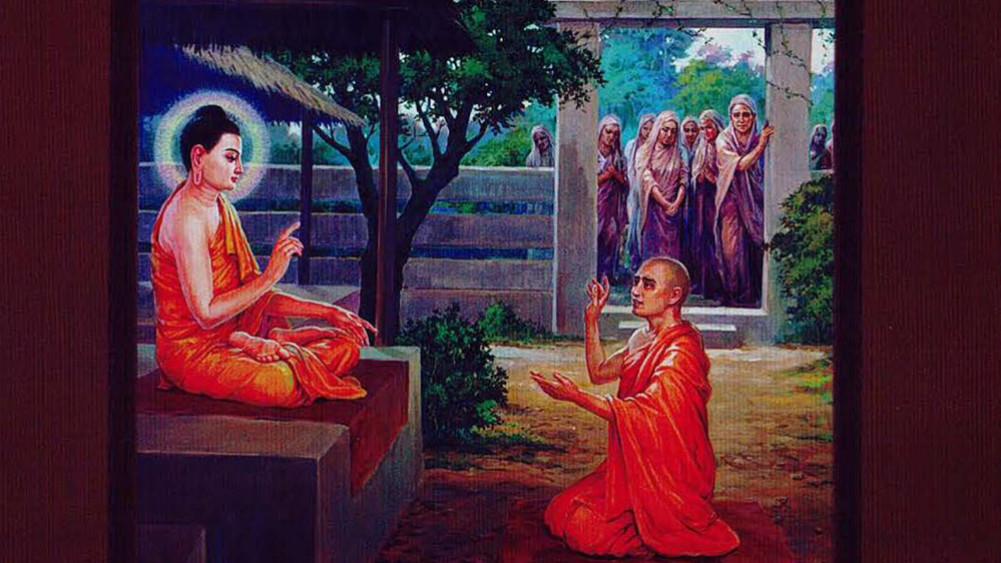
Lord Buddha ordained five hundred Shakya Kumaris as nuns, along with Queen Mother Mahaprajapati Gautami. Thus, for the first time in history, women had the opportunity to become nuns during the Buddha's reign.
We use Google Cloud Translation Services. Google requires we provide the following disclaimer relating to use of this service:
This service may contain translations powered by Google. Google disclaims all warranties related to the translations, expressed or implied, including any warranties of accuracy, reliability, and any implied warranties of merchantability, fitness for a particular purpose, and noninfringement.
An elderly but healthy-looking woman, with shaved hair and wearing a saffron robe, was coming out of the eastern gate of the Kapilvastu palace. Behind her were about five hundred women of different age groups. They were walking barefoot and were led by none other than Mahaprajapati Gautami, the youngest queen of King Suddhodana of the prosperous kingdom of Kapilvastu, and the daughter of Devdaha Nagar. Goutami is the maternal grandmother of Shakyamuni Buddha. She is the maternal grandmother of Nepal, who first established the Bhikshuni Sangha.
Siddhartha Kumara was born in the Lumbini forest on the day of Vaishakh Purnima. After the death of his birth mother Mahamaya Devi on the seventh day after his birth, the maternal grandmother Mahaprajapati Gautami breastfed the child Siddhartha and raised him. He left home at the age of 29 and attained enlightenment at the age of 35, becoming the Buddha.
After attaining the enlightenment, the Buddha returned to his hometown Kapilavastu and established his father, King Suddhodana, mother, Mahaprajapati Gautami, Yashodhara, etc. on the path of enlightenment. By this time, Nanda Kumar, Rahul Kumar and five hundred other Shakya Kumars had also taken the vows and became monks. Later, King Suddhodana attained the fruit of arahantship and passed away. As time passed, Queen Mahaprajapati Gautami developed a sense of detachment. She also resolved to leave home and become enlightened. Queen Gautami had asked the Buddha for permission to become a nun twice, but did not get permission.
The wives of five hundred Shakya Kumars also came to the court with the same intention and requested Mahaprajapati Gautami. Until then, the Bhikshuni Sangha had not been formed during the Buddha's reign. Women were exploited in the society of that time. No matter how much physical and mental suffering they had to endure, they did not have the courage to follow the path of peace. Nevertheless, Gautami firmly decided to leave the palace, believing that if men could attain the knowledge of liberation from the cycle of birth and death, women could too. As a result, five hundred Shakya Kumaris shaved their hair, put on saffron robes, and walked barefoot from the eastern gate of the royal palace, Tilaurakot Kapilvastu. From there, they walked 2,300 km to Kutagar Vihara in Vaishali, where Lord Buddha was residing. Lord Buddha ordained five hundred Shakya Kumaris as Bhikshunis there, along with Queen Mother Gautami. Thus, for the first time in history, women had the opportunity to become Bhikshunis during the Buddha's reign.
This is why even today, nuns around the world are reverently contemplating this event of 2600 years ago and worshipping and honoring Buddha Mother Gautami as the primordial mother who opened the door for nuns to become nuns under the Buddha's rule. Not only this, nuns around the world are celebrating the day of Madhu Purnima, when Prajapati Gautami took ordination, as 'International Bhikkhuni Day'.
In this context, a group of nuns around the world organized a program titled Footsteps of Maha Prajapati Gautami Honoring Women in Dhammacharika in December 2025, in which nuns from 13 countries around the world came to Nepal to participate in this historic program.
Bhikkhuni Dhammavati Guruma is the one who first introduced the statue of Bhikkhuni Gautami to Nepal. The day Gautami became a nun, the custom of celebrating Bhikshuni Day began on Madhu Purnima (Yedya Punhi). The statue of Bhikshuni Gautami made in Lalitpur, Nepal, has been installed in many monasteries today. It is also interesting to note that after learning about this, Bhikshunis from 13 countries ordered a statue of Bhikshuni Gautami to be installed in their respective countries.
Bhikshuni Dhammavati Guruma was the first to introduce the statue of Bhikshuni Gautami in Nepal. The day Gautami became a bhikshuni, Madhu Purnima (Yedya Punhi) was the day Bhikshuni Day was celebrated. The statue of Bhikshuni Gautami, built in Lalitpur, Nepal, has been installed in many monasteries today. In this way, Nepal's artwork has gained a place in the hearts of foreigners. Gurumaa gave a clay statue and a fiber statue to the International United Bhikshuni Sangha as gifts to the nuns who came to visit the venerable Dhammavati Guruma, and the nuns representing 13 other countries took fiber statues for their respective countries. From here, they took along the sacred bone metal for Bhikshuni Gautami's Charika, along with the statue of Gautami Bhikshuni made in Nepal.
Another purpose of this group of bhikshunis coming to Kathmandu was to visit and worship the Charumati Chaitya built by the historical character Bhikshuni Charumati. According to the genealogy, Charumati Chaitya in Chabahil was built by Charumati, the youngest daughter of the Indian Emperor Ashoka Maharaja. It is mentioned that Princess Charumati married Prince Devpal of Nepal and assumed royal duties and became a bhikshuni only after Prince Devpal's death.
During the excavations during the renovation of the stupa from 2059 to 2061 BS, two very important bricks were found there, where the ground structure of the stupa was found. On one brick, the word Dharmachakra was written on top and Charuvati Thup in Brahmi script below, and Charuvati Thup and Dhande He Tu Pra Bha were written below it in Bhujimol script. In Pali, Charuvati Thup means Charumati Stupa. Thus, this record confirms that Charumati Chaitya is from the Ashoka period and is dated to the third century BC. It is currently preserved in the Buddhist Art Room of the National Museum, Chhauni.
The Charumati Vihar built by this nun Charumati, for which historical and archaeological evidence has been found, has become an important tourist destination for nuns around the world. For this reason, nuns who come to Charika also like to visit Charumati Stupa.
The Gautami Bhikshuni Vihara, built under the leadership of Dhammavati Guruma in Lumbini, has a special significance. This monastery is a monastery built from the people under the leadership of the revered Dhammavati Guruma. According to the vision of the unique female leader Dhammavati Guruma, there is not only a statue of Lord Buddha here, but also statues of Siddhartha Kumara, the birth mother Queen Mahamaya Devi, and her maternal grandmother Queen Prajapati Gautami. Recently, the dignity of the monastery has been enhanced by replacing the statue of Bhikshuni Prajapati, who left home to become a nun in order to achieve the path of Nirvana for all women.
Deepak Anand, coordinator and researcher of the Mahaprajapati Gautami Great Renunciation Trail Program, and Vikram Pandekaji, a tourism entrepreneur from Nepal, studied for a long time and found a trekking route from Tilaurakot Kapilvastu to Vaishali, India. After worshipping in the Tilaurakot Durbar complex and starting from the eastern gate, the same place where Prajapati Gautami began his ascension, the nuns representing 13 countries started their trekking campaign.
They reached Anomaghat via Nigrodharam and Ramgram via this trekking route. There, they worshipped the Buddha and recited the Bhikshuni Patimokkha. From there, they reached Vaishali via Valmiki Nagar, Nandangadh, and Lauria Kesariya in India. They completed the Charika by walking 6/7 km daily and by bus. First, after visiting the place where Gautami established the Bhikshuni Sangha, they reached the Parinibbana area in Vaishali and performed group prayers. To the north of Vaishali, there is a Parinibbana area in Birpur, where Gautami and five hundred other nuns attained Parinibbana.
This Mahaprajapati Gautami Great Renunciation Trail has given a special energy to the women of the world. Their devotion to the world-famous senior nun Dhammavati Guruma of Nepal, and their devotion to the Shakya nuns, clearly show the view of Nepal in the Buddhist world.
These nuns of today have not only followed in the footsteps of Gautami. Of course, they have sought Gautami's path to attain ordination. Next year, there is a plan to prepare five hundred nuns, just like in the time of the Buddha. Due to this dimension, it is hoped that the intellectual, academic and spiritual level of women in the world today will reach a high peak.