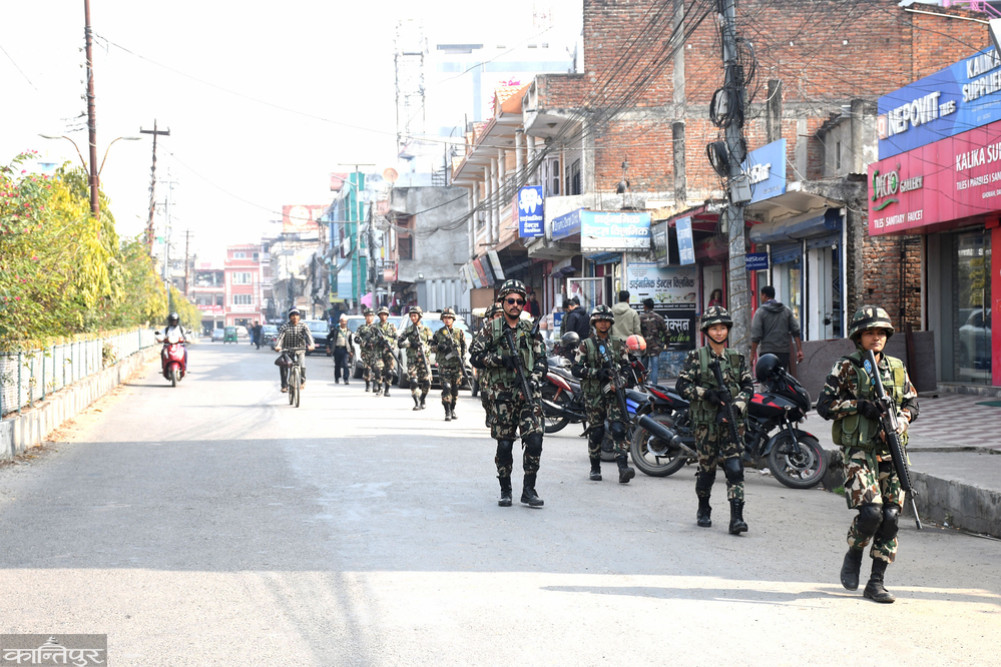
Sometimes the army has shown spontaneous activity by violating the process. The statement made public by the army on Democracy Day, its presence around the squatter settlements when they were removed, and the letter written to the local level are such references that have raised suspicions among the citizens. The Prime Minister and the army should clarify this to the citizens.
We use Google Cloud Translation Services. Google requires we provide the following disclaimer relating to use of this service:
This service may contain translations powered by Google. Google disclaims all warranties related to the translations, expressed or implied, including any warranties of accuracy, reliability, and any implied warranties of merchantability, fitness for a particular purpose, and noninfringement.
Most countries have established an army with the aim of protecting the integrity and sovereignty of the country. The mentality that the army will fight and save the country when there is an external attack on the country is found among the citizens of many countries, including Nepal. On the other hand, there is a practice of seeking the help of the army in internal security, disaster management, and development work. Although the Nepali Army has not participated in external wars for almost two hundred and fifty years, it is found that the army is frequently mobilized when there is an emergency.
There are many examples of it being deployed for security during elections, being deployed for rescue during earthquakes and floods, and being entrusted with the construction of some development projects. All these issues fall within the scope of the constitutional expectations placed on the army and the responsibilities it must fulfill. Legal procedures have also been completed for that. However, sometimes the army has shown spontaneous activity by violating the procedure. The statement made public by the army on Democracy Day, its presence around the settlement of squatters when it was removed, and the letter written to the local level are such references that have raised suspicions among the citizens. The Prime Minister and the army should clarify this to the citizens.
It has been controversial before. During the Gen-G movement last Bhadra, the Nepali Army became controversial. It was criticized for not showing interest in the security of structures such as the President's Residence and Singha Durbar, which are under the responsibility of the army, and for giving priority to dialogue with people unrelated to the Gen-G movement on the issue of facilitating the formation of a new government. There has been no serious debate in society on such issues. In the last few days, the news that has been made public in connection with the army has shocked society.
For example, on April 11, it was warned that the Nepali Army is regularly monitoring content that mentions the Nepali Army and its leadership in the media and social media. On April 12, when the government used a dozer in a squatter settlement, armed soldiers were also seen nearby. On the same day, it sent letters to various municipalities asking them to provide details of the squatter settlements (location of the settlement, date of settlement, number of households, contact number of the settlement officials). This has increased suspicion towards the army. Despite the army's clarification, society has not been able to agree. This has demanded a more serious debate.
The audacity of the army to monitor the exercise of freedom of expression by citizens and to remind them of the scope of the law is against the essence of democracy. It should be concerned with the fact that legal processes also have their own rules. On the other hand, there is a constitutional provision that allows the army to be mobilized for development and disaster management. But there is a rule for that. Article 266 of the constitution provides for the National Security Council. It recommends to the Council of Ministers to mobilize or control the Nepali Army. The army can be mobilized only after the President gives approval after the decision of the Council of Ministers.
However, the decision to remove the Sukambasi settlement is neither part of the development work nor disaster management. This is not a matter related to sovereignty, geographical integrity or security. There is no situation where the Security Council recommends and the Council of Ministers decides and the President approves it. The army remained silent on 24 Bhadra when the country was burning, citing similar reasons. If his argument was correct then, his initiative around squatter settlements is now critical.
Similarly, the letter written by the army to the Land Problem Resolution Commission and the district municipality office from the army units in various districts requesting details of squatters makes it clear that it does not want to be bound by the constitutional scope and designated scope of work and is interested in unnecessary initiative. Because, landless and squatter management is a task that falls under the jurisdiction of the local government. However, at a time when the federal government is now unilaterally opposing the process of using dozers in the settlements, the army has also entered the matter in search of data.
The decision to raise the squatter settlements is neither part of the development work nor disaster management. It is not a matter related to sovereignty, geographical integrity or security. It is not a situation where the Security Council recommends it and the Council of Ministers decides and the President approves it. The army spokesperson has stated that the purpose of removing the letter from the army unit is disaster risk reduction. Whereas, the decision should be made by the District Security Committee meeting. Such a meeting was not held and the decision was not made. The National Federation of Rural Municipalities and the Nepal Municipal Association, after the army's letter and explanation, said, 'There is a lack of clarity of responsibility, mutual trust and coordination among state bodies, and such a situation cannot be beneficial in the long term in a democratic system of governance.'
This determination of the local level in protecting and protecting its area of work is commendable. It will strengthen the federal system.
The army is not a structure that is constantly debated or discussed in a democratic system of governance. But the army has repeatedly been in controversy in Nepal. Despite criticism ranging from its business interests to contract issues, no concrete conclusions have been reached. Rather, it is showing interest in carrying out activities beyond the established norms and jurisdictions set by the constitution of Nepal regarding the role of the army. The institutional trust that citizens have in the army should be utilized, not misused. The army should be clear about the limits given by the constitution and law. It should be sensitive and restrained when asked questions.
This is not only a matter of the army's activities, but also a question of civilian control over the army. The incident of autocracy imposed in Nepal under the auspices of the army is fresh. Therefore, if his interest in the work of various levels and bodies of the civilian government cannot be controlled in time, a difficult situation can arise at any time. Therefore, citizen awareness and surveillance are mandatory. The question is on the army, and it is also on Prime Minister Balendra Shah.
Because, he is handling the responsibilities of the Ministry of Home Affairs, which is connected to the peace and security of the citizens, and the Ministry of Defense, which is the talukdar of the army. Is the current advancement of the army happening with his knowledge and consent or is the army surpassing him too? He should clarify this issue. He cannot remain silent on sensitive issues.