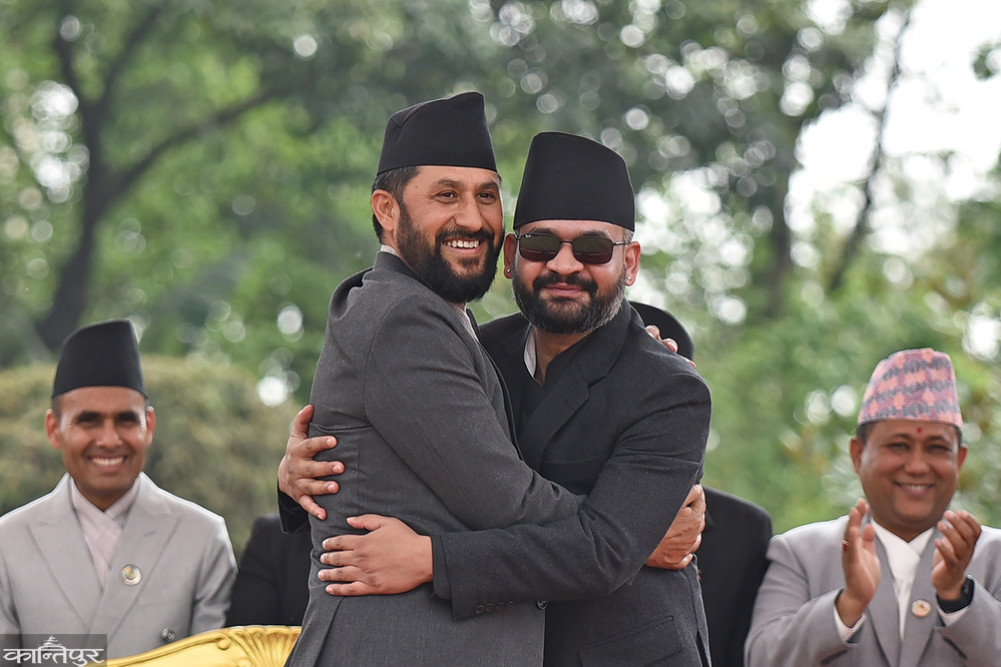
Can this party rise above the personalities of Ravi-Walendra and become an institution? Or will it be overwhelmed by the overload of personalities? Or will the party become 'Ular' and limited to the dominance of one person? This is the crisis of religion of the Rashtriya Swayamsevak Sangam (RSS).
We use Google Cloud Translation Services. Google requires we provide the following disclaimer relating to use of this service:
This service may contain translations powered by Google. Google disclaims all warranties related to the translations, expressed or implied, including any warranties of accuracy, reliability, and any implied warranties of merchantability, fitness for a particular purpose, and noninfringement.
There is a line in the Bengali poem ‘Shei Kale’ (That Time) by the famous poet Rabindranath Tagore, ‘Jadi Amar Janam Hoti Kalidaser Kale, Daive Hoto Dasham Ratna Nav Ratna Majhe.’ The meaning is – If I had been born in the time of Kalidas, I would have been the tenth jewel among the nine jewels. In today’s Nepali political context, the psychology of some leaders who have held high positions in old parties seems to be something like this. If they had contested the elections from the Rashtriya Swatantra Party (RSWP) this time, they would have been a ‘minister’ of the Balendra court today.
This is not just poetic imagination, but the psychology of power and recognition. This same psychology is manifesting itself in a new form in today’s Nepali politics – with the rise of the RSWP. Such expressions not only show the intensity of attraction towards the RSWP, but also reveal the eagerness to arrange ‘settings’ within it for the upcoming provincial and municipal elections. In electoral politics, such psychology works like a magic spell. A ‘success formula’ that brings quick success.
The literal meaning of the word ‘politics’ is itself very broad. It is not logical to understand it in a narrow sense. Politics is the life of society, both a means of upliftment and downfall. When politics advances, society advances, and when it declines, society also declines. A party is the penance of a few dedicated individuals. Developing a dynamic, disciplined and accountable party-life is a coherent invention according to the country, time, and situation.
However, this is the problem in the case of the Rashtriya Swayamsevak Sangh (RSS). The debate and discussion are focused on the Prime Minister and the party president, while the party structure has been neglected. If criticism continues only to the top of the government and the party, the rest of the party ranks become an ‘invisible shield’. This weakens collective responsibility. In a democracy, the real accountability should be collective. Because policies are implemented in the name of the party, not in the name of an individual.
How can we call the Rashtriya Swayamsevak Sangh (RSS) a party? Critics say – it is the product of a kind of 'pseudo-alliance'. Was the collaboration between Ravi Lamichhane and Walendra Shah born out of necessity or was it made like that. Again, an alliance came into existence, in the name of a few points of agreement. How can we not call the Rashtriya Swayamsevak Sangh (RSS) a party? It is recognized by the Election Commission, approved by the ballot. The message of change brought by the Rashtriya Swayamsevak Sangh (RSS) through electoral politics is broad, profound and far-reaching. The entire discourse has changed, which was established after multi-partyism became dominant in the 1946s. How can we call the Rashtriya Swayamsevak Sangh (RSS) a party? Critics say that this is the product of a kind of 'pseudo-coalition'. Was the collaboration between Ravi Lamichhane and Walendra Shah born out of necessity or was it made like that? Again, an alliance came into existence, in the name of a few points of agreement. The Indian Ocean and the Pacific Ocean meet in the Gulf of Alaska, but even when their waters mix, they do not seem to mix. The flow of water is separated by color. Walendra seems so busy with political affairs that it seems like he has lost the sense of saying 'I also have a party'. On the other hand, Ravi Lamichhane is balancing his parental role. Today too, the same question remains – is this collaboration directed or structured?
Where is the umbilical cord of the Ravi-Walendra superhit pair? Why are characters like Kulman Ghisingh left out of a multi-starrer film? Is this conflict in the RSSW an internal matter of a party or a public political question? If the RSSW is a democratic political party, then this is not just the party's concern, but the concern of the entire society. Therefore, there should be an open debate on this. This debate determines its democratic character. The RSVP is not only the largest party in the House of Representatives, but in its own words, it is a party that has come with a resolve to purify the democratic system. The essence and vitality of constitutional democracy is obtained only by its internal life remaining democratic. However, the psychology that justifies its decisions based on electoral victory is prevalent within this party.
The concept of ‘circular time’ can be very useful in understanding the rise of the RSVP and its existence. Circular time tells us that history does not move forward in a straight line, it moves in cycles. Each cycle brings old aspirations, disappointments and rebellions to the fore in a new form. The rise of the RSVP is a new version of old discontent. However, the question is not just about rise, establishment and ascension to power. Does it have the ability to break that cycle or not? Is the Rashtriya Swayamsevak Sangh (RSS) a new version of the old discontent? If every new face works in the same old pattern, it itself becomes a part of that pattern.
The crisis of the RSS is that it remains what it is. Or, it becomes what it has been fighting. Power is not just an opportunity, it is also a structure. And, the structure has the amazing ability to change a person. Will the RSS remain steadfast in the moral ideals that it has written in its documents, even if it has to suffer political losses? Or will it become practical, even if its moral image is tarnished? The RSS is entering this kind of crisis of religion in the short period of its rule. Another question is, can this party rise above the personalities of Ravi-Valendra and become an institution? Or will it be overwhelmed by the overload of personalities? Or is the party limited to the dominance of a single person by becoming a 'stubborn' party? This is the crisis of religion of the Rashtriya Swayamsevak Sangam.
When studying the situation of the formation of parties in Nepali politics, some parties are formed from ideas, some from struggle, and some from the atmosphere. The Rashtriya Swayamsevak Sangam is a chemical compound that was formed suddenly and reacted rapidly. The formation of the Rashtriya Swayamsevak Sangam should be seen as a chemical process - where different elements, different circumstances and catalysts come together to form a combination. The stability of any compound depends on its 'bounds'. What are the bonds of the Rashtriya Swayamsevak Sangam? Is it a common ideology? Is it organizational discipline? Or, just a common aspiration to reach power? Is the Rashtriya Swayamsevak Sangam a new political culture? Is it a new packaging of the old structure?
In the Rashtriya Swayamsevak Sangam, the organization is reflected later, the face first. This conflict within the RSVP is basically a struggle for existence and structure. Can an individual represent the collective consciousness? Has the ‘I’ become too big within the party, while the ‘we’ is being marginalized? In the RSVP, the ‘I’ is getting bigger, while the ‘we’ is getting smaller. This is not a good sign. In a democracy, the party is strong, not the individual. When the individual becomes bigger than the party, institutional decay begins. Questions are being raised about signs of authoritarian tendencies in the RSVP-led government. Many doubts have been spread at the ground level. The way the government is moving forward, the manner in which the leader of the parliament is acting, the RSVP is silent about this. There are certain processes, assumptions and expectations of parliamentary practice. This fine line between hope and illusion is the real test of the RSVP.
The RSP is described as an ‘anger-driven’ political formation more than an ‘ideology-driven’ one. It is an institutional form of people’s frustration. However, its institutional structure is weak. There is ambiguity in ideology. We are not like the old parties, but we do not have a clear ideological framework. Information is leaking that internal democracy is weak within the party. Elected representatives are complaining that they have become innocent. After all, which gap is the RSP claiming to fill? Isn’t the RSP itself, which claims to be in search of answers, having more questions and fewer answers?
Whether it is bread or power, we must always keep turning it upside down. If the bread is not turned over, it burns and the power becomes corrupt. The RSP firmly established these beliefs. It institutionalized anti-establishment energy. Increased participation of youth and new classes. Shifted the debate towards 'performance'. But, instead of prioritizing internal democracy, institutional processes, human sensitivity and accountability, will it use 'jugaad' to achieve its purpose? Is the Rashtriya Swayamsevak Sangh (RSS) moving towards institutional justice through its government or is it giving the name of justice to revenge? Will it bring about a 2:0 Panchayat in the face of the majority? The real religious crisis of the RSSW politics is not which path is it? Rather, it is what are we willing to lose by choosing a path? Remaining in power by compromising with the permanent establishment or preserving our purity even after being caught in turbulence?
Political transformation usually happens in two ways. From within (conviction) or from outside pressure.
Sometimes, when society has such deep faith in an organization or person, it creates pressure to show the truth even to its liars. Sixty years ago, a Hindi film ‘Guide’ was released. This film raises the question, ‘Are we who we appear to be?’ The change in its character Raju does not come spontaneously from within. Rather, it is the result of pressure and expectations created by society. According to Irving Goffman’s ‘Dramaturgy’ theory, society gives us ‘roles’ and we play those roles. Raju first ‘acts’ but gradually that acting becomes his reality. ‘Guilt’ and ‘responsibility’ arise within Raju. He begins to understand that his ‘lies’ are now affecting the lives of others. And, this is the point at which change begins within him. (compulsion). In which direction is the journey of the RSSW headed? If its democratic loyalty is only an ‘image’, it will soon collapse. If it comes from internal consciousness, it can also change the structure. But, here the crisis of religion is deep. How can it contain the growing ambition of permanent power? Permanent power is a double-edged sword. It both builds and destroys. The Rashtriya Swayamsevak Sangh (RSS) is now at a crossroads. The RSP is described as an ‘anger-driven’ political formation more than an ‘ideology-driven’ one. It is an institutional form of people’s frustration. However, its institutional structure is weak. There is ambiguity in ideology. To regulate permanent power, it must reach an understanding with the old parties. Either it breaks the cycle or becomes part of the cycle itself? The decision is in its hands. However, the entire democracy will suffer the consequences.
Charles Horton Cooley says – We start seeing ourselves the way society sees us. When Raju is constantly called ‘Mahatma’, he starts seeing himself in that light. The external image gradually translates into his internal identity. When society makes him a moral symbol, Raju tries to restructure his life. As a result, he becomes a ‘believer’ from a ‘performer’. The pressure of public trust takes him to the point where he transforms himself or, so to speak, is forced to change. The story of the Rashtriya Swayamsevak Sangh is also at this juncture. The public trust is not only an opportunity for this, but also a test.