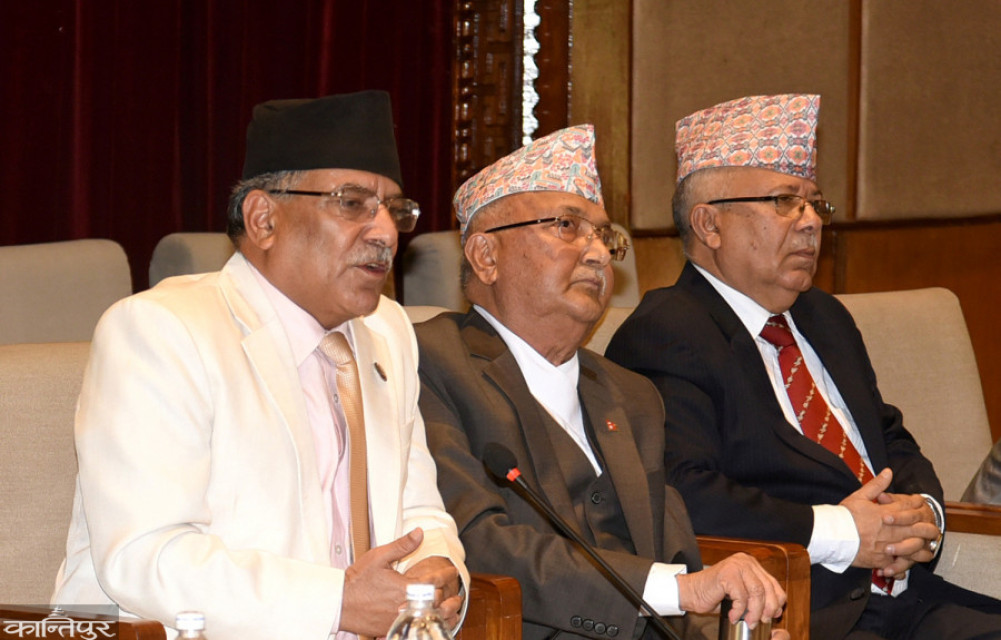
The history of the Left in Nepal extends from the people's movement, the Maoist People's War, and the Constituent Assembly to the establishment of the Republic. In this journey, the Left has worked to bring the voices of landless farmers, Dalits, indigenous peoples, women, and marginalized communities into the political mainstream.
We use Google Cloud Translation Services. Google requires we provide the following disclaimer relating to use of this service:
This service may contain translations powered by Google. Google disclaims all warranties related to the translations, expressed or implied, including any warranties of accuracy, reliability, and any implied warranties of merchantability, fitness for a particular purpose, and noninfringement.
The longer poverty, social division and economic inequality persist in society, the longer the left will remain the only weapon of retaliation. It is not the slogan of any one ideology, party or organisation. It is the living voice of the exploited, the oppressed, the marginalised and the marginalised all over the world. There has hardly been as much debate, controversy and criticism about the left as there has been since the founding of the French Republic. But history has proven that the left has given voice to the working class in various ways.
In South Asia, including Nepal, there is a misconception that the left is often synonymous with communism. This has created some confusion. The left is close to communism, but the left is not necessarily communism. There is no certain ‘truth’ of the left’s campaigns, programmes, policies and governance. It has diversity, flexibility and the ability to transform over time. While communism and capitalism have definite models. The chaos and confusion arising from both these systems have caused a serious crisis in the global governance system today.
From the French Revolution to the Global Left
The French Revolution of 1789 divided the world into two camps – the Left and the Right. When the revolutionaries sat on the left in the National Assembly, they raised their voices against feudalism, monarchy, and the dominance of the church. The concept of ‘leftism’ was born from that sitting on the left. As the French philosopher Voltaire said, ‘Everything can be changed, but change requires struggle.’ The Left came to represent that kind of struggle.
As the Industrial Revolution intensified capitalism in the nineteenth century, the conditions of factory workers became miserable. As a result of that study, the extraordinary and talented young men Karl Marx and Friedrich Engels published the Communist Manifesto in 1848. The essence of the manifesto was – ‘The history of human society is the history of class struggle.’ That is, one of the fundamental conflicts of human society is the constant confrontation between those who produce and those who possess the means of production. From this contradiction, leftist ideology derives its moral and intellectual strength.
In the twentieth century, Lenin, developing Marxist rhetoric, said that imperialism is the highest stage of capitalism. In other words, ‘imperialism is the deathbed of capitalism.’ The Russian Revolution (1917) led by Lenin established the first socialist state and inspired colonial nations around the world. The time and context in which Jawaharlal Nehru emerged as a non-communist figure, a serious follower of the Bolshevik Revolution, can be considered instructive for today’s South Asian society.
During the development of leftism, the Italian philosopher Antonio Gramsci put forward the concept of ‘cultural hegemony’. ‘Since the ruling class instils its ideology in the minds of the people through culture, education, and the media, the Left must break that hegemony (Gramsci: 1971).’ Exploitation is not only in the economic sphere but also in the ideological and cultural sphere. This means that the Left seeks not only economic revolution but also a transformation of cultural consciousness. French existentialist philosopher Jean-Paul Sartre says – ‘Marxism is the transcendental philosophy of our age’, meaning that this ideology is the most relevant interpretation of contemporary reality, which cannot be easily transcended. The concepts of Sartre and Gramsci are helping to understand the contemporary global cultural struggle.
The vast umbrella of leftist ideology includes many currents, from social democracy, democratic socialism, anarchism, green leftism, feminist leftism, liberation theology to the slogans of federalism and identity in Nepal’s originality. The social-democratic model of Norway, Sweden, Denmark is a product of the left – where there is neither complete state ownership, nor unbridled capitalism, but the people are getting universal health, education and social security. This is what we need in Nepal.
British political philosopher Ralph Miliband has argued in his famous work ‘The State in Capitalist Society’ – in a capitalist democracy, the state is not neutral, it works in the interests of the capitalist class. From this perspective, the left, in addition to binding diversity into a common thread, directs the guarantee of real representation of the masses in governance and economic justice.
Leftism in South Asia
In South Asia, the left is often considered synonymous with ‘communism’. But this perception is only partially true. In Nepal, the left means everything from the secularism of the state, a dignified life for the marginalized and social justice to identity politics. When the left movement in Nepal was started in the 1950s, Pushpalal Shrestha had said, “Service to the people is our religion.” Ironically, the communist movement in Nepal went from service to government madness and ended up in the swamp of infamy.
The role of leftist parties was decisive in the people’s movement of 1990 and the second people’s movement of 2006. It would be no different to say that Nepal has become today’s conscious society because the 10-year people’s war raised its voice against feudal exploitation in rural Nepal. Despite the Maoist leadership’s attempt to blindly imitate the formula that ‘political power comes from the barrel of a gun’, Prachanda has made a historic contribution in Nepal by transforming this principle into peaceful politics. In fact, Madan Bhandari had already put forward a new interpretation of the relevance of the Communist Party and the Left through ‘People’s Multi-Party Democracy’. Today's UML is playing with the same rhetoric, but its oligarchy behavior is floundering in the swamp of right-wing populism. However, the history of the Left in Nepal extends from the people's movement, the Maoist people's war and the Constituent Assembly to the establishment of the republic. In this journey, the Left has worked to bring the voices of landless farmers, Dalits, indigenous people, women and marginalized communities into the political mainstream. There is general consensus that elements such as proportional inclusion, federalism and secularism included in the Constitution of Nepal (2072) to the concept of a socialist-oriented state are the achievements of the Left's struggle.
The role of the Left in the Indian independence movement was unparalleled. BR Ambedkar's Dalit liberation movement, Bhagat Singh's revolutionary nationalism and EMS Nambudiripad's Kerala experiment - all these are considered to have created the unique character of the South Asian Left. Moreover, the interaction between the Left and the Communist Party in India seems more interesting. In Kerala, the communist government carried out land reforms and education revolutions in 1957. In West Bengal, the Left government for 34 years is considered to have made a historic contribution in protecting the interests of farmers and workers. The non-communist Left has also struggled against caste, gender and regional discrimination in South Asia. The architect of the Indian Constitution, Ambedkar, has established himself as a capable commentator who draws the essence of the similarities between the Dalit liberation movement and the Left. Ambedkar himself had said, ‘Economic equality is not possible without political freedom.’ Its contemporary relevance is becoming more and more evident.
Capitalist crisis and the renaissance of the Left
An interesting phenomenon has occurred after the global financial crisis of 2008 – the sale of Karl Marx’s ‘Das Kapital’ has suddenly increased. This is not just a coincidence. When the capitalist system is immersed in its own contradictions, people turn to the Left in search of an alternative. French economist Thomas Piketty, in his famous work ‘Capital in the Twenty-First Century’ (2013), has proven with solid data that there is an inherent tendency for inequality to increase in capitalist economies. The essence of the Piketty thesis is that the rate of return on wealth is always higher than the rate of economic growth, which makes the rich richer and the poor poorer. This formula is becoming a mathematical explanation of modern inequality.
American linguist and left-wing thinker Noam Chomsky has said – ‘Capitalism is fundamentally a flawed system, which serves the wealthy minority.’ According to him, democracy and capitalism cannot fully flourish together because the centralization of economic power also captures political power.
These and similar reasons and factors are causing new leftist waves to rise around the world – ‘Syriza’ in Greece, ‘Podemos’ in Spain, ‘Pink Tide’ in Latin America, the mix and conflict of Jeremy Corbyn and Starmer in Britain, and the relevance of the movement advocated by Bernie Sanders in the US, resulting in the victory of Zohrab Mamdani in the capital of global capitalism. The common sign of all these developments and developments is that the left is not a ‘failed ideology’ but a powerful alternative that is being revived and revived in this new situation.
The greatest strength of the left lies in its diversity. It can be seen in all its forms, from the Soviet model, the Chinese model, the European social democratic model, to the Bolivarian socialism of Latin America. But its structure has no fixed ‘truth’. The left changes form according to time, place and the needs of the people. But it does not compromise on serving the people and social justice.
While the neo-liberal model of capitalism has been dreaming of a ‘trickle down’ economy since the 1980s, Nobel Prize-winning scholars like Joseph Stiglitz have proven through their thesis ‘Globalization and Its Discontents’ (2002) that the neo-liberal model has made the rich richer and the poor poorer. Today, the richest 10% of the world owns 76% of the wealth (Oxfam: 2024). When we turn the pages of history, one truth repeats itself over and over again – where there is hunger, there is rebellion. Where there is inequality, there is question. And, where there is question, there is leftism. Leftism is not just a manifesto of a party, nor is it just a theory born from the mind of a single thinker. It is a collective declaration of the lives of those who have been exploited, victimized and despised for centuries – a voice that has never been completely suppressed in any period of history. However, any system collapses when it is separated from the people. The left has no choice but to learn from the same mistakes and move forward. Now it is the turn of Nepal's left to be renewed.
The relevance of the left
The COVID-19 pandemic, climate change, the Ukraine war and the Gaza crisis, and the war on Iran, which resembles World War III, have not only exposed the structural weaknesses of the capitalist system, but have also clearly indicated that the time for neoliberal and imperialist capitalism is over. From rich countries focusing on vaccines and aid for themselves to the climate crisis, poor countries affected by developed countries increasing emissions have had to pay the price. Now the Nepali left must be able to voice this agenda.
Inequality is increasing in Nepal. The number of young people migrating from villages to cities is increasing. As people's discontent with unemployment, high prices, and corruption has turned into anger, the various consequences of the Bhadaure uprising are becoming apparent. At this time, it has become imperative for the Left to honestly restructure the Left power structure by presenting an alternative economic model and advocating cooperatives, community production, and social security. As Noam Chomsky said in ‘Requiem of the American Dream (2017),’ ‘Capitalism has taken democracy hostage. Only the Left can free it.’ Chomsky’s statement has become eloquently relevant for Nepal today.
The future of the Left
The lack of alternatives for the Left does not mean its immortality. It is a process of its continuous transformation. In today’s digital age, the Left must embrace social media, climate justice, and gender equality, as well as be vocal about the economic conditions of the people at the grassroots level. Although the Left alliance in Nepal gave the slogan of ‘Prosperous Nepal, Happy Nepali’, it was left stranded due to the Oli-Prachanda tension. कथित वाम बेइमानीकै कारण समय क्रममा देश नै दुर्घटनामा परेको वास्तविकतालाई आत्मसात् गरेर वामपन्थले भ्रष्टाचार, नातावाद र सत्तालिप्साबाट मुक्त हुने संकल्पका साथ ‘जेनेरेसनल सिफ्ट’ लाई समेत स्विकार्न तयार हुनुपर्छ । सोहीअनुसार रूपान्तरण र पुस्तान्तरण गर्न कत्ति पनि ढिलाइ गर्नु हुँदैन । अब नेपालमा वामपन्थ तथा कम्युनिस्ट पहिलो पुस्ताले खुसीसाथ अवकाश लिनु अनिवार्य छ । तथापि एक्काइसौं शताब्दीको वामपन्थले नयाँ चुनौतीहरूसँग जुध्नु त छँदै छ । जलवायु परिवर्तनदेखि कृत्रिम बुद्धिमत्ताले सिर्जना गर्ने रोजगार–संकट, डिजिटल एकाधिकार र वैश्वीकृत वित्तीय पुँजीको शक्ति संकेन्द्रणका विरुद्ध समेत योजनाबद्ध संघर्ष गर्नुपर्छ ।
जलवायु न्यायको आन्दोलन अनिवार्यतः वामपन्थी चरित्रको रहँदै आएको छ । जलवायु परिवर्तनको सबैभन्दा बढी मार गरिब, अल्पविकसित देश र सीमान्तकृत समुदायले खेप्छन् नै, त्यसको पहिलो लहरमा नेपाल रहेको तथ्य आमरूपले महसुस हुँदै छ । पुँजीवादी उत्पादन प्रणाली र असीमित वृद्धिको दौडले पारिस्थितिक संकट सिर्जना गरेको छ । दक्षिण कोरियाली–अमेरिकी विचारक सुही–याङ पाईले ‘हाइपरट्रान्सपरेन्सी’ को अवधारणामा भनेका छन्– ‘डिजिटल पुँजीवादले मानवीय स्वतन्त्रता र गोपनीयतामाथि नयाँ प्रकारको वर्चस्व स्थापित गरिरहेको छ ।’ यस सन्दर्भमा वामपन्थले डिजिटल अधिकार, एल्गोरिदमिक न्याय र प्रविधिको लोकतान्त्रिक स्वामित्वको नयाँ एजेन्डा तय गर्नुपर्ने वैश्विक अवस्थाका लागि सञ्जाल निर्माण र सहभागिताको चरण ढिलो भइसकेको छ ।
वामपन्थ विकल्पहीनताको उपज मात्र होइन– यो मानव सभ्यताको अग्रगामी चेतनाको अभिव्यक्ति हो । जबसम्म एउटा बच्चाले भोकले रुनुपर्छ, एउटा किसानले ऋणको भारीमा थिचिनुपर्छ, एउटी महिला आफ्नै घरमा असुरक्षित हुनुपर्छ, दलितले मानवीय मर्यादाका लागि संघर्ष गर्नुपर्छ तबसम्म वामपन्थको प्रासंगिकता अरू बढी मुखरित भइरहन्छ । के नेपाल यिनै समस्याबाट प्रताडित छैन र ?
अर्जेन्टिनाली क्रान्तिकारी चे ग्वेभाराले भनेका थिए– ‘यदि तपाईं अन्यायका सामु क्रोधित हुनुहुन्न भने तपाईंका संवेदनाहरू मरिसकेका छन् ।’ यसखाले क्रोध, यही संवेदना र यही न्यायको आकांक्षा नै वामपन्थको मूल ऊर्जा–स्रोत हो । तर भावनाले मात्र त परिवर्तन हुँदैन । वामपन्थले आफ्ना गल्ती र बेइमानीप्रति आत्मालोचना गर्न सक्नुपर्छ, लोकतान्त्रिक मूल्यहरूप्रतिको प्रतिबद्धताप्रति व्यावहारिक रूपमा खरो उत्रन सक्नुपर्छ, नागरिक स्वतन्त्रतालाई कहिल्यै बलिदान दिनु हुँदैन र जनताप्रतिको जवाफदेहितालाई सर्वोपरि राख्नुपर्छ । यिनै अर्थराजनीतिक कारण वामपन्थ विकल्पहीन मात्र नभएर अपरिहार्य बन्छ भनिएको हो । मानव जातिको इतिहासको शिक्षा भनेकै न्याय सधैं तिनीहरूकै पक्षमा रहेको छ, जो शोषितका पक्षमा उभिन तयार भए । तसर्थ नेपालको वामपन्थले आजको मौलिकता, पुस्तान्तरणको जायज माग र डिजिटल लोकतन्त्रले उपलब्ध गराएको अवसरलाई कुशलतापूर्वक सही सदुपयोग गर्ने नयाँ चरणका लागि ढिलाइ गर्नु आत्मघाती र इतिहासप्रतिको बेइमानी हुनेछ ।
(कँडेल राजनीति, कूटनीति र मिडियाको अध्ययन, अध्यापन र लेखनमा संलग्न छन्)