Currently, the majority of youth lack social science awareness. The importance of humanities and social science education in higher education is very deep and multifaceted.
We use Google Cloud Translation Services. Google requires we provide the following disclaimer relating to use of this service:
This service may contain translations powered by Google. Google disclaims all warranties related to the translations, expressed or implied, including any warranties of accuracy, reliability, and any implied warranties of merchantability, fitness for a particular purpose, and noninfringement.
Around 2054/55 BS, a young man studying for a bachelor's degree in science at Amrit Science Campus was an active participant in the street protests organized by the then CPN (ML) on the issue of Kalapani. He was a 'topper' of the Proficiency Certificate level in science, who participated in the protest, which included stone-pelting and scuffles with the police. Another young man who had come to study science from a rural area on the campus was not happy that a 'topper' more senior than him was involved in a political protest and took the opportunity to ask him, 'Doesn't your studies get spoiled when a topper like you joins the protest like this?' The brother replied, 'What we have studied in class is pure science, what we have learned by joining the protest is a part of social science, the fusion of pure science and social science makes our knowledge complete. Without each other, these are incomplete.'
The person who answered this way is now established as a well-known academic in Nepal, while the person who asked him the question told me about that time a few years ago.
I teach in the Department of Community Development. The reading material includes topics such as various aspects of society, political and social movements, and the changes they brought. However, the students who study are from the generation called 'We Hate Politics'. When the history of the Nepali democratic movement, its impact and changes in society are discussed in the course of study, they seem to be sympathetic towards leaders like BP Koirala, Pushpalal and their affiliated political parties. Similarly, when the context of the increasingly inclusive state mechanism and the Maoist armed struggle and the Madhesh movement that are strong in its background comes up, they come out of the prejudice of absolute condemnation of political movements.
Not only that, while reading about the Gorkha expansion campaign launched by Prithvi Narayan Shah and the subsequent modern Nepal, some students feel emotional towards the natives of the valley who were forced to leave their homeland due to the fear of war at that time. Some are proud of Prithvi Narayan Shah's strategic campaign in the geopolitics of that time. Similarly, with topics like the opening of Trichandra College and Bir Hospitals during the Rana regime or the end of the Sati system, students are confronted with the facts of the contribution made to social change by various events during those periods. And they say with confidence – no person or system is completely black or white, it is rather like a unique collage made of various colors – sometimes there is some light and sometimes there is some shadow.
Students consider every movement to be a sacred effort made by conscious people to travel from darkness to light. The classroom becomes a place of lively debate. And, the debates between the pros and cons in the classroom seem constructive, not destructive.
But, social media, which plays a decisive role in today's times, is not like that. Have you seen the content related to politics on social media and the comments on it? If so, you clearly see the shadow of an intolerant and violent society. Here, there is no reaction based on merit and demerit, but rather, you only find the deification of the party and the distortion of the opposition. In this way, the absolute partisanship and division growing in society weakens the morale of every conscious person from within.
Looking through the eyes of a teacher who interacts with the younger generation daily, I see a lack of awareness of social science among the majority of young people. However, the importance of humanities and social science education in higher education is very deep and multifaceted. Humanities provide people with in-depth knowledge about the development of society and civilization through subjects such as language, history, political science, philosophy, literature, and culture. It develops critical thinking, moral awareness, and creativity in students, which enables them to solve complex social, cultural, and ethical problems. With the rapid development of science and technology, humanities education plays an important role in preserving human values, empathy, and a sense of responsibility. In today's complex and rapidly changing society, it is very necessary to make people aware of not only technical knowledge but also human values, ethics, and social responsibility. Humanities play an important role in balancing the use of science and technology from a human perspective. Therefore, the contribution of humanities education in higher education seems indispensable for building a balanced and inclusive society.
But students, parents, and policymakers do not seem to prioritize humanities education. The number of students studying such a vibrant subject is decreasing every year. Youth are gradually turning away from these subjects. Parents also seem to be interested only in technical subjects that are in high demand in the labor market. The number of students enrolled in the humanities and sociology faculties in higher education in the last five years also highlights this fact.
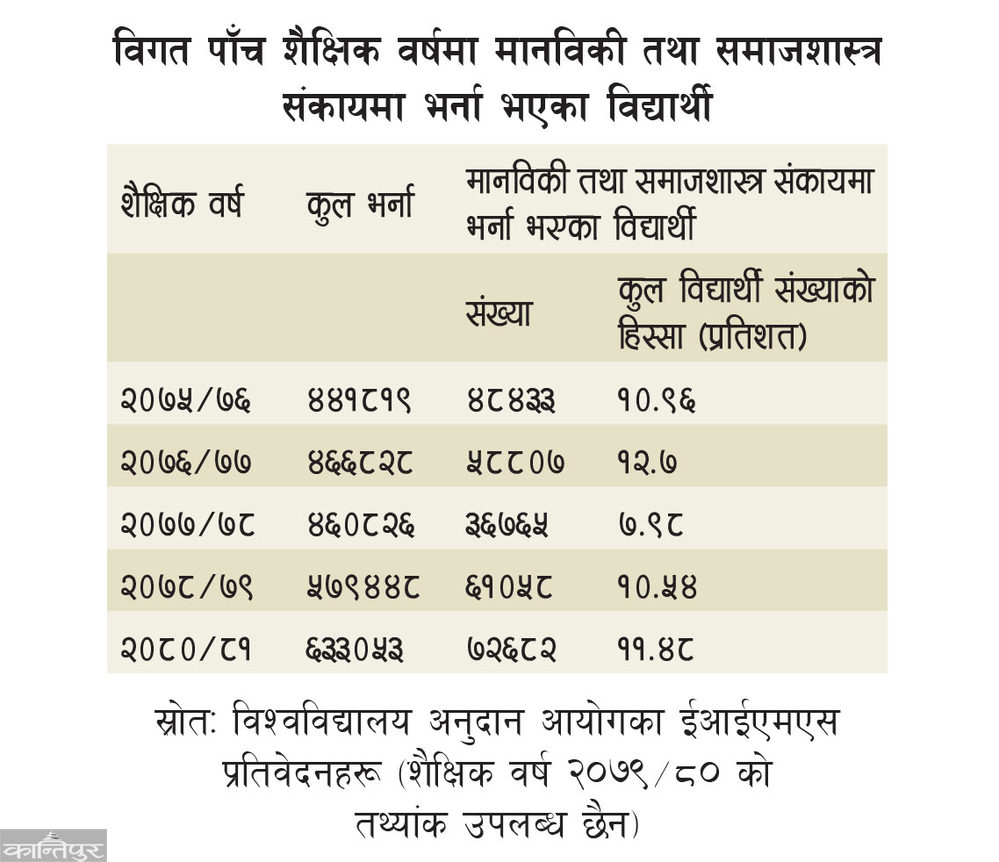 Over the past few months, I have been involved in interactions with grade 12 students in about a dozen schools in Kathmandu about their preferred subjects in higher education. The main objective of the interactions was also to motivate students to study humanities. The priorities of most students who wanted to continue their studies after grade 12 were subjects like information technology, medicine, engineering, management, and most of their higher education destinations were abroad.
In such a background, it seems challenging to attract young students towards humanities subjects. Some parents and policymakers consider humanities subjects unproductive. Perhaps these subjects are not among the government's priorities because they produce critical-minded human resources? Academics have concluded that the importance of the humanities is high. According to Nussam (2017) and Paul Elder (2008), humanities education develops skills that are considered highly desirable in the job market (such as writing, oral expression, collaboration, and problem-solving skills). Not only in the modern labor market, but also in society, there is a shortage of these skills, which humanities education can fill. Similarly, the study of humanities and social sciences provides a deep understanding of different cultures, histories, and social structures, which expands tolerance and worldview. According to Bruner (1990), the study of humanities does not just teach students facts, but also helps them understand the meaning of life and society. It develops the ‘meaning-making’ process by connecting the creative and critical thinking of citizens, which is related to the deep use of knowledge. Looking at the current Nepali society, it seems that there is a lack of humanities education among the youth.
Youth are more sensitive. They are more influenced not only by family and society, but also by social media. In recent days, they have become more confused by the algorithm-guided content on the network. Nowadays, if we look at the opinions expressed on social media, it seems that the aspect of factual criticism or support is weakening. Therefore, it is necessary to emphasize humanities studies in higher education, which can develop a culture of factual criticism and support among the youth.
Now, representatives of the generation called ‘I hate politics’ have established themselves in politics. On the one hand, this intervention by the youth seems like a very positive sign, but on the other hand, there is also a fear that the blind favoritism and extremism that are being spread on social media will disturb the society. The situation is even more frightening when people who want to respond based on merit and demerit do not want to appear on social platforms or cannot appear. In such a situation, it is appropriate for the government to create an environment for healthy criticism.
Healthy and factual criticism provides an opportunity to correct mistakes and weaknesses that may be made due to impulse and mistake. It is said that when BP Koirala was in government, he used to encourage journalists to point out the government's weaknesses and write critical news or articles. In the long run, if the youth are encouraged to study humanities and sociology in higher education, the number of young people who can criticize healthily will increase and the culture will develop.
The current Prime Minister is well-known in the field of rap music. Therefore, I believe that he respects proper criticism and objective caution. Critical awareness and caution are constructive, not destructive. A member of the current cabinet wrote on social media shortly after Bhadra 23/24 that ‘Balen cannot even be imagined making any mistakes’. These days, there are more such statements on social media. The current Prime Minister is a member of this society. He may have weaknesses and mistakes, for which objective caution is required. However, the tendency to bully those who make such cautions on social media is alarming. This hinders the Prime Minister from doing work according to the needs of the country and the people. Such a tendency must be discouraged.
The attitude that even the breath of a beloved lover/girlfriend is fragrant does not benefit anyone in the long run. We must come out of this tendency. Otherwise, new versions of ‘Emperor’s New Clothes’ will continue to be repeated.

