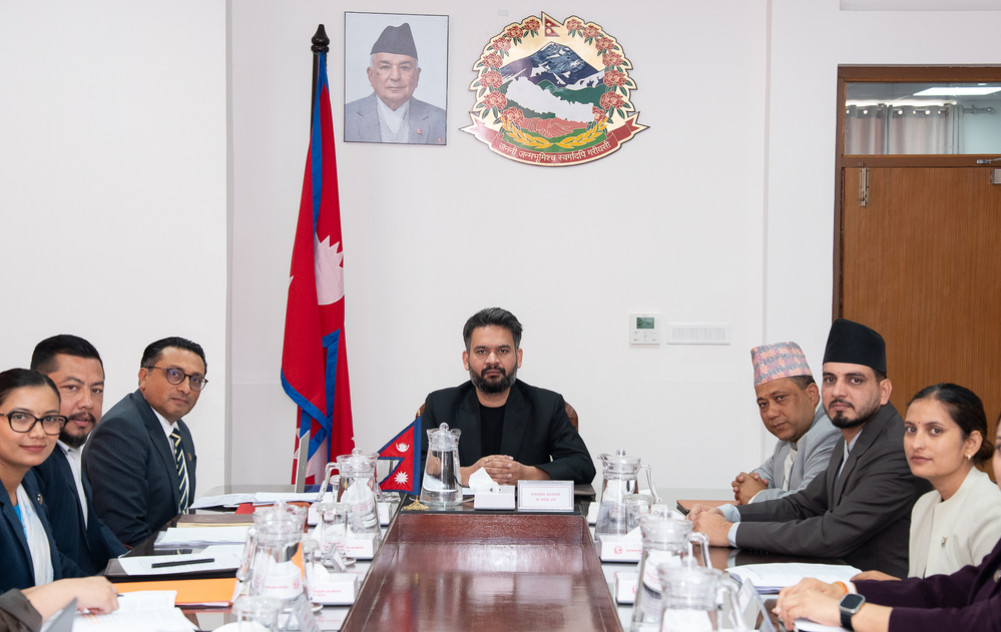
In a country that does not have resources, and does not mobilize the resources it has, the development of that country will never be possible. This is an eternal truth. This truth should be understood not only by Prime Minister Balan and his associates, but also by leaders in decision-making positions of all parties.
We use Google Cloud Translation Services. Google requires we provide the following disclaimer relating to use of this service:
This service may contain translations powered by Google. Google disclaims all warranties related to the translations, expressed or implied, including any warranties of accuracy, reliability, and any implied warranties of merchantability, fitness for a particular purpose, and noninfringement.
The Nepali people have expected a 'miracle' from Prime Minister Balen Shah. That miracle has no shape or definition. Prime Minister Balen has instilled hope in the hearts of the people. That's all.
Although such hope is good for Prime Minister Balen, even if he can instill hope according to the expectations of the people, he is not in a position to give confidence. After assuming the reins of power as the Prime Minister, Balendra Shah has made two big decisions. First, he has removed Minister for Labor, Employment and Social Security Deepak Shah from his post. Second, he has relieved the incumbent Home Minister Sudhan Gurung from his responsibilities as Home Minister. How favorable or unfavorable will his dismissal of two ministers from the Council of Ministers within a few days of the formation of the Council of Ministers be for him? Reactions are yet to come on this. For now, everyone has praised his move. However, these events may also create an unnatural situation for the Prime Minister in the near future.
As per the Prime Minister's instructions, bulldozers have started moving in the huts and huts of the squatters. He was supposed to do this work when he was the mayor of Kathmandu city. He did not pay attention to that at that time. Most of the settlements known as the 'squatters' are under the control of the 'hukumvasi'. Where will the Prime Minister take that crowd of squatters and put them? Last week, Prime Minister Balen has started the work of removing the squatters who have built their houses on the banks of the rivers and canals of the Kathmandu Valley. As per the Prime Minister's instructions, dozers have started moving on the huts and huts of the squatters. He was supposed to do this work when he was the mayor of Kathmandu city. He did not pay attention to that at that time. Most of the settlements known as 'squatters' are under the control of 'hukumvasi'. Where will the Prime Minister take that crowd of squatters and put them? Now this question has arisen in everyone's mind. After removing the squatters' settlements, the rivers will also have to be cleaned. It is certainly a good thing for the Prime Minister himself to take initiative in the work that should be done by the local level. However, this is also a painful issue.
Nepali society, which has been operating under a centralized state system since the beginning of history, has only recently embraced the federal system. However, due to the rebellious nature of political party workers, the arbitrary behavior of leaders and the restrictions placed on the media, the voices, expressions and opinions of the people have been ignored. The processes of nation-building remain incomplete until the sentiments of the people of all seven provinces in the country are transformed into national sentiments. Political parties should pay attention to this matter. However, neither the new party nor the old party seems interested in this matter. It seems necessary for Prime Minister Balen to take action on these issues as well. There is no moral basis for members elected to parliament from the National Independent Party to continue enjoying the privileges of parliament until they actively work in their respective fields as members of parliament. At one time, in Germany, the slogan 'Hail Hitler', the father of Nazism, was chanted and the people were forced to follow his every order. The same thing is now being tried to be implemented in Nepal as well. The way social media has been misused to bake their political bread, the chaotic situation will not end until it is stopped. The number of people who join the ruling coalition for the convenient politics of the leaders in the country is not small. Moreover, the slogan of Balen Zindabad is being chanted all over the country. The country cannot develop by listening to or reciting 'Hail Hitler'.
Balen Shah's active role in the politics of 'rule-power' as the country's Prime Minister has been seen after the last local elections. Balen, who has been in office for three years after winning the post of mayor in the Kathmandu Metropolitan City elections, must have understood the importance of the 'musical chairs' game played in Nepali politics for the first time as the Prime Minister. If he succeeds in this game, it will be considered a good sign for the country. Balen, who is in a technical profession, has definitely understood the character of Nepali politics. He did not spend his entire term as the mayor. Balen's acquaintances say that when he saw his political future shrinking as the mayor of Kathmandu Metropolitan City, he thought of 'something big' at that time.
Of course, the Gen-G rebellion, which took place for the first time after Nepal entered the Federal Democratic Republic, inspired Balen to establish himself at the center of power. His moral support for that rebellion was clearly visible. A constitutional crisis arose in the country after the dissolution of parliament against the backdrop of the deadly uprisings of 23 and 24 Bhadra. The then Oli-led Congress-UML coalition government had not even had a sense of the major changes that the uprising could bring to national politics. Nor was the government in a position to handle the situation after the uprising. After the security establishment searched for an interim alternative, an electoral government was formed under the leadership of Sushila Karki. The
election established Balendra Shah as the senior leader of the National Independent Party and the country's Prime Minister. Balen's presence and charm as the leader of the National Independent Party almost dismissed most leaders of political parties including the Congress and UML from the national political scene. Balen Shah, who did not seem to have much interest in politics, was a familiar figure with people at the highest levels of national security. After Sushila Karki's arrival as the interim Prime Minister, political developments began to intensify. In the eyes of Prime Minister Karki, there was no question of Balen Shah and Sudhan Gurung not running. Prime Minister Karki never hid his affection, affection and goodwill towards Balen and Sudhan. He showered them with as much love as his own children.
In the elections, the leaders of the country's major political parties, the Nepali Congress, the Nepal Communist Party (UML), and the Maoists, who had gathered under the umbrella of the Nepali Communist Party, suffered a humiliating defeat. In the alternative, the National Independent Party (NIP), succeeded in winning the election results. As a senior leader of the party, Balendra Shah led the nationwide election campaign of the National Independent Party. In the elections, Balendra Shah defeated Communist Party (UML) Chairman KP Oli in his own constituency. This was a great achievement for Balen, but a big setback for the Oli-led UML.
The election campaign of the Rashtriya Swayamsevak Sangh (RSS) under the leadership of Prime Minister Balen has destroyed the two major political parties of the country, the Nepali Congress and the Nepal Communist Party (UML). General Secretary Gagan Thapa established himself as the decision-making body of the Congress, that is, the President, through a special convention of the party. However, neither the important leaders of the party accepted him, nor did the people believe him. If he had joined the election as the General Secretary together with President Sher Bahadur Deuba, who was injured in the Gen-G attack, his reputation would have been saved and the accusation of dividing the Congress would not have been made. However, that did not happen. He did not trust his voters in Kathmandu. He himself jumped from Kathmandu and reached Sarlahi to contest the election. However, unfortunately, a strong Congress leader like Gagan was defeated by Amresh Singh, who had just joined the Rashtriya Swayamsevak Sangh (RSS). All the big and small political parties in the country, including the Congress and the UML, are currently in a state of shock due to the pain of defeat in the elections.
The two big political parties of the country, the Nepali Congress and the Communist Party (UML), still do not seem to be able to make a realistic analysis of the national situation. Both parties have not been able to escape the shock of electoral defeat. The deadly attack on Congress President Sher Bahadur Deuba was planned. However, the leaders of the Congress have not been able to demand an investigation into the incident. The new and old leaders of the Congress have failed to stand up to it. This situation will not always remain.
Politics does not always run in a one-sided manner and should not be allowed to run. In recent times, the major political parties of Nepal have raised the slogan of development. However, it must have become clear to everyone that those slogans have proved to be hollow. Now, the people, influenced by Balen Shah and his sensitive personality, have voted for the party he is associated with, the Rashtriya Swayamsevak Sangh (RSS). If the expectations of the people are not met in the future, they have the right to change the government. No one can erase that circle of rights even if they want to erase it. There have been many uses for human development in all countries of the world. Development slogans are used by politicians in every country. Leaders of all political parties in Nepal who use development slogans do not seem to want to understand this.
Nepal's political world is decorated with the beautiful imaginations of leaders. That decoration will fade one day or another. Saying that new people do good is just a kind of fantasy. In a country where there are no resources, the resources that exist are not mobilized, the development of that country will never be possible. This is an eternal truth. This truth should be understood not only by Prime Minister Balen and his associates, but also by leaders in the decision-making positions of all parties.