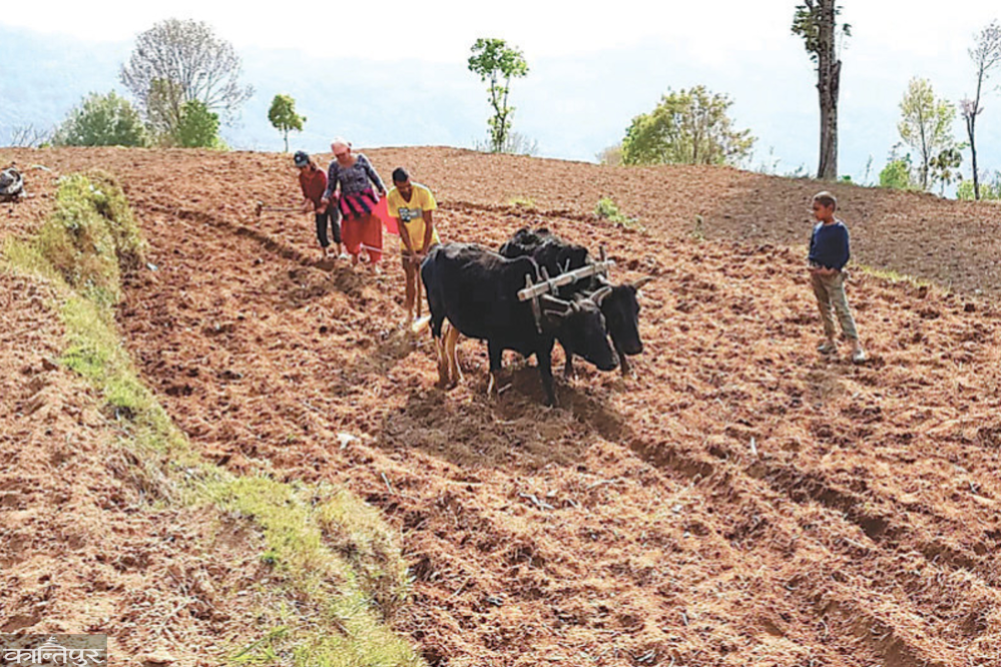
In a country like Nepal, with its diverse nature and abundant biodiversity, instead of advancing traditional natural farming systems, we have not only become dependent on imported chemical farming, but are also trapped in a cycle of invisible, slow poison. But why do our policymakers and planners continue to favor slow poison?
We use Google Cloud Translation Services. Google requires we provide the following disclaimer relating to use of this service:
This service may contain translations powered by Google. Google disclaims all warranties related to the translations, expressed or implied, including any warranties of accuracy, reliability, and any implied warranties of merchantability, fitness for a particular purpose, and noninfringement.
The government has announced that it will establish a chemical fertilizer factory in collaboration with the private sector and make special arrangements for its operation. It is regrettable that the Prime Minister, who wished good health on the occasion of the New Year, made such an announcement. Previous governments had also tried this many times. However, this effort has always failed. And, there should be no haste in building such a synthetic fertilizer factory. Living soil is the basis of life, and doing anything to kill it would be fatal.
In the modern era, synthetic chemical fertilizers and pesticides introduced with the 'Green Revolution' to meet the food needs of the growing population have now become a challenge for humanity over time. It is true that the use of these chemicals made it easy to increase production in the initial days and avoid immediate famine. However, its use over time has confirmed that living soil is dying. These chemicals are now having a deep and long-term impact on our soil, environment and human health.
In a country like Nepal with a diverse nature and biodiversity, instead of improving the traditional natural farming system and emphasizing imported chemical farming, we have not only become dependent, but are also falling into an invisible cycle of slow poison. But why do policymakers and planners continue to support this slow poison?
Nitrogen plays an important role in the cycle of making food or energy for all species in nature. Nitrogen is the main energy source of life in nature. However, due to the intensive farming system of a single crop, the amount of natural nitrogen in the soil began to decrease. To supply it, artificial fertilizers such as 'urea' produced by factories began to be used.
Due to the petroleum hydrocarbons currently used in urea production, heavy metals such as lead, mercury, arsenic and cadmium are mixed in the soil. These elements destroy friendly organisms and microorganisms in the soil.
According to a study, even with appropriate intervals and systematic use, only 30 to 50 percent of urea is usable by plants, while the rest evaporates into the air or mixes with water and is wasted. Chemical residues that mix with water reach rivers and groundwater. This makes drinking water toxic and destroys the biological cycle of aquatic organisms. The greenhouse gases emitted by these chemicals are damaging the ozone layer and intensifying the effects of climate change. Although they appear effective in scientists' laboratories and home pots, their use in the fields of ordinary farmers is not suitable in terms of both effectiveness and cost.
Another thing is that what we eat is the basis of our health. However, food containing chemical fertilizers and pesticides is not nourishing our bodies, but giving us diseases. Research has shown that crops grown with artificial chemical fertilizers lack essential nutrients such as iron, zinc, carotene and vitamin C. On the other hand, chronic diseases that are not currently contagious due to toxins such as cadmium and nitrates entering the body have spread as epidemics. This is due to the entry of these toxins into the body through food.
In a country like Nepal with a diverse nature and biological abundance, instead of improving the traditional natural farming system, instead of displacing it and emphasizing imported chemical farming, we have not only become dependent, but are also falling into a cycle of invisible slow poison. But why do policymakers and planners continue to support this slow poison? After the Second World War and especially since the 2030s, the widespread use of chemical fertilizers began in Nepal. After the development of seeds and fertilizers introduced with foreign aid and subsidies initially increased production, farmers who were facing a shortage of manpower were attracted to it. Presenting the difficulties in maintaining traditional family farming as a weakness, the state itself continued to encourage this, falling into the trap of external knowledge and commercial vested interests.
Our agricultural technicians, educated by external knowledge, technology, and concepts, left no stone unturned to declare local organic fertilizers and indigenous seeds unproductive. Even now, a section of policymakers and experts are advocating chemical fertilizers due to commission and greed. While even they know very well that such chemicals kill the soil over time.
Although ‘food sovereignty’ is written in the constitution, in practice, emphasis is placed on imported toxic fertilizers and seeds. Making this the standard of agricultural development is not only contradictory, but also an insult to our self-respect and self-respect. Even the current government has shown a tendency to shake its head in the fabric of making Nepal’s agriculture dependent and destroyed, which is unfortunate.
Can we produce agriculture without chemical fertilizers? The answer is not just ‘we can’, but ‘we must’. There is no comparison between organic fertilizers and synthetic fertilizers. No one needs these soil-killing chemicals except those who trade in synthetic chemicals, earn a living from them, and collect rent. Rather, farmers naturally need simple technology, knowledge, and skills to make organic fertilizers. The government needs to feel responsible to help in this task. If we want to care about soil and human health, food production without synthetic chemicals is the first condition. According to various studies, organic fertilizers are effective and sustainable in all respects.
Organic fertilizers improve the physical and biological properties of soil. They retain moisture in the soil and activate beneficial bacteria. In addition, making fertilizers from locally available cow dung, straw, and farm residues saves the cost of imported fertilizers. Currently, the government has spent more than half of the agricultural budget on buying these chemical fertilizers. If real farmers get this amount, this amount of nitrogen or more can be easily delivered to the farmers' fields. At the same time, thousands of youth can also get employment at the local level by helping in this work.
It is necessary to take practical steps to change the toxic farming system based on chemicals by reviewing all these things in depth and with self-awareness.
A clear policy should be made to give the local government the entire responsibility of fertilizer management, including the fertilizer currently in stock, and to provide a fair distribution of the government's resources for fertilizer management and such assistance to the hands of real farmers. If necessary, the province can be given a role and responsibility to help in this work. This allows the local government to arrange fertilizer management in the local situation and gradually reduce chemicals. A transition action plan should be prepared by assessing the risk of some decline in production immediately by going from chemical to fully organic. If necessary, the government should provide additional special subsidies and technical assistance to farmers to prevent such a situation from happening.
This is a common campaign to improve soil and farming. Facilitation and assistance should be provided to operate organic fertilizer industries at the community level using leaf litter and organic resources obtained from community forests, private and national forests. In such industries, organic fertilizers based on charcoal and fertilizers can be made from urban waste. Such fertilizers help to increase the amount of nitrogen and phosphorus in the soil naturally.
The issue of processing the rotting waste of the city and making fertilizers is in the interest of both the city and the farmers. It is also an opportunity to make money from waste. This fertilizer work also increases income and employment.
The use of artificial chemicals is a suicidal journey. Even if it gives temporary profits, it will leave only barren soil and diseased bodies for future generations. It would be wise to move forward by combining the natural farming system adopted by our ancestors with modern science. Only with self-respecting farmers, conscious citizens and responsible governments can we save our soil, environment and health . Replacing toxic chemicals and embracing organic agriculture is not only a necessity of today, but also a fight for our survival . The essence of the youth movement is certainly not to produce toxic soil and food . (The author is an agricultural expert)