Agencies that routinely work to control corruption are strained by bureaucratic hassles, political pressure, limited resources, and a lack of expert manpower. They may have lost public trust. At such times, those agencies cannot effectively investigate assets.
We use Google Cloud Translation Services. Google requires we provide the following disclaimer relating to use of this service:
This service may contain translations powered by Google. Google disclaims all warranties related to the translations, expressed or implied, including any warranties of accuracy, reliability, and any implied warranties of merchantability, fitness for a particular purpose, and noninfringement.
Gen-G had protested on 23 and 24 Bhadra demanding an end to corruption and good governance. At least 76 people lost their lives during the protest. After the protest, the demand for an investigation into the assets hidden through corruption became even more intense. Then, in the manifesto prepared for the Falgun 21 election, the major political parties expressed their commitment to investigate the assets of high-ranking individuals.
The third point of the 100-point pledge issued by the National Independent Party before the election states that the assets of those occupying important public positions since 2046 BS will be transparently investigated according to the legal process and that a clear procedure will be prepared and effectively implemented for the confiscation and nationalization of illegally acquired proven assets.
However, the scope of the authority has been limited by providing that this clause will not apply to officials who have separate provisions in the constitution and other laws. The National Independent Party won about a two-thirds majority in the election. Then, on Chaitra 13, 2082, the first meeting of the Council of Ministers held after the formation of the government under the leadership of Balendra Shah decided to form a powerful assets investigation committee within 15 days.
The committee to be formed in this way will be given the authority to collect, analyze and make recommendations on necessary documents, details and records, and the committee will collect, verify and investigate the assets of major political officials and high-ranking employees who held public positions from BS 2062/63 to BS 2082/83 in the first phase.
It has also been decided to investigate the assets of officials and employees of the same nature who held public positions from BS 2048 to BS 2061/62 in the second phase. However, the cabinet meeting on Baisakh 2 decided to form a 5-member commission under the coordination of former judge Rajendra Kumar Bhandari instead of a committee.
In fact, Part 21 of the Constitution of Nepal has established the Commission for the Investigation of Abuse of Authority to control corruption. There is a constitutional provision that the commission can investigate or have an investigation conducted in accordance with the law regarding any person holding a public office who has committed corruption and misused his authority. However, the scope of the commission has been limited by providing that this clause shall not apply to officials who have separate provisions in the constitution and other laws that have separate special provisions.
Similarly, the Department of Money Laundering Investigation has been working to control the assets obtained from criminal activities after the Money Laundering Control Act-2064 was issued. However, the demand for the formation of a Property Investigation Commission has been rising for a long time, saying that such bodies have not been able to effectively control corruption.
Similarly, the demand to investigate the assets of people holding public offices in Nepal is not new. The Property Judicial Inquiry Commission, formed in 2058 BS under the leadership of Judge Bhairav Lamsal, investigated the assets of more than 30,500 high-ranking political leaders and administrators. According to unofficially released details, the commission found that 80 people had undisclosed assets and 601 people had suspicious assets.
Similarly, the commission had questioned the assets of 26 judges. However, neither the report was made public nor could it be fully implemented. Now, a commission has been formed to investigate assets since 2048. In such a situation, it seems appropriate to look at the experiences of other countries in the world in investigating assets outside the regular bodies.
Foreign experiences in investigating assets
Bodies that are regularly working to control corruption suffer from bureaucratic hassles, political pressure, limited resources, and lack of expert manpower. The task of preventing corruption and controlling the laundering of illegal assets has become a challenge for developing countries, as the informal economy has a large share and is a challenge for developing countries. When regular commissions or other bodies fail to stop corruption in a country, are afraid to investigate powerful people, or the corrupt receive political protection, the level of corruption increases.
In such a situation, it is a practice all over the world for the government to establish special commissions to control corruption. Basically, special bodies are formed after major movements during political transitions or to end systemic corruption. Such bodies are given special legal powers, ranging from seeking expert assistance, and the responsibility of performing their duties quickly.
Bodies that are regularly working to control corruption suffer from bureaucratic hassles, political pressure, limited resources, and lack of expert manpower. In some cases, such bodies may have lost public trust.
In such a situation, such bodies cannot effectively investigate property. A commission established in special circumstances gets the special right to view and investigate property records from years ago. In this way, the involvement of an impartial person instills trust in the general public. Such bodies are given special jurisdiction to focus only on the assets of certain high-ranking officials.
Special mechanisms and achievements formed by various countries to investigate corruption and confiscate assets
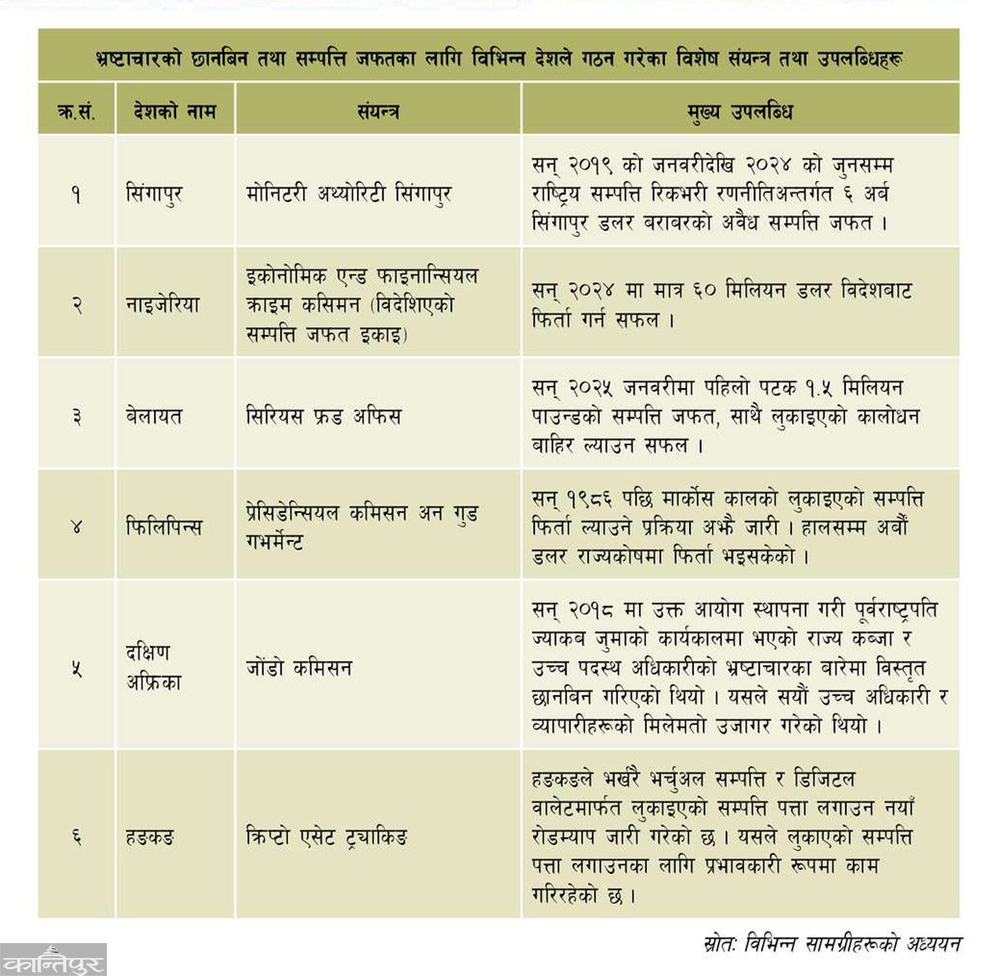
After a change in political system or regime, many countries around the world have formed special bodies to investigate corruption and money laundering of high-ranking officials. The most prominent example of this is the Presidential Commission on Good Government of the Philippines. The commission was formed in 1986 after the fall of the Philippine dictator Ferdinand Marcos. Its main objective was to search for and nationalize the assets hidden by the Marcos family and people close to them.
Georgia introduced a law to confiscate the assets of anyone who could not show the source of their wealth. This act helped Georgia become a country with less corruption in a very short time. The commission succeeded in repatriating a large amount of money from banks in Switzerland and other countries in about a decade and a half. Another example is Italy's Clean Hands campaign. The anti-corruption campaign in Italy in the 1990s shook the entire political structure. The commission formed subsequently brought the then prime minister and even big industrialists to justice for embezzlement of state funds, and the looted assets were returned.
Similarly, after the Rose Revolution in 2003, Georgia took drastic measures to end corruption in the police and civil service by dismissing thousands of employees at once and conducting asset searches. Georgia introduced a law to confiscate the assets of anyone who could not show the source of their wealth. This act helped Georgia become a country with less corruption in a very short time.
Looking at the experience of these countries, strong political will is required for special bodies formed for property investigation to be successful. In addition to this, three other prerequisites are seen. The first is legal autonomy. Such special mechanisms should be given the authority to arrest, freeze bank accounts, and coordinate with international bodies such as Interpol regarding assets abroad. Second, experts in various subjects and fields should be included in the commission.
Since property investigation is a very complex subject, the participation of experts is a mandatory prerequisite. Third, a clear procedure for confiscation of assets should be determined. Special bodies should not only investigate but also have a clear legal provision to nationalize proven illegal assets, which should be passed by parliament. Looking at the experience of foreign countries, in some countries they seem to be successful because of political will, legal autonomy, and clear legal provisions to nationalize illegal assets, while in some countries the process seems to be prolonged due to political vendetta.
The commission to be formed in Nepal should also include experts in the commission who can follow digital footprints in coordination with the National Bank and international agencies. In such a situation, in addition to the above three issues, it seems that in order to make the commission recently formed by the government in Nepal successful, it is necessary to pay attention to the following issues. First, arrangements should be made for the person concerned to provide evidence during the investigation. In general criminal law, the person is presumed innocent until proven guilty. However, in property investigations, many countries place the burden of proof on the person. If someone's lifestyle and assets do not match their source of income, the person concerned should take the responsibility of proving that the assets are legitimate. Nepal's Anti-Corruption Act has also made this provision. Therefore, this concept should be strictly implemented.
Second, there should be arrangements for the use of information technology and digital tracking. In recent times, the style of corruption and hiding assets has become extremely complex. Rather than saving in land, shares, gold, or foreign banks, the practice of hiding or laundering assets through cryptocurrencies and fake companies has increased. The commission to be formed in Nepal should also include experts who can follow digital footprints in coordination with the National Bank and international agencies.
Third, there should be no statute of limitations and freedom from political retaliation. There is a legal system in Nepal that does not have a statute of limitations in terms of investigating corruption. Therefore, in some cases, if the investigation requires investigating assets dating back to the Panchayat period before 2046 BS, the commission should be given the authority to do so. In addition, the investigation and investigation carried out in this way should be free from political retaliation and motivated by the objective of establishing the rule of law. If such a commission is made a weapon to intimidate the opposition, its legitimacy will end and it will not achieve its intended purpose.
Fourth, the weaknesses in the existing law regarding the return of assets should be amended and necessary new laws should be created. While investigating illegal assets is one aspect, another important aspect is to bring back the illegal assets discovered through the investigation to the state treasury and use them for the development of the country. Although Nepal has already issued the Prevention of Money Laundering Act in 2064 BS, it should be further strengthened and implemented by signing 'Mutual Legal Assistance' agreements with various countries to bring back the money hidden abroad.
Autonomy is important for the commission to work effectively. For that, passing the newly formed investigation commission act through the parliament and moving forward will ensure its autonomy. This will instill confidence in the public that the commission is free from the shadow of the executive. In addition, arrangements should be made to take the help of experts in various fields (such as digital forensics, chartered accountants and legal practitioners).
नेपालले सम्पत्ति शुद्धीकरण निवारण ऐन २०६४ सालमै जारी गरिसके पनि उक्त ऐनलाई थप बलियो बनाउँदै विदेशमा लुकाइएको धन फिर्ता ल्याउन विभिन्न देशसँग ‘म्युचुअल लिगल असिस्टेन्स’ सम्झौताहरूमा हस्ताक्षर गर्दै कार्यान्वयनमा जानुपर्छ । The commission should provide progress reports to the general public through regular public hearings, press conferences and bulletins. साथै सुराकी तथा सूचनादाताको संरक्षणको सुनिश्चितता गरिनुपर्छ । भ्रष्टाचारबारे सूचना दिने व्यक्तिलाई इनाम र सुरक्षाको सुनिश्चितताले आयोगलाई थप प्रभावकारी बनाउन मद्दत गर्छ । त्यसले मात्रै सूचना तथा जानकारी भएका व्यक्तिले आयोगलाई सूचना उपलब्ध गराउन सक्छन् ।
नेपाल सरकारले पनि आयोगले प्रतिवेदन बुझाएपछि त्यो कार्यान्वयन गर्ने स्पष्ट समयसीमा र संयन्त्र निर्धारण गर्नुपर्छ । लम्साल आयोगको प्रतिवेदन जस्तै कार्यान्वयन नगरी थन्क्याउने हो भने यसले राज्यको स्रोतको दोहन मात्रै हुन्छ । त्यसैले प्रतिवेदनको कार्यान्वयन गर्ने समयसीमा तोकेर अगाडि बढ्नुपर्छ । त्यस्तो आयोगले सम्पत्ति छानबिन गरे पनि त्यसबाट प्राप्त तथ्यका आधारमा अख्तियार दुरुपयोग अनुसन्धान आयोगले नै विशेष अदालतमा मुद्दा दायर गर्नुपर्ने संवैधानिक व्यवस्था छ ।
त्यसैले सम्पत्ति छानबिन आयोगले अख्तियारसँगको समन्वय र सहकार्यका लागि कानुनी रूपमा प्रस्ट व्यवस्था गर्दा त्यसले छिट्टै परिणाम दिन सक्छ । त्यसैगरी, अन्तर्राष्ट्रिय समन्वय गर्ने कार्यमा नेपाल सरकारले आयोगलाई आवश्यक सहयोग उपलब्ध गराउनुपर्छ । हालको समयमा अवैध सम्पत्ति क्रिप्टोकरेन्सी वा विदेशी बैंकहरूमा हुने सम्भावना बढी हुन्छ । त्यसैले, संयुक्त राष्ट्रसंघको भ्रष्टाचार विरुद्धको महासन्धिबमोजिम अन्य देशसँग सूचना आदानप्रदान र सम्पत्ति पुनःप्राप्तिका लागि नेपाल सरकारले आवश्यक सहयोग उपलब्ध गराउनुपर्छ ।
अन्त्यमा, यदि आयोगलाई कार्यपालिका र राजनीतिक हस्तक्षेपबाट पूर्ण रूपमा मुक्त गर्दै र आवश्यक स्रोत तथा साधनले सम्पन्न गर्दै पूर्ण स्वायत्त बनाउन सकियो भने लुटिएको धन फिर्ता गर्न र सुशासनको नयाँ जग बसाल्न महत्त्वपूर्ण योगदान गर्छ ।