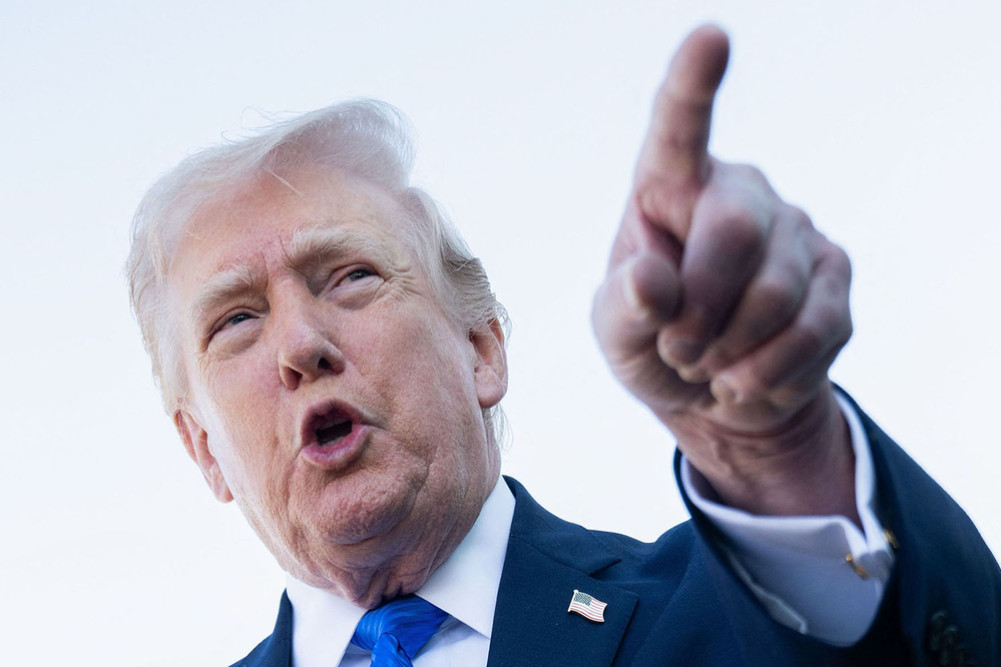
Professor Samuel P. Huntington, who concluded in his book that there would be war between bordering civilizations, would have to add a new chapter to his book if he were alive – and that the United States would lead the fight against such a civilization.
We use Google Cloud Translation Services. Google requires we provide the following disclaimer relating to use of this service:
This service may contain translations powered by Google. Google disclaims all warranties related to the translations, expressed or implied, including any warranties of accuracy, reliability, and any implied warranties of merchantability, fitness for a particular purpose, and noninfringement.
On April 17, 2026, US President Donald Trump announced that he would launch a devastating attack on Iran, and Aung San Suu Kyi declared, ‘The Whole Civilization Will Die Tonight.’ That is, Iran will be destroyed tonight, and with it a civilization. Coincidentally, that did not happen. The peace efforts being made behind the scenes worked, and the US declared a ceasefire for two weeks. Although the declaration of a ceasefire immediately ended the crisis, it signaled something serious. That is, the US attack was not aimed at the country of Iran or its radical rulers, but at an entire civilization. Iran itself is a country with a very ancient history and civilization. While extremism is dominating politics, it is a different matter that radicals are ruling there. The attack continues even though the US suddenly attacked Iran and killed more than 50 high-ranking officials, including its supreme religious leader, Ayatollah Khomeini. The recent announcement by US President Trump to attack Iran to end its civilization has raised the eyebrows of many in the international political arena. This has not only shocked and angered the Muslim world, but its effects have also begun to be seen regionally.
In this context, as predicted by Harvard University professor Samuel P. Huntington three decades ago, America itself has focused today's war on a clash between civilizations rather than on economics or ideology. In his widely acclaimed book 'The Clash of Civilizations and the Remaking of World Order' (1996), the American scholar concluded that there are basically eight civilizations (Western, Chinese, Islamic, Hindu, Orthodox, Japanese, Latin American, and African) that are dominant in the world and that the war will be between the civilizations that have the closest borders. After his article in the magazine ‘Foreign Affairs’ in 1993 sparked a heated debate, he probably didn’t expect that three years later, when he published his concept in a book, the US president would say in a rude way, “I will kill your civilization tonight.” Perhaps, if he were alive, he would have to add a new chapter to his book – and the fight against such a civilization would be led by America.
The US attack on Iraq and now Iran has emerged more than any other as a ‘clash of civilizations’, as Huntington called it. The Muslim community is also suspicious of America, and America is also distrustful of Muslim countries. We don’t have to go far, this issue is clear even if we look at American targets since the beginning of this century. The fact that the invasion of Iraq was not due to concerns about the proliferation of nuclear weapons, but to overthrow its arch-rival Saddam Hussein, was confirmed by the lack of any sign of nuclear weapons there, but it did not make any difference to the US. Also, civilization is found somewhere in the American invasion of Afghanistan, decades of investment and eventual failure. US President Trump's claim that the US will maintain peace by invading is nothing but the promotion of US civilizational hegemony. This attack on Iran without reason, justification and context has once again adversely affected the world order. International agreements, treaties, protocols, etc. are just for show, and the concept of realism put forward by power-loving scholars like Hans Morgenthau has once again been exposed as the main trend of today's world order. The fact that the US is not ready to confront sovereign countries one after another indicates a more sinister future. Until it realizes that others also have power, the US has received a strong license to continue in this way.
The world was already going through two major wars before the US attacked Iran. The Middle East has also been in tension for two years. When the Israeli-Palestinian war, which has been going on for half a century, reached its peak, Palestine was almost destroyed and thousands of innocent people lost their lives. The Palestinians, who have been gradually made stateless under the guise of power, are in the most dire crisis in history. Similarly, the ongoing war between Russia and Ukraine has not reached a permanent halt. Even if Ukraine has lost a third of its territory, Russia is not likely to achieve complete victory over it. At the same time, the sudden attack on Iran by the United States has caused more uncertainty, chaos and crisis in the world. One after another, events are showing that although it is in the hands of man to start a war, it is not in his own hands. However, as is said, even if not everything, at least the reins to stop the wars that are currently underway are in the hands of America. Even though President Trump is facing strong opposition in his own country, it has not affected him. The daily spontaneous demonstrations of thousands of people against the war, the strong editorials of newspapers, the sharp writings of scholars, the dangerous warnings of strategists and the sharp criticisms of politicians have not made any difference to Trump. Let's say that no one is against this inhuman war and it has not affected anyone.
Since Donald Trump's rise to power was due to the announcement of placing white supremacy at the center, the policies he adopts are derived from that. Trump's campaign to deport illegal immigrants, ignoring the benefits of America becoming a country for everyone, is a continuation of his policy commitment. On the day Trump was welcoming Indian Prime Minister Narendra Modi to the White House as 'my good friend', he informed India of the last situation and brought more than a hundred Indian citizens to Amritsar with handcuffs and nails on their feet. This is a campaign that was started as an exercise to show that America does what it wants around the world, rather than out of the belief of keeping its own country safe.
President Trump's statement regarding the G-20 meeting in South Africa can also be understood as his hatred of a different race and civilization. He defined the freedom that South Africans achieved through a hard struggle under the leadership of Nelson Mandela as 'the property of white people was looted and driven away' and said that he could not go to such a place, which is an insult to civilization. During his first term in 2018, he insulted all African countries as ‘shithole countries’. Trump’s recent public insult of Japanese Prime Minister Sanai Takaichi, who visited the White House at his own invitation, has also been seen as a continuation of his hatred for other civilizations. Trump is not at all guilty of the intense protests in Japan and the embarrassing situation that led to the Prime Minister returning home and announcing that he would not visit the US in the future.
It is not acceptable to have political differences, to try your best to establish your dominance internationally, and to position yourself as a world leader in power politics. From our traditional practices to the most eminent scholars of political science, realism has been advocated that only a strong state can protect itself and its citizens. However, now, both the method and form of war have changed and there is a growing danger that it will lead to a direction that will never end. When human civilization is attacked, it will not hesitate to pay any price. Even its traditional allies are not willing to support the policies that America itself has now adopted. From waking up the sleeping president of a sovereign country in the middle of the night to killing key leaders, the world has been terrified. This has appeared to be more aggressive and brutal than the 'war on terror' that America launched after the attack on the Twin Towers in 2001.
The American attack on Iran was not for the Strait of Hormuz. It is just a way for Iran to find a point and use it for defense. Whether it is America's assistance to Ukraine or pressure on Latin American countries, it seems to be guided by dominance over mines and minerals. This policy of maintaining its dominance by fearing rather than creating more and more allies in the international arena has not only isolated America further, but has also made it very difficult for the president who will take office after Trump leaves in two years to correct America's wrong policies.
The world order has become unstable due to the US attack on Iran. The Iran-US war has affected the kitchens of every household in the world, especially due to the fuel crisis.
Nepal is one of the countries that is affected the most quickly when there is a war in any corner of the world. When the fighting in Kargil takes place, Nepali youth enter Nepal as corpses. When terrorists cut the throats of Nepalis in Iraq, Nepalese people stop breathing. And when the war between Russia and Ukraine rages, Nepali mothers' chests are torn apart by pain. When bombs are dropped on Israeli bunkers, the explosions are heard in the ears of our villages. The same thing is happening now. America is attacking Iran. The fragments of the fierce war that is going on in that land across seven seas are roaming around our country. There is a fear of which Nepali body will come back at any time, and the situation of millions of Nepalis who have lost their livelihood and have to return to Nepal is going to create a terrible situation.
According to the data released, there are about 1.9 million Nepalis working in the Gulf region. Nepali workers have become terrified due to the fear created when Iran, in anger at America, targeted American bases in neighboring Gulf countries. More terror is going on in the minds of our relatives in our villages. Even if the government safely rescues Nepalis in the Gulf, relatives who are in a panic thinking that they will have to hear the news they did not expect one day, it is not under Nepal's control. Although the Nepali generation that suffered the tragedy when Iraq attacked Kuwait in the 1990s was not there, the current generation did not expect that they would have to live in so much fear. The government has tried to assure that it has formed a task force to study the situation in the Gulf region, but this problem is not under its control.
Countries like Nepal, which have an economy dependent on petroleum products, are most affected by wars in oil fields. Despite being a country rich in water resources, where is there a place in Nepal that has not yet eliminated load shedding? Electric vehicles are starting to operate, in limited quantities. Apart from that, the use of induction cookers for cooking is very low. There is no area that is unaffected by the increase in transportation fares. From schools to food, from air travel to micro buses, the price increase has directly exceeded the projections of our statistics.
This is not just a problem in Nepal. Today, the world has become so interdependent that an unusual situation in one place cannot help but affect another place. The blockade of the Strait of Hormuz, one of the five major oil shipping routes to the world market, has also affected countries like ours that are not even known and export oil from third countries. The immediate effects of this war are dangerous, but the long-term effects for the world will gradually become visible like a slow poison. Let us hope that the ongoing talks between Iran and the United States, mediated by Pakistan, will yield meaningful results and the world will breathe a little peace after escaping this tragedy.
(UML central member Rijal studies, researches and writes articles on international relations)