Many leaders in the Congress have become irrelevant not only in terms of age, but also in terms of energy and competence. Those accused of violating discipline are also among them. The Congress leadership should have a plan and policy for the exit of all these tendencies.
We use Google Cloud Translation Services. Google requires we provide the following disclaimer relating to use of this service:
This service may contain translations powered by Google. Google disclaims all warranties related to the translations, expressed or implied, including any warranties of accuracy, reliability, and any implied warranties of merchantability, fitness for a particular purpose, and noninfringement.
In politics, neither victory is permanent, nor is defeat the end of everything. Every victory comes with a formidable challenge, while not everything is over after a defeat. Instead, the doors of new opportunities open. This is what has happened in the case of Nepali Congress President Gagan Thapa.
Friday's Supreme Court verdict has not only provided legal relief to Gagan, who suffered a crushing defeat in the February 21 election, but has also opened a new door for political revival. A bench of Supreme Court Justices Saranga Subedi and Nripadhwaj Niraula has given legal recognition to the Congress led by Gagan, who was unanimously elected at a special general convention.
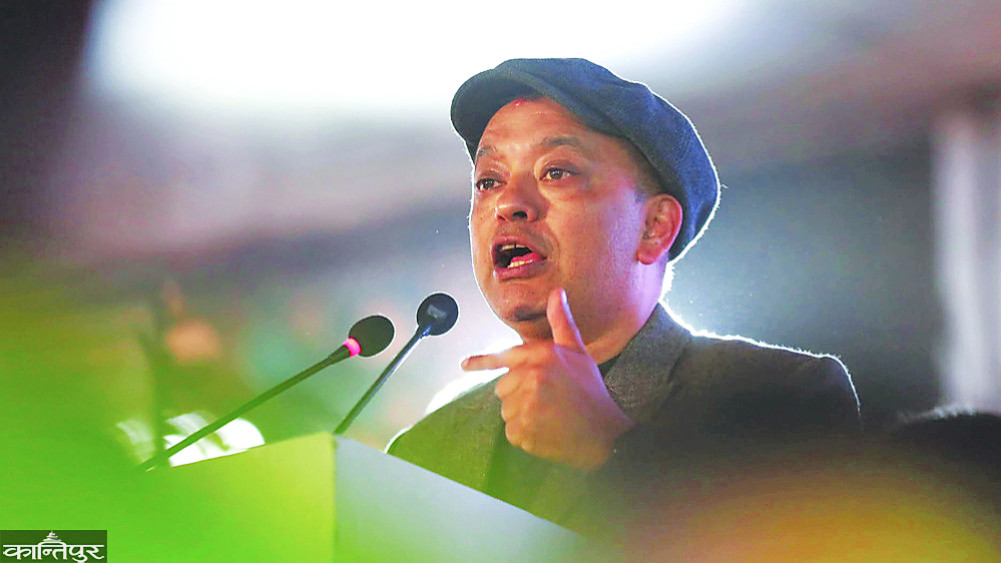
The Supreme Court's decision has brought a big wave in the internal life of the Congress. Gagan has called this decision an opportunity to strengthen the Congress. He has called on the disgruntled leaders and activists to come together, saying, 'It is not a matter of victory or defeat, but of the law, let us unite.' Gagan's confidence had been shattered after being defeated in the 'people's court' in the form of an election. He was in a state of almost depression, weighed down by the weight of the election results. Meanwhile, the Supreme Court verdict has given judicial approval to the method, methodology, and democratic practice. And, he has been presented as a carrier of the possibility of giving new life to the legacy of the Congress, which has a political history of seven and a half decades. He has once again entered into another great test.
The Supreme Court's decision has brought a big wave in the internal life of the Congress. Gagan has called this decision an opportunity to strengthen the Congress. He has called on the disgruntled leaders and activists to come together, saying, 'It is not a matter of victory or defeat, but of the law, let us unite.' Other office bearers of his party have also advocated for a united Congress.
After the decision, former President Sher Bahadur Deuba's party leaders, who were engaged in discussions to formulate their group's strategy, have said that they will accept the court's decision despite their disagreements. However, they did not have the option to disobey the court's decision. Even though Bimalendra Nidhi, a leader close to the Deuba group, reacted impulsively not to accept the leadership of the special general convention, this group has only two options: to merge with the Gagan-led Congress or to start a new political journey by opening a separate party. Now, this group has adopted a 'wait and see' strategy, saying that the responsibility of unifying the party has fallen on Gagan's shoulders. In other words, the ball has completely fallen into Gagan's court.
The question arises, what will the Congress be like now under Gagan's leadership? He has presented himself in a soft style, saying that he will build a united party and bring everyone together. Does he want to take the Congress forward with its old inept organizational character in the name of unifying the party? After being elected from the special general convention, Gagan claimed that the Congress had changed under his leadership. He also resolved to change the country with the changed Congress. However, the people did not approve of his resolution. In particular, the general voters did not believe his declaration that the Congress had changed. Now, to give the impression that the Congress has changed at the public level, should we strengthen the party's old organizational unity or adopt a new one?
It is today's bitter reality that an entire generation of the Congress has failed and become irrelevant. The party's software has become rusty and 'outdated'. Should we 'dentify' or replace the rusty party machinery in the name of unity? Will a simple 'dentification' alone restore the lost trust at the public level? There are many such tricky questions before the sky. The resolution of these questions will determine the future destination or destiny of the Congress.
The Congress, which has played a leading role in Nepal's democratic movements, is currently weak and defensive. Although it is numerically far below in the arithmetic of the parliament, it is the second largest party. That is, it is the main opposition party in its parliamentary role. However, at the moment, this party is in a serious transition. There is internal discord within the party, and it is also under intense psychological pressure in the national political scenario. How can the Congress, which is in a weak psychology, establish its changed perception at the public level? What will be the role and challenges of Gagan, who has been approved as the leader of the Congress as a whole? This analysis will focus on these issues.
The current destiny of the Congress is not accidental, it is a collection of long-term errors/weaknesses. To get the Congress out of this destiny and give the people confidence that it has changed, the first thing to do is to initiate reforms from the leadership.
The current fate of the Congress is not accidental, it is a collection of long-term errors/weaknesses. To bring the Congress out of this fate, the first step should be to start reforming the leadership to convince the people that it has changed. First of all, Gagan himself should be able to initiate reforms by introspecting on the weaknesses seen in his own role in the past. Under Gagan's leadership, the Congress was able to hold a special general convention. This defeated the tendency to violate rules and procedures. However, he was very late in making that decisive intervention within the party. Before the special general convention, he was the general secretary of the party. As the general secretary, he raised his voice against the unhealthy factionalism and undemocratic behavior growing within the party, but he was not able to make a decisive intervention.
He also put forward new thinking, working style and issues, but he could not become a result-oriented leader to implement them. On his own initiative and efforts, the party's operating calendar was created, various important events were organized, and attempts were made to make institutional reforms by holding regular meetings, but they could not be continued. Some of the references he raised were limited to promotional consumption. For example, he was one of the main leaders who demanded an investigation into the assets of high-ranking officials to maintain good governance.
However, even when his own party went to the government, he could not put pressure on the formation of such a commission. Now the government led by Balendra Shah has addressed his issue. No one else could play a pressuring role in making the government more efficient in providing people-oriented services. While taking the Congress forward from a new direction, Gagan should be able to take these and other shortcomings of his past as a lesson. The lesson is that it is not enough to just raise the issue, the leadership must also be able to implement it.
Second, the legitimacy dispute in the Congress is over now. The factional conflict has not ended. Gagan has the responsibility to manage the existing conflict within the party and change the Congress in a way that the people believe in. Can that responsibility be fulfilled only by managing the factions with different interests within the party? The biggest obstacle to Congress reform is the factional tendency that has grown within it.
Critics say that the issue of generational transfer was weak in the past because the Congress is just like a club of faction-driven interest groups. After the special general convention, generational transfer took place in the party, but factional politics could not end. The Congress is in a divided mindset from top to bottom. It is emotionally fragmented. Which issue came to the surface even more during the elections. There have been examples of leaders and workers not only not cooperating with their own party's candidates, but also not voting for them. The challenge of converting the political erosion that has reached this level into energy will not be possible only through faction management in the name of internal balance.
Third, the Congress has become a stronghold of factions, there is no emotional unity within it. Therefore, analysts have repeatedly suggested that reorganization is necessary. The Congress led by Gagan should initiate that reorganization. Indeed, the Congress has started a grassroots campaign to purify the organization from the ward level. By continuing this, the Congress should be able to build an organization with political/ideological clarity from the bottom up.
For example, Gagan has introduced the concept of social democracy as the party's political line. This concept should now be institutionalized. It is often accused that political discussions are less in the Congress. It is said that it has become more reactionary than creative national discussions. The current leadership of the Congress should be able to break through the theoretical apathy in the party ranks and walk on a clear political path. The policy of whose leadership should be adopted in practice.
Fourth, the Congress led by Gagan should move towards further institutionalizing the issue of generational transfer established by the special general convention rather than seeking management and balance of internal factions. Gagan has been saying that the faction will end now. Now it should end in a way that is felt by the cadres. The party should be reorganized based on efficiency and competence, given a decisive role to the new generation, and most importantly, a policy should be made for exiting the party.
Not only in terms of age, but in terms of energy and competence, many leaders in the Congress have become irrelevant. Those accused of violating discipline are also among them. Not only in terms of age, but also in terms of energy and competence, many leaders in the Congress have become irrelevant. Those accused of violating discipline are also among them. The Congress leadership should have a plan and policy for the exit of all those tendencies. This too should be done based on age, tenure, and efficiency, not on factions or leaders.
Fifth, this leadership of the Congress should be able to take a strong stand against good governance and corruption. It is not enough to bring cases, the Congress needs a leadership that takes action. The main reason for the breakdown of public opinion with the Congress and its credibility is that this party leadership has failed to provide good governance. Former Prime Minister and former President Sher Bahadur Deuba, who has been active in politics for a long time, is facing serious allegations of financial irregularities.
Even now, the government has issued arrest warrants for Deuba and his wife Arju Deuba. The notes found burnt in his house during the Gen-G movement have raised many suspicions and questions. Other leaders are also under question.
In this context, it is not enough for the Congress leadership to just bring cases in favor of good governance. It must be able to take action. At this time, that action may mean at least releasing leaders accused of corruption within the party and making public the assets of office bearers, including central members, and their MPs. Even if this is all that can be done, it will be an important step towards transparency and accountability.
Sixth, after the Gen-G movement and the recently held elections, there has been a major change in the power structure of Nepali politics. The newly formed party, which has not even completed four years of its establishment, has won almost two-thirds of the seats in the House of Representatives. The old parties, including the Congress, have shrunk considerably. It is as if these parties have almost severed ties with the new generation. After the Gen-G movement, Gagan made a lot of efforts to connect himself with this generation.
He tried to connect with the youth by being self-critical in the incidents of 23 and 24 Bhadra. During this, he also released several video messages addressing the Gen-G generation. However, this generation was not attracted to the Congress in the elections. Reviewing its shortcomings in the last attempt, the Congress led by Gagan should be able to give priority to connecting the party with this generation.
Seventh, the Parliament is an important platform for the Congress to show its strong role. Even though the number of MPs in the Parliament is low, the Congress is the main opposition party. In the general public, while looking at who can be the opposition voice in the Parliament, many eyes have been on the Hark Sampang of the Shram Sanskriti Party. यो बेला कांग्रेसले सदनमा आफ्नो भूमिका सिद्ध गर्ने चुनौती छ । मुलुकले शक्तिशाली जनमतसहितको सरकार पाएको छ । शासकीय सुधारका नाममा उनले सुरुवाती दिनहरूमा देखाएका हडबडी र अपरिपक्वताले एउटा बलियो प्रतिपक्षको आवश्यकताबोध हुन थालिसकेको छ । कांग्रेसको यो नेतृत्वले यसतर्फ पनि ध्यान दिनुपर्नेछ ।
आठौं, सबैभन्दा मुख्य विषय, कांग्रेसले असोजमा पन्ध्रौं महाधिवेशन गर्ने घोषणा गरिसकेको छ । त्यसकारण अहिले आन्तरिक शक्ति सन्तुलन र सबैलाई खुसी पार्छु भन्नेतिर नेतृत्व लाग्नुभन्दा पन्ध्रौं महाधिवेशनलाई परिस्कृत कांग्रेस निर्माण गर्न सक्ने ऐतिहासिक पानीढलो बनाउनेतिर केन्द्रित हुनु उचित हुन्छ । अहिले तल्लो तहबाटै पार्टी सुधारका लागि चलाएको जरा अभियानलाई निरन्तता दिँदै पन्ध्रौं महाधिवेशनबाट आन्तरिक लोकतन्त्रलाई संस्थागत गर्न सकेमा कांग्रेसमा भएको नेतृत्व रूपान्तरणले सार्थकता पाउनेछ ।
यतिबेला तत्कालीन कांग्रेस सभापति गिरिजाप्रसाद कोइरालाको एउटा अभिव्यक्ति स्मरणीय छ । २०६४ को पहिलो संविधानसभा निर्वाचनमा कांग्रेसले अपेक्षाभन्दा धेरै पराजय भोगेपछि कोइराला ‘पार्टी एकता ब्लन्डर भएछ’ भनेर पछुताएका थिए । कांग्रेस र कांग्रेस प्रजातान्त्रिक एकीकरण भए पनि यी भिन्न गुटहरूबीच भावनात्मक एकता हुन सकेको थिएन । अहिले पनि राजनीतिक, वैचारिक, कार्यक्रमिक वा भावनात्मक एकता होइन, गुटहरूको व्यवस्थापन गर्ने नाममा एकताको बाँसुरी फुकिँदै छ । तर, अहिलेको अहम् प्रश्न पार्टी एकता अथवा गुट व्यवस्थापन होइन, व्यापक रूपान्तरणसहित नयाँपन भएको कांग्रेस कसरी निर्माण गर्ने ? सायद यो बेला गगनको सबैभन्दा ठूलो चुनौती फनि यही हो ।