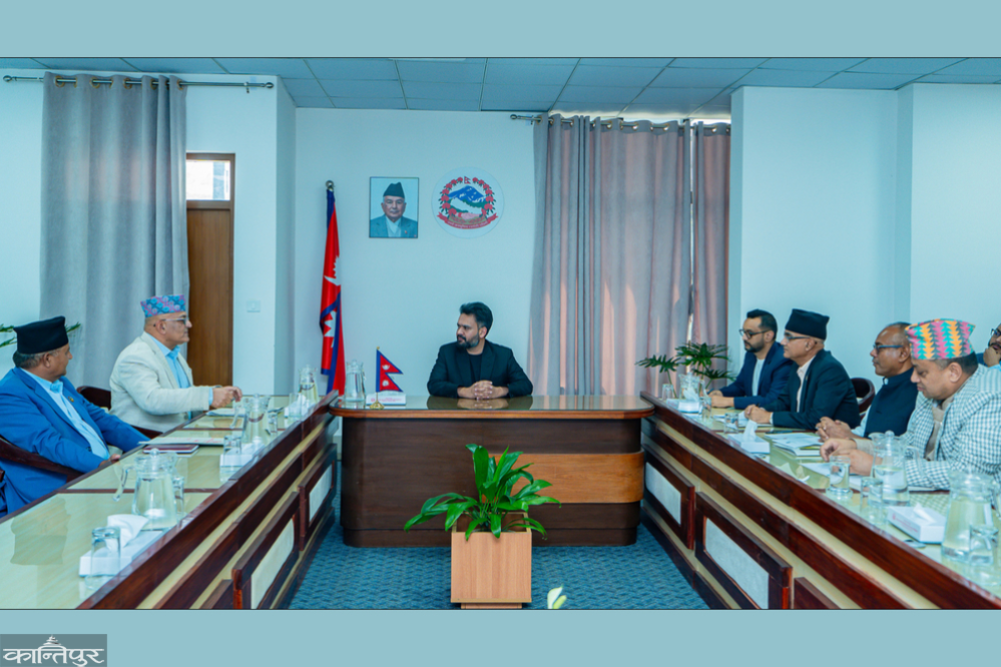
This time, Prime Minister Shah's initiative to meet the Chief Minister within three weeks of becoming Prime Minister can be expected to increase dialogue between the Union and the provinces in some way.
We use Google Cloud Translation Services. Google requires we provide the following disclaimer relating to use of this service:
This service may contain translations powered by Google. Google disclaims all warranties related to the translations, expressed or implied, including any warranties of accuracy, reliability, and any implied warranties of merchantability, fitness for a particular purpose, and noninfringement.
It has been eight years since the federal system of governance was implemented. In the meantime, 10 governments have been formed in the union. But the provincial governments have not been able to get the support they need from the federal government to implement the powers granted by the constitution.
Therefore, in every debate on the implementation of federalism, complaints such as the union not making the necessary laws, reducing the budget given to the provinces, and the prime ministers not being generous in strengthening the provinces have been given more space. The chief ministers have been excited by their first meeting with Balendra Shah, who became the prime minister after a strong government was formed in the union in the 21st Falgun election.
They have found that the prime minister is serious about addressing the concerns of the provinces and are confident of receiving support. Now, Prime Minister Shah should show a generous heart for delegating powers. If he is especially active in making the laws, providing the budget and facilitating the facilities that the union should provide, he will be recorded as a prime minister who carries the essence of the constitution.
On Thursday, the chief ministers demanded that the prime minister ensure the powers granted to the provinces by the constitution. Earlier, the Chief Ministers were dissatisfied because the police and employees were not adjusted, supplementary and special grants were cut, and the previous Prime Ministers presented the provinces as a unit of the union.
Stakeholders advocating for strengthening federalism and increasing its effectiveness had also highlighted the aforementioned problems. But there had been delays in resolving the legitimate and constitutional demands of the Chief Ministers. Some necessary laws had not even been enacted. For example, although the provincial government is responsible for peace and security within the province, the province does not have its own police.
Without a police act, the province is forced to depend on the federation for even basic issues like peace and security. In such a situation, it is becoming difficult for the provincial government to play an effective role. Meanwhile, those who are against federalism have been questioning the legitimacy of the province by pointing out the weak role of the 'powerless' province. The time has come to take a qualitative leap from such a situation.
There was/is doubt in Nepali society regarding the views of the Rashtriya Swayamsevak Sangh (RSS) as a party and Balendra Shah personally on the federal system. Nepali society is closely observing Shah's role in the province's affairs, as he did not vote for the province despite voting for the House of Representatives in the 2079 elections on the same day.
However, while addressing his first election rally in Janakpur on 5th Magh in Maithili, Shah had said that the province should be strengthened. And, the meeting with the Chief Minister on Thursday and the interest he expressed in solving the problems of the province have clarified many issues. Many aspects will be felt in practice in the coming days.
Mainly, he should be able to give up the greed of becoming strong alone and centralizing power. He should not concentrate as much power on himself, but should be liberal towards decentralization. This is the essence of the constitution, the formula for the success of modern democracy. Prime Minister Shah should be able to behave by becoming stronger and keeping in mind that no ruler has been successful.
Thursday's meeting is also positive due to the interaction between the federal government and the provincial governments. However, Article 234 of the Constitution of Nepal has provided for an Inter-Province Council to resolve political disputes arising between the federal government and the provinces and between provinces. But its concept is narrow. Because, the Prime Minister is said to be the chairman and the objective is to resolve political disputes. However, this is a proper platform to increase interaction between the union and the provinces.
However, not many meetings are held. This time, Prime Minister Shah's initiative to meet the Chief Minister within three weeks of becoming the Prime Minister can be expected to increase dialogue between the union and the provinces in some way. Such dialogue should be continued in the coming days. This will help in informing each other about their problems and difficulties and helping them solve them.
Before the election, Shah had said in Janakpur - I am going to visit Kathmandu, not to demand rights. Many people want to see this expression he gave in the name of strengthening federalism put into practice. For that, he should be clear that the provinces are not a government under him. Although the union and the provinces can cooperate, the union government cannot give instructions or force the provinces.
This should also be put into practice. The federal government should refrain from acts such as interfering with the rights of the provinces, obstructing the exercise of rights, criticizing, taking revenge, and viewing them as political vendettas. Priority should be given to the creation of laws related to civil service, education, police, land acquisition, forests, national parks, and public procurement, which are urgently needed to strengthen federalism and the provinces. If this can happen, the distrust between the federation and the provinces will be eliminated. It will also help to make the perception of the provinces positive. Federalism will mainly be successful.