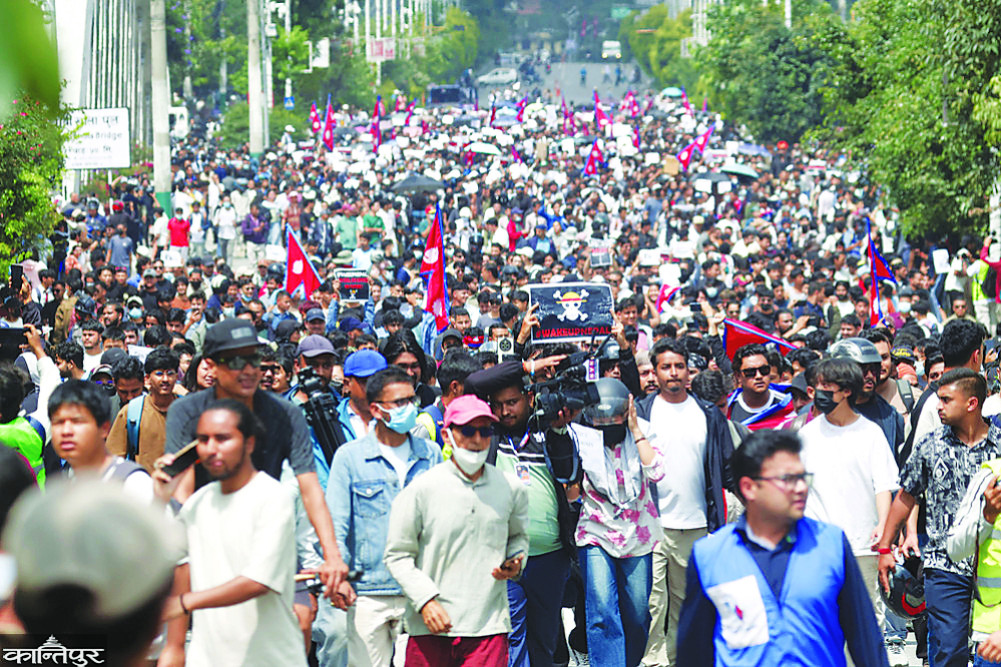
The real 'heartbeat' of democracy is the activism of the citizens. As long as this heartbeat remains alive, authoritarian thinking does not flourish. However, when the work of flattering the powerful by creating this or that commentary continues, the common people are eager to cheer on that power against themselves.
We use Google Cloud Translation Services. Google requires we provide the following disclaimer relating to use of this service:
This service may contain translations powered by Google. Google disclaims all warranties related to the translations, expressed or implied, including any warranties of accuracy, reliability, and any implied warranties of merchantability, fitness for a particular purpose, and noninfringement.
If a road is built but not maintained, it is not development. If there is representation but no voice is heard, it is not inclusion. If there is information but no accountability, it is not governance. But the question is – are the common people eager to question the power structure? Are the citizens themselves making efforts to bring their voices forward? These are not ordinary questions. There are scenes all around us where people who can speak deliberately prefer to remain silent.
‘Why do we speak?’, ‘What is the use of speaking?’ These sentences may seem ordinary. But, in fact, this is a sign of a serious deviation emerging within a democratic society. This mentality gradually transforms the citizen from an active actor to a passive spectator. A living citizen does not know when he becomes an ‘idol’.
When the road in front of his own house becomes inferior and we remain silent. When the construction of a public drain to drain the water of our own house remains incomplete for years and we leave it as ‘just the way it is’ – how do we understand such a trend? Is it just negligence or an erosion of democratic consciousness? Such silence draws invisible lines of irresponsibility on the canvas of democracy.
We speak on big issues, comment on world politics, but turn a blind eye to the small injustices in our own neighborhood. Isn’t this intellectual hypocrisy? In thought, we are ‘leap-frogs’, in practice, ‘sliders’. There is debate in tea gardens, mango orchards or poplar groves, but only to that extent, as long as it does not inconvenience the government. The silence expressed at the neighborhood, street-mohalla level, this local silence ultimately becomes the limitation of the national debate. When neighborhood corruption, poor construction, or service failure are not questioned, the community is unknowingly sending a message to the government, ‘You can go this far, we won’t say anything.’ And the government is waiting for such a signal. Gradually, the perimeter of this ‘this far’ is getting wider.
Today, the great controller of information is algorithms. Which video will go viral? Which issue will trend? Which voice will get ‘amplification’? All this is decided by an invisible market system. In this process, the right to know becomes subject to algorithmic priority. Today, the naming of a street, tomorrow the domination of a particular institution, and the day after that the creation of arbitrary laws. As Gramsci said, power is not only exercised by force, it is exercised by consent. And, that consent is often given through silence. The silence of the stakeholders is that consent. ‘He is elected, he will move on a little bit’ – such concessions gradually transform into a culture.
From this moment on, questions start to become dead, that is, they disappear, they remain silent. Gradually, a culture begins to form – ‘the culture of silence.’ In this culture, questions begin to feel uncomfortable. Criticism is called ‘negativity’. And, those who speak are considered ‘clumsy’ or ‘too reactionary’. This is the developing social environment, which gives the elected government the illusion that it is above questions. Its own favorable interpretation of the constitution is considered legitimate. Questions are not blocked, disagreements are not suppressed. However, it is limited so much that it becomes ineffective.
An elected dictatorial tendency may be growing in the surrounding environment. Even by looking at it, one might not know that it is ‘that’ form. Its charming appearance keeps everyone amazed and enchanted. Whoever has won the election is following the patronage moment by moment. Elected dictatorship does not come with a bang. It gradually becomes institutionalized by gaining acceptance in the minds of the people. It establishes silence in the environment by blowing the conch shell to bring out ‘flowers’. It uses democratic language, but inside it carries a deep intolerance – towards questions, criticism and accountability. Who, how and for whom does it decide? What was done, why was it done and what was the result? The government is not ready to give clear answers to these questions.
When opinion makers start giving the ‘benefit of the doubt’ to the orders, orders, whims and whims of ‘power and authority’, it becomes more dangerous than the justification claimed by the hypnotized class. If you have a box in front of you and you are only looking at six different parts of it, then the thought makers must be looking at the seventh part of that box as well. Like a cardiograph, on whose screen the heartbeat of a marriage is ticking, the real ‘heartbeat’ of democracy is the activism of the citizens. As long as this beat remains alive, the authoritarian mindset does not flourish. But, when this or that commentary is being made to flatter the powerful, the common people are eager to praise that power against themselves. The current crisis is the growing mobilisation of the ‘air-air intellectual class’. When scripted mantras like ‘let’s be positive, let’s be quiet’ start being chanted, then it becomes the welcoming song of the dictator.
No society becomes ‘dead’ all at once. It gradually loses its sensitivity. At first, he feels uncomfortable seeing injustice, but then he starts to consider it normal. And, eventually, he starts to ignore it. At first, injustice seems uncomfortable, then normal, finally invisible. If the powerful are not put under timely pressure for accountability, the definition of the relationship between citizens and the government will change. Right now, we are not just thinking about legal and administrative structures - we are talking about building a new governance culture through citizen activism, access to information and transparency. How many of us have questioned the injustices, irregularities or arbitrariness around us in the last one year? When we do not question and start thinking - this is 'normal', it is the nature of power to 'squeeze', then in fact the definition of 'normal' has changed.
Therefore, democracy is not defended only through large-scale movements, it is through small disagreements. It starts from the moment when a citizen says – ‘This is not right’. This sentence is short, but its meaning is deep. It informs the authorities that society is still aware, still sensitive and still has the ability to question. We are entering a new realm. There are new tools and new expectations. Today, the need is that we recognize our silence. Let us remember where we should have spoken. But we did not speak. Let us accept that our inaction is also a political act and has consequences.
Democracy does not die when the information we need to know is blocked. It begins to die when the flow of information begins to be so controlled that the gap between truth and demonstration disappears. Dopamine politics says – show results now. Democracy says – adopt the right process. The tension between these two is the real struggle today. The crisis today is not that there is no information. The crisis is that the right information, the right context, and the right questions are disappearing. Similarly, the government is presenting information in such a way that the citizen feels that he knows everything. The public gets information, but does not get the 'trick' of truth.
Who owns power, resources, and information? How are they influencing each other? The 'right to know' lies between this triangle - power, capital, and information. Where there is information, there is control. The right of the common people to know is not only transparency, it is also a struggle against the centralization of power. Democracy survives where citizens not only vote, but also ask questions. And, have the ability to get answers. Are we truly aware of this? Or are we seeing what is being shown to us? The government chooses rather than hides information. This is ‘selective transparency’, when citizens think they know everything when in fact they are only seeing a ‘curated reality’.
Democracy does not die when the information that is important to know is shut down. It begins to die when the flow of information becomes so controlled that the gap between truth and performance is erased. Dopamine politics says – show results now. Democracy says – adopt the right process. The biggest controller of information today is the algorithm. Which video will go viral? Which issue will trend? Which voice will get ‘amplification’? All this is decided by an invisible market system. In this process, the right to know becomes subject to algorithmic priority.
Hindi poet Kedarnath Singh has a line – ‘Silence is increasing, in all those places where it was necessary to speak, they are increasing, just as hair is increasing, nails are increasing and it is surprising that it does not even bother anyone.’ Why do some people keep quiet? Why do they keep quiet on issues of their own concern? There are many classifications of silence, but in our context it can be done like this. First, fearful silence – considering the risk of criticizing the government. Second, silence of consent. The ‘everything is fine’ mentality, such silence indirectly supports the government without opposing it. Such silence gives legitimacy to the government. Third, silence of indifference, this happens when the citizen starts thinking – what difference does this make to me? Fourth, strategic silence, this is a conscious and planned silence. In some cases, people are seen waiting for an opportunity to cover up the conversation or to avoid unnecessary friction. Some people sit patiently for some time in the season of 'wah wah'. Fifth, the silence of resistance - this becomes a moral statement against the government. Sixth, the silence of fatigue. When the hope of change diminishes. The psychology of saying, "What will happen if I speak up?" becomes dominant. Seventh, confused silence. When a person cannot be sure what is right? Then he remains silent. Eighth, coercive silence. Control over the media, legal or administrative pressure. Nine, the silence of privilege. When some class remains silent because it is not affected by the problem. Tenth, moral silence. The person knows that something is wrong. But does not have the courage or desire to speak up. This is the silence, which is often called silent participation. Keeping silent in the face of wrong often becomes part of the wrong. Keeping silent in democracy is also a political act. And, each silence stands in its own way for or against the government.
No society dies in a day. It slowly loses its voice, loses its questions, and ultimately ends up holding its consciousness hostage. Because democracy is not a distant object. It is present all around us, in our behavior and daily decisions.
Democracy is not just about being applauded. Keeping silent on everyday questions is an organized complicity, where the entire society is both a witness and a participant.