If we align structural management, production, and industrialization strategies, employment in Nepal will not be as difficult an issue as it has been analyzed as a crisis. Politics alone can guide the direction of production, industrialization, and employment.
We use Google Cloud Translation Services. Google requires we provide the following disclaimer relating to use of this service:
This service may contain translations powered by Google. Google disclaims all warranties related to the translations, expressed or implied, including any warranties of accuracy, reliability, and any implied warranties of merchantability, fitness for a particular purpose, and noninfringement.
One of the biggest crises in Nepal right now is the employment crisis. All parties agree on this issue. But there has not been a deep and constructive discussion on the originality of employment and the path to employment based on Nepali characteristics. There are many dimensions of employment. But among all those dimensions, the path to creating employment in Nepal is natural resources. It is necessary to increase the productivity of natural resources. In this article, how can production be increased by keeping natural resources? An attempt has been made to examine the dimension of which process can be used to industrialize and create employment. Especially, despite being rich in natural resources, employment has not been created in our country due to managerial weaknesses in productivity. In this sense, a fundamental path should be found for the management, protection and utilization of natural resources. The three main sectors for creating employment are the state, the private sector and cooperatives. The state's priority is on large physical infrastructure. Which cannot create many jobs. The private sector is in trade and services. This too has not been able to create many jobs. Cooperatives have not been given priority in Nepal. They are only involved in savings and loans. This sector is not involved in production, industrialization and employment. The role of all three parties should be towards increasing production. What kind of production should the state increase? What kind of production should the private sector increase? What kind of production should cooperatives increase? This issue needs to be discussed. But production must be prioritized. Therefore, all three sectors need to be restructured.
Land productivity and employment
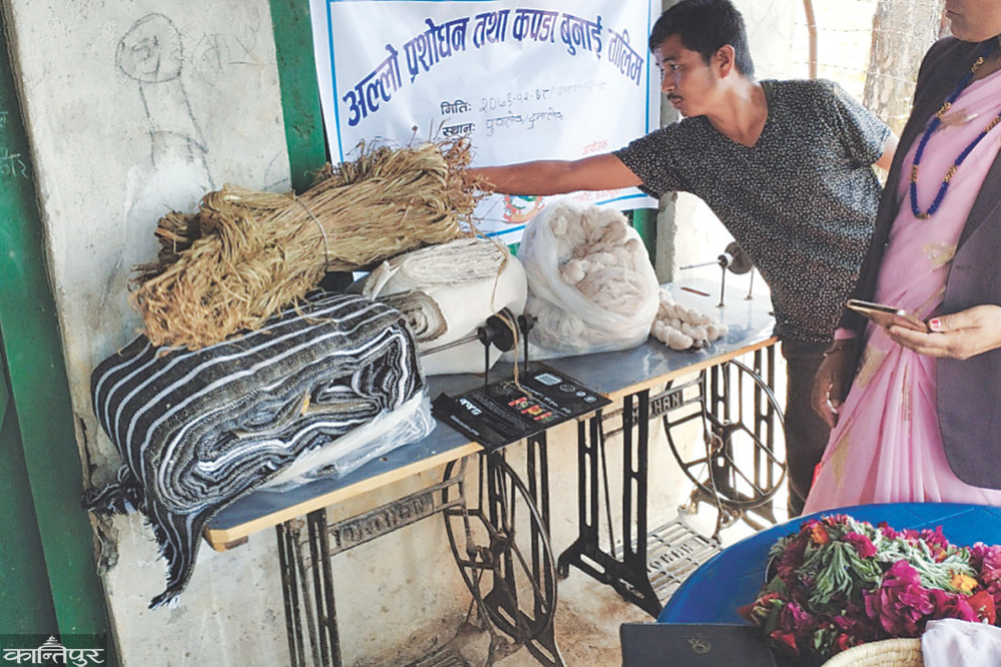
Let us discuss the first natural resource, land. There has been a lot of discussion on the distribution and ownership of land in Nepali politics. There was a debate on the slogan of land reform. One aspect of land reform is also to increase production. Now the possibility of land reform in Nepal has died. Whether land reform is needed or not is still a topic of debate. But there is no possibility of land reform immediately. Now a strategy should be found to increase production without land reform. When discussing land in Nepal, especially along with agricultural production, we should also discuss increasing the production of barren land. In particular, our agriculture should move forward based on the three-pillar principle. First, farming for food. Which does not create employment but helps to make food self-sufficient, which is a very important task. This work should be facilitated by the local government. Second, the production of crops with comparative advantages, which can be consumed within Nepal. The province should study and research this and facilitate high-value crops with comparative advantages at the community level in collaboration with the local government. 500 households in a village can grow beans. Those beans can be packaged and branded on the spot and taken to the market. If many households grow millet, measures should also be adopted to make millet husks and market them. If such work can be done, small-scale employment can be created at the local level. Such work can only be done based on local characteristics. In a study conducted by me in Ram Prasad Rai Rural Municipality of Bhojpur, it was found that at least 20 very small industries can be operated, that too based on natural resources. One conclusion of the study there is that if priority is given to small industries, there is a possibility of employment in Nepal. But the priority of such industries should be enterprises based on natural resources. Food production and industrialization also improve the relationship between villages and cities. Villages become centers of production, cities can stop imported food and eat their own village. Pride and identity also mix.
The third way is to produce goods like coffee and cardamom keeping in mind the international market. For this, the provinces can increase production in collaboration with the local government under the facilitation of the association by studying local characteristics. And, the three levels of government and the private sector should work in a coordinated manner to process the products on the spot and send them to the external market. Which can make Nepali agriculture export-oriented from import, must be created . This process increases local production . Strengthens the local economy . It also creates employment at the local level .
The trust of the local government should be increased . For this, the local government should be made stronger . The current problem of the local government is that they have very little money . They have to spend the money they have on physical infrastructure . If we are to take the path of creating employment by making natural resources productive, the provincial and federal governments should take the responsibility of physical infrastructure . The local government should be guided towards the path of local production, local economy, rural industrialization and employment . As far as the use of barren land is concerned, it is no longer possible to use it individually . The youth should be attracted to high-value products for barren land . The attraction among the youth can be increased through production subsidies and marketing arrangements . If the products of barren land are processed and brought to the market, they also get value . If we can organize youth in community groups, cooperatives, and public companies to move in the chain of production and industrialization, small jobs can be created. That is why we should not walk on the path of miracles, but on the path of small jobs.
If priority is given to small industries, there is a possibility of employment in Nepal. But the priority of such industries should be natural resource-based enterprises. Forest and water productivity and employment
Currently, the forest area in Nepal has increased to 46 percent. But we import wood and furniture from outside. What does it mean to increase the forest? Our forest management policy is very conservation-oriented. There is a belief that forests should not be used. Now the concept of forest use should be broadened in terms of policy. What should be the meaning of increasing the forest area is that it should help in the livelihood of the people. The difficult policies for forest use should be amended immediately and the forests should be used in four ways. First, we should become self-reliant in wood. Where wood can be cut, wood should be extracted after studying and researching. Wood should be extracted from the forest. But the method and process should be appropriate. Second, small wood-based industries should be increased. Wood-based industries can be established under the management of the private sector, cooperatives and public companies. Which also creates employment and prevents imports.
Third, herbal collection and processing can be carried out with the involvement of local governments and provincial governments in the financial management of the federal government. This work is currently very disorganized. A study has shown that the processing operations taking place in the Far West are being closed. The path of processing herbal products should be taken in collaboration with the government and the community. This program should be carried forward as a partnership between the government and the community by keeping it within the framework of state-protected industrialization. Which works to attract foreign exchange and create employment. Fourth, the concept of agroforestry. This means using the forest area to increase agricultural production without spoiling the situation. That is, it is to assimilate the concept of agroforestry. It is to do agricultural work within the forest based on local characteristics. This work should be done based on the community. Community forests can be taken on the path of agroforestry. Community forests can be made autonomous and turned into timber enterprises. For such programs, we should trust in community mobilization under the facilitation of the local government. This can create community economy and employment at the community level.
The fifth aspect is tourism. As soon as we say tourism, we understand it in a very high-fidelity way. Tourism should be promoted through different means, taking into account the diversity of Nepal's forests. Communities and cooperatives can also take forward such tourism as managers. Community forest groups are also suitable characters. Communities and cooperatives cannot provide all tourism services. At such times, the private sector should also cooperate with communities and cooperatives. This is also an opportunity for the private sector. In particular, in terms of increasing forest productivity, we should open the door to tourism potential, not just in timber, timber-based enterprises, herbs, and agroforestry. Currently, a systematic and organized campaign has not been launched to advance this potential. If this big campaign can be launched, it will provide a large amount of employment.
The current situation is that water is used only for hydropower. As a result, rivers have dried up. Biodiversity has been destroyed. The cultures of communities connected to rivers have been destroyed. Indigenous communities are suffering from the tendency to think of electricity as soon as they see a river. Rivers should now be considered as multidimensional uses. Multidimensional uses within tourism can include tourism with the culture of indigenous and tribal communities living on the banks of rivers, tourism related to fish, i.e. food, swimming tourism, and tourism related to rafting. It is necessary to study this further and highlight it. In particular, our means of employment should be made from natural resources. This is an advantage for a country with a small population and abundant natural resources. We have not been able to reap this benefit. Our politics has never prioritized this issue. We have not stopped saying that we are rich in natural resources, but we have not even arranged the management.
Startup Production and Employment Development Board
The chain of production and employment from natural resources has been discussed. Institutional management is necessary for this. The federal government can form a Production and Employment Development Board and connect startups to this process. The topic of startups has not been talked about for the past few years and there have been no positive results. This means that institutional management has not been achieved. Now, institutional management should be established and the creative potential of the youth should be transformed into programs and projects. If institutional management is done well, the hassle of employees is eliminated and the board is made empowered and autonomous, the creative potential of the youth will be revealed at one stage. It also becomes a place for the youth to use their discretion creatively. What the youth are thinking for themselves is expressed through programs and projects. One side is startups, the other side is the board itself conducting research and opening the door to production and employment based on regional characteristics. One area in this can be the area of indigenous peoples with cultural diversity, a different economy, and different knowledge, skills, and technology.
Similarly, based on natural resources and geographical characteristics, employment and economy can be strengthened by increasing production based on large geography and establishing small industries in the place where production takes place. Its three dimensions are clear. First, startups. Second, indigenous peoples' communities are special. Third, geography is special. If we combine structural management, production and industrialization strategies, employment is not as difficult an issue as it has been analyzed as a crisis in Nepal. Politics alone can guide the direction of production, industrialization and employment.
(Ghimire studies natural resources and local government)