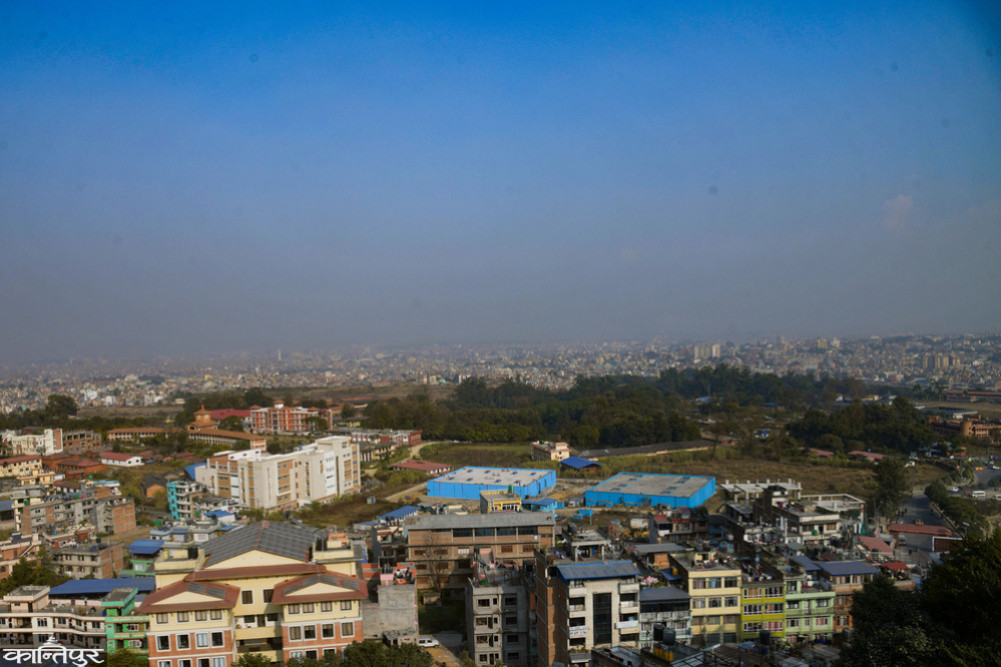
On the one hand, the encroachment of land, and on the other hand, the delay in returning it even after receiving information about it, shows how lax this organization has become. Therefore, it is necessary to actively take action against the encroachment and those who help in it to bring their land under their own ownership.
We use Google Cloud Translation Services. Google requires we provide the following disclaimer relating to use of this service:
This service may contain translations powered by Google. Google disclaims all warranties related to the translations, expressed or implied, including any warranties of accuracy, reliability, and any implied warranties of merchantability, fitness for a particular purpose, and noninfringement.
As the oldest university in the country, Tribhuvan University has many problems. One of them is land encroachment. Out of the 5,218 ropanis of land acquired by the government in 2013 and 2030 for the establishment and operation of Tribhuvan University, about 2,539 ropanis of land have been encroached. Although the investigation committee formed under the coordination of former Joint Secretary Mahendra Kumar Thapa submitted a detailed report on this to the then Prime Minister KP Sharma Oli on 2081, the process of returning it has not started.
On the one hand, the encroachment of land, and on the other hand, the delay in returning it even after receiving information about it, shows how lax this institution has become. Therefore, it is necessary to actively take action against those who encroach and help in doing so.
The report submitted to the then Prime Minister Oli on 2081 was not made public during his tenure. The Minister of Education of the Sushila Karki-led interim government formed after the Gen-G movement, Mahabir Pun, made it public on October 26. Both these governments did not prioritize the responsibility of returning the land of Tribhuvan University. Whereas, if the process of returning the land had been started by making the report public during Oli's time, the work could have been completed by now.
Even if it had been started during the Karki-led government, it would have been returned. On the other hand, Tribhuvan University has also decided to return the encroached land only on March 23. Tribhuvan University has made an 8-point decision on the issue of returning the encroached land. But what is the style of Tribhuvan University? Even the decision to make the report public on the university website for everyone's information has not been implemented.
The delay in implementing the report has raised questions. Such questions have also become stronger due to the involvement of former ministers, Tribhuvan University's leadership and many influential people and organizations. Therefore, it seems that the process of returning the land has been started only to deceive the public, but in reality it seems that the work has been done with a strategy that does not yield any results.
Since the land encroachment was due to the arbitrariness of the government and the negligence of the TU officials, the suspicion that the report will not be implemented at this time has become strong. The TU leadership should work honestly to get its land back and the government should support it. In addition, all stakeholders should create pressure for this work.
In the context of the fact that the land encroachment has been made public, it is now necessary to move forward with some work. First, the work of returning the land and the process of taking action against those involved in land encroachment should proceed simultaneously. TU's activeness is certainly necessary in this. It can only instruct those encroaching on its land to vacate through correspondence, and accordingly, the TU Executive Council has also decided to call for vacating within 35 days through a public notice. It is certain that TU's single effort to get the land back will not be possible. Therefore, the government should provide strong support and support to TU.
Along with the process of returning the land, action should also be taken against those involved in encroachment. Because, the investigation committee has also recommended that action be taken against those who illegally occupy and use the land of educational institutions through the authority and police administration. This is also logical. It may be a matter of giving priority only to returning the land now and ignoring the issue of action later. In particular, influential people and organizations can adopt a strategy to avoid action by returning TU's land to them.
There are such people and groups within TU who can create a situation where TU's decision is not implemented by confusing TU. The leadership level should be aware of this. Another reality is that TU cannot take action against encroachments. It has been said that the decision of the TU Executive Council will be sent to the Prime Minister's Office, Ministry of Education, Ministry of Home Affairs, Land Revenue, Surveyors, Authority, Vigilance Center, CIB and other concerned bodies. Therefore, all the aforementioned bodies should be positive in the process of taking back the land and taking action against the encroachers. The activeness of bodies like the Authority is expected.
The issue of taking back the land of Tribhuvan University and taking action against the encroachers is natural and must be implemented. Along with this, another important question is – ensuring that the land will not be encroached in the future. For that, it is imperative to have a debate on some issues. First, what is the policy of an institution like Tribhuvan University, which is open for educational and academic purposes, and what should be its land leasing policy? Although the issue of leasing land for educational and academic purposes or the practice of Tribhuvan University itself taking ownership of it can be adopted, the practice of leasing it for commercial and professional purposes should now be ended.
On the other hand, the government itself is seen to have been arbitrarily and eyeing Tribhuvan University's land. As a result, there are many institutions on Tribhuvan University's land, from cricket grounds to laboratory schools, Radhaswamy Satsang Vyas Nepal. Therefore, the responsibility of making the issue of land leasing clear lies with Tribhuvan University and the government. For this, TU can propose a law. The government can further enrich it and move forward with the bill.
Overall, at this time, the priority should be to return previously encroached land, take action against encroachers and government and TU officials who support them, and establish a strong mechanism to ensure that land is not encroached in the future.