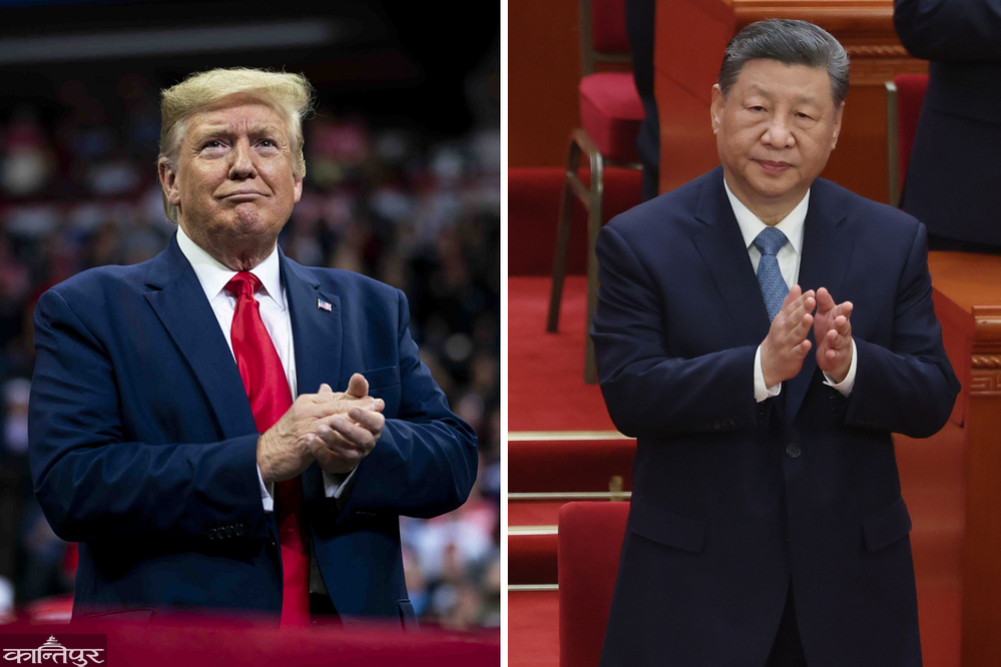
The US-China competition will depend on the strategic cultures of the two countries. The US is moving forward through pressure, military alliances and economic sanctions. China is becoming more influential in the world by expanding its economic networks, trade and diplomatic relations.
We use Google Cloud Translation Services. Google requires we provide the following disclaimer relating to use of this service:
This service may contain translations powered by Google. Google disclaims all warranties related to the translations, expressed or implied, including any warranties of accuracy, reliability, and any implied warranties of merchantability, fitness for a particular purpose, and noninfringement.
Sports metaphors are sometimes used to effectively illustrate world politics. A comparison between chess and Wei-chi (also known as Go) may be useful in understanding the growing strategic competition between the United States and China.
Wei-chi means to surround. Played on a large board with 361 intersections, the game does not have a king, queen, or hierarchy on either side. All pieces used as pawns are equal. In chess, all pieces must be moved onto the board at once, but in Wei-chi, pieces are moved only as needed.
The objective of the game is not to destroy the opponent's pieces, but to gradually expand your influence and surround more territory. Some of the qualities of Bagchalak, played in Nepal, are similar to Wei-chi. However, Bagchalak is played on a smaller board and with 24 pieces. Its perimeter is much smaller than that of Wei-chi. Needless to say, a smaller perimeter also means a smaller strategy.
Henry Kissinger, who introduced one of America's leading and influential strategists in the 20th century, described chess and Wei-chi in his book 'On China' published in 2011.
Wei-chi players can assess not only the pieces on the board, but also the potential reinforcements that the opponent can add. The game of chess is reminiscent of Clausewitz's concepts of 'center of gravity' and 'decisive point'. The game often begins with a struggle to capture the center of the board. His two main ideas about war are - identifying the main source of the enemy's power and attacking and destroying that main center.
According to the same strategy, the country seems to have come under the control of the US when Venezuelan President Nicolas Maduro was taken prisoner from his residence to the US. The US is currently in a state of ceasefire with Iran. Even after the assassination of Iran's supreme leader Ayatollah Ali Khamenei, the outcome of the war is likely not in America's favor if Iran itself cannot be controlled.
How is the US-China competition played out? This issue depends on the strategic culture of the nation. The US often tries to move forward through direct pressure, military alliances, and economic sanctions. American political scientist Robert Dahl has defined power as a relational and behavioral concept. He writes about power - 'A' has power over 'B' only to the extent that it can make 'B' do something that 'B' would not otherwise do.
According to Dahl's explanation of power, let's consider the current US as 'A' and other countries as 'B'. In the past, the US was in a position to control Venezuela and Iran just by talking. Some specific examples now show that this position is now weakening. The reason is that the US is forced to land on the borders of those countries! In addition, the US was also facing the challenge of increasing the dominance of the petro-dollar in the changed situation.
America's competitor is China. China's relations with Taiwan have been tense for the past few decades. Until recently, some Western analysts used to say that China could attack Taiwan in 2027. They probably no longer hold that view. Since China gained independence in 1949, its relations with Taiwan have not been good. China considers Taiwan an integral part of its territory, while Taiwan claims to be an independent nation.
On April 10, the leader of Taiwan's main opposition party met with Chinese President Xi Jinping in Beijing. The meeting was described by the BBC World Service as a rare meeting. Amid fears of a war between the two countries, Taiwan's main opposition party leader Cheng Li-won visited China for the first time in 10 years.
In 2016, Tsai Ing-wen, leader of the ruling Democratic Progressive Party, became president. After she said she would not support the one-China concept, Beijing severed high-level contacts with Taiwan.
It cannot be said that a high-level meeting between China and Taiwan will solve the problem. However, it seems that China is trying to take a different path when the world's most powerful country, the United States, goes to war with its opponents. This can certainly be called part of the Wei-Qi game strategy.
Let's look at these events through the eyes of the theory of chess and Wei-chi. A skilled chess player tries to eliminate the opponent's pieces one by one in a confrontation. Wei-chi players make their place in the empty spaces on the board. In this way, Wei-chi players weaken the strategic influence of the opponent's pieces.
The Chinese strategic tradition is based on the principle of long-term thinking, indirect pressure, and avoiding unnecessary confrontation. The ancient Chinese strategist Sun Tzu writes in his famous work, 'The Art of War,' 'The highest art of war is to subdue the enemy without fighting.'
This ancient idea is consistent with the philosophy of Wei-chi. The main strategy of war is not to defeat the opponent immediately, but to surround him from all sides and reduce his options.
The theory of international relations helps to understand this competition. According to ‘Offensive Realism’, propounded by American scholar John J. Mearsheimer, powerful nations always seek to expand their influence because there is no supreme authority in the international system. Mearsheimer says that the rise of China naturally creates competition with the United States. Mearsheimer’s book ‘The Tragedy of Great Power Politics’, published in 2014, provides five main foundations of ‘Offensive Realism’. The book also talks about the competition between the United States and China.
How is the competition between the United States and China played out? This issue depends on the strategic culture of the nation. The United States often tries to move forward through direct pressure, military alliances, and economic sanctions. China, on the other hand, mostly expands its influence by expanding economic networks, trade, and diplomatic relations.
America’s strategy often looks like a game of chess. Under President Donald Trump, the US has been trying to impose large trade tariffs on China, ban technology exports, and isolate Chinese companies from Western markets. The aim of such moves is to weaken the key capabilities of its adversary. The US is trying to strategically balance China by expanding military alliances such as NATO and partnerships in the Indo-Pacific region. The US has also formed Pax Silica in December 2025 to break China's monopoly on rare earth minerals in the world market. The tensions with Iran also provide a clear picture of these different strategies. The US has long sought to limit Iran through economic sanctions and military pressure. In particular, the US wanted Iran to not have access to nuclear weapons. China has taken a different path. Beijing has expanded its economic ties with Iran while maintaining close ties with Saudi Arabia and other Gulf states. China’s role in the 2023 Iran-Saudi Arabia agreement is an example of this strategic flexibility. In Wei-chi’s terms, China is expanding its influence by placing its pieces in different places in the same region.
The comparison between chess and Wei-chi is not a complete explanation of world politics. However, it does provide an effective metaphor for understanding the strategic differences between the United States and China.
If Wei-chi’s metaphor is correct, the outcome of this competition will not be determined by a major decisive event. Rather, who will have more influence at the world’s various geopolitical ‘intersections’? This issue will gradually surface.
Ultimately, the balance of power in the 21st century may be determined by who controls more territory, relationships and options – not by checkmating the king, but by encircling the entire board.
(Poudel is a correspondent for The Kathmandu Post and a student of international relations)