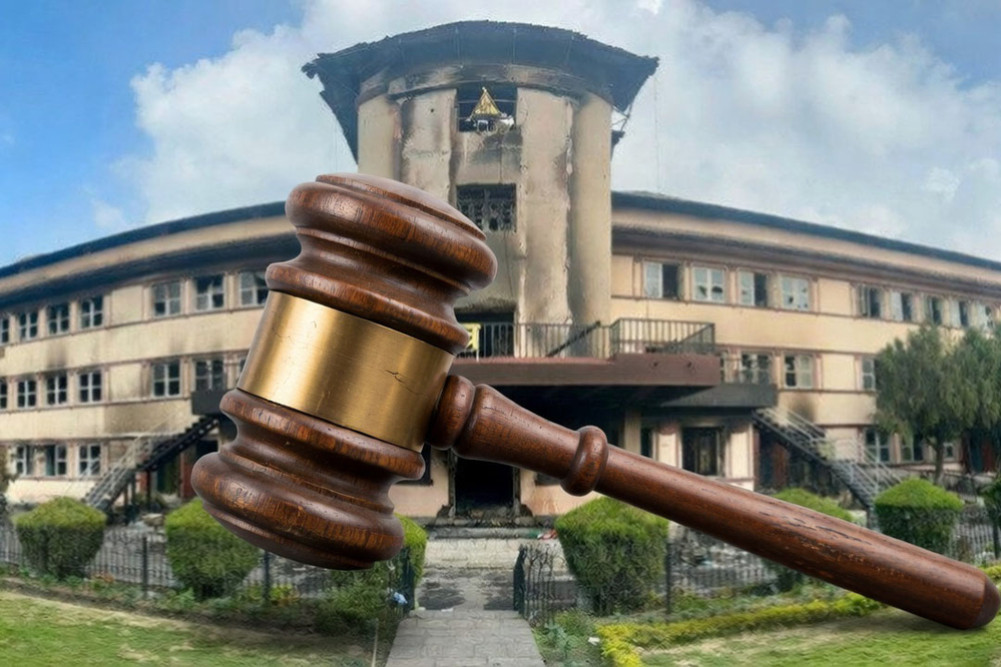
Failure to follow the Supreme Court's interpretation and principles is not just a technical error, it is a direct violation of Article 128(4) of the Constitution.
We use Google Cloud Translation Services. Google requires we provide the following disclaimer relating to use of this service:
This service may contain translations powered by Google. Google disclaims all warranties related to the translations, expressed or implied, including any warranties of accuracy, reliability, and any implied warranties of merchantability, fitness for a particular purpose, and noninfringement.
Every citizen who enters the temple of justice has the same expectation – that everyone is equal in the eyes of the law and that the process will be transparent.’ However, when, as a law student, I had to cross the administrative and mental walls to raise my questions at the doorstep of the Supreme Court, I realized that serious questions were raised about the rule of law. The recent contempt of court petition filed by me against a High Court judge and the subsequent unnatural events have exposed the impartiality of our judicial system and its tolerance for new legal thinking.
Precedent or legal principle?
The starting point of this debate was a writ petition (081–WO–2717) filed by me in the Patan High Court, where I challenged the illegal installation of ‘wheel locks’ on vehicles by the city and traffic police. In that debate, I presented arguments on clear legal principles promulgated by the Supreme Court, such as: that power cannot be exercised without law and that a legal person must act only within the limits set by law. However, the High Court did not accept those principles while making its decision, and remained ‘silent’ without even giving the minimum legal reason why they should not be applied. Here, many asked me – why did you directly file a contempt case instead of going to the Double Appeal (Dopa) after losing the case, when the legal principles were not followed?’ What I had to explain was, ‘Dopa is only a corrective measure, which corrects the decision, but my concern was related to ‘contempt’, i.e., judicial discipline and disobedience to the authority of the Supreme Court. If the lower court is allowed to deliberately ignore the principles promulgated by the Supreme Court, then I believed that the very foundation of the rule of law would be destroyed. Therefore, this was not for my personal discussion, but a constitutional obligation to protect the dignity of the judiciary.
Administrative obstacles and the torture of registration
The process of registering a petition became like a war for me. On 16 Chaitra 2082, when I submitted a petition in Field No. 4 of the Supreme Court, the head of the field asked, ‘Is there any contempt even if precedent is not followed?’ I clearly experienced how much obstruction there is in judicial access when the administration tried to make the decision to be made by the bench and when I was pressured to ‘refer my petition’ or withdraw it. Finally, only after the intervention of the city registrar did the path to the bench open for me.
The ‘unnatural’ presence of the bar
The scene that was witnessed in the Supreme Court bench on 18 and 19 Chaitra 2082 was a matter far beyond my legal understanding and normal judicial practice. At the initial stage of filing a petition, where only the petitioner and the judge were supposed to discuss the legal question, the active presence of the Nepal Bar Association and the President of the Patan Bar was in itself ‘unexpected’ and ‘unnatural’. In general, their presence ‘suo moto’ (spontaneously) without informing the parties named as opponents in the petition and without the formal involvement of the bar, gave rise to serious suspicions that this case was not being put under administrative or institutional pressure.
During the debate, the Honorable Judge advanced the argument that ‘society is dynamic and precedents change’. As a law student, I accept the fact that law should evolve according to the needs of society. However, my main question was – can legal principles established in the name of ‘changeability’ be simply ‘ignored’ without any consideration, refutation or argument? A judge can hold a different opinion from the principles established in the previous judgment, but for that, he must give a clear and logical reason why the old principle is not relevant. The silence on those principles in the High Court's judgment was a violation of the rule of law.
I was even more surprised when I heard the argument of the President of the Nepal Bar Association during the debate. On the one hand, he defended himself by saying, 'A judge cannot be made an opponent', on the other hand, he tried to divert the depth of my petition by saying, 'This is a matter of interpretation, sir.' What this unnatural presence of the Bar President and the defensive style of the bench confirms is that when brutal questions are raised about the shortcomings within the system, there is an organized effort to suppress and divert the subject in an institutional manner.
Intellectual luxury or rule of law?
As the debate continued in the bench, the presence of officials from the Nepal Bar Association and Patan Bar took a serious turn. They called my petition an ‘intellectual luxury’. Their argument was – ‘Such petitions instill fear in judges across the country and undermine their morale to administer justice independently.’ However, a fundamental question arises here – is it a luxury for a law student to question the loopholes and blatant violations of established principles in the judicial system? Or is it a necessary effort to bring this system back on track?
Not following the Supreme Court’s interpretation and principles is not just a technical error, it is a direct violation of Article 128 (4) of the Constitution. When the Constitution itself has made a binding provision that ‘everyone must follow the legal principles promulgated by the Supreme Court’, how can it be a luxury for the lower courts to try to correct them by ignoring those principles?
If lower court judges are given ‘immunity’ to flout the principles and precedents established by the Supreme Court and are argued that ‘judges are intimidated’ when they raise their voices against it, then the end of public trust in the judiciary begins right there. The essence of the rule of law is that judges should not be afraid to follow the law and principles, but should be held accountable for violating them.
I had said while standing in the bench – ‘If the basic legal principles raised in my petition are not attractive here, then let the bench legally refute each point mentioned in the petition.’ After my request, the bench replied that ‘we will refute everything one by one’. The full text of the order is yet to be made public. What I suspect is that instead of facing those core questions, the bench may adopt a ‘pick and choose’ strategy. That is, the petition may be ‘not registered’ by setting aside the main constitutional and doctrinal questions and only catching some minor or technical errors. If the court were to deviate in this way, it would not only be a dismissal of a petition, but it would also prove that the Supreme Court has deviated from its own pre-established principles and judicial accountability.
Conclusion
This judicial journey was not just a technical issue for me, it was a test of the accountability of the judiciary. The response of the bench and the bar officials made me realize how generous our system is to accept new legal questions. However, my faith as a law student has not wavered. Whatever the order, I am confident that it will define the boundary between ‘disobedience of principle’ and ‘contempt of court’ and will add a brick to the jurisprudence of Nepal towards building an accountable judiciary.
(Chaudhari is a law student. He has been filing petitions in the court on matters of public concern)