Since the 1990s, due to the unstable government, armed conflict, and then the transition to the drafting of a new constitution, the leadership has not been able to focus its attention on international relations. Due to our own internal problems and practical weaknesses, we have fallen far behind other countries. As a result, Nepal's international relations have become historically weak.
We use Google Cloud Translation Services. Google requires we provide the following disclaimer relating to use of this service:
This service may contain translations powered by Google. Google disclaims all warranties related to the translations, expressed or implied, including any warranties of accuracy, reliability, and any implied warranties of merchantability, fitness for a particular purpose, and noninfringement.
It was expected that Nepal's weak international relations would definitely be a priority for our new Prime Minister. But the question has been raised whether this area has not been a high priority for the Prime Minister due to limited activities. Before meeting the ambassadors last week, the new Prime Minister should have prepared some new ideas and strategic concepts for our international relations, but that did not seem to have happened. Although it is not appropriate to say anything hastily since it is the 'honeymoon time' now.
But in the current world perspective, it is absolutely essential for international relations to be a high priority for the Prime Minister. In the current globalization situation, international relations are directly linked to the economic progress of the country. In a sensitive and complex geopolitical background like Nepal, international relations seem to be even more linked to the existence of our country.
Historically, weak international relations
In countries like Thailand and Dubai, which were easy tourist destinations for Nepalis in the past, it is now difficult to get visas. This reflects our deteriorating international relations. While it is still very easy for citizens of other countries to get visas in these countries. Our neighbor India, which has more poor people than our total population, has a system of getting an 'on arrival visa' upon reaching both these countries.
With visas for many countries that were easy to obtain in the past becoming not only difficult but also impossible for Nepalis these days, Nepal's passport has ranked lower in the world list. Only 6 countries in the world (mostly war-torn areas such as Yemen, Iraq and Syria) have a lower passport rank than Nepal's. While preparing the world list of passports, the issue of how easy it is for citizens of that country to enter other countries is taken as an important basis. This ease is determined not only by economic relations with that country but also by diplomatic relations. Therefore, a weak passport rank shows weak diplomatic relations.
Once upon a time, our head of state, King Mahendra, had the opportunity to speak in the parliament of the most powerful country in the world, the United States. He was the first person from South Asia to address like that. Recently, it is heard that our Prime Minister did not dare to speak in the parliament of neighboring India. That is why some leaders of the Congress-UML also admit that international relations are weaker today than during the Panchayat era. Whereas in a democratic system where the people are sovereign, international relations should be the strongest in history.
When analyzing why international relations have weakened, political reasons seem to be the main reason. Since the 90s, due to unstable governments, armed conflicts, and then the transition to the drafting of a new constitution, the leadership has not been able to pay proper attention to international relations. Due to being entangled in our own internal affairs and practical weaknesses, we have fallen far behind other countries. As a result, Nepal's international relations have become weaker in history.
After the advent of the republic, some new initiatives were taken, but they were not enough to catch up with the rapid pace of the world. Prime Minister Baburam Bhattarai put forward the concept of Nepal becoming a bridge between China and India, but could not provide a clear blueprint for its implementation. Although international relations are included in the new constitution, it seems to have been given very little priority. It has been limited to a small section (not even a separate paragraph). The then NCP government, which had almost two-thirds of the seats, formed after the 2074 elections, also took some initiatives to organize international relations, but in practice, those initiatives were meaningless when relations with the closest neighbor deteriorated. Overall, our international relations did not get the new vision and clear theoretical ground needed to stand in a world that was changing at a rapid pace. Not only the
theory, but also international relations weakened in practice. Here, I would like to present an example of what two foreign ambassadors said in an informal conversation. A former ambassador had said, pointing to one of our leaders, ‘He does not do what he tells me to do and does not say what he does.’ Similarly, another ambassador had also said in one context that Nepali leaders had lied to him on some issues. The habit of some of our leaders who lie without hesitation in domestic politics had probably spread to diplomatic relations as well. But high diplomatic relations are based on trust in words. It seems that our international relations have weakened if we do not adopt even such simple conduct. Analysts say – Foreign leaders do not trust Nepal as much as Bhutan.
Continuation or a new leap?
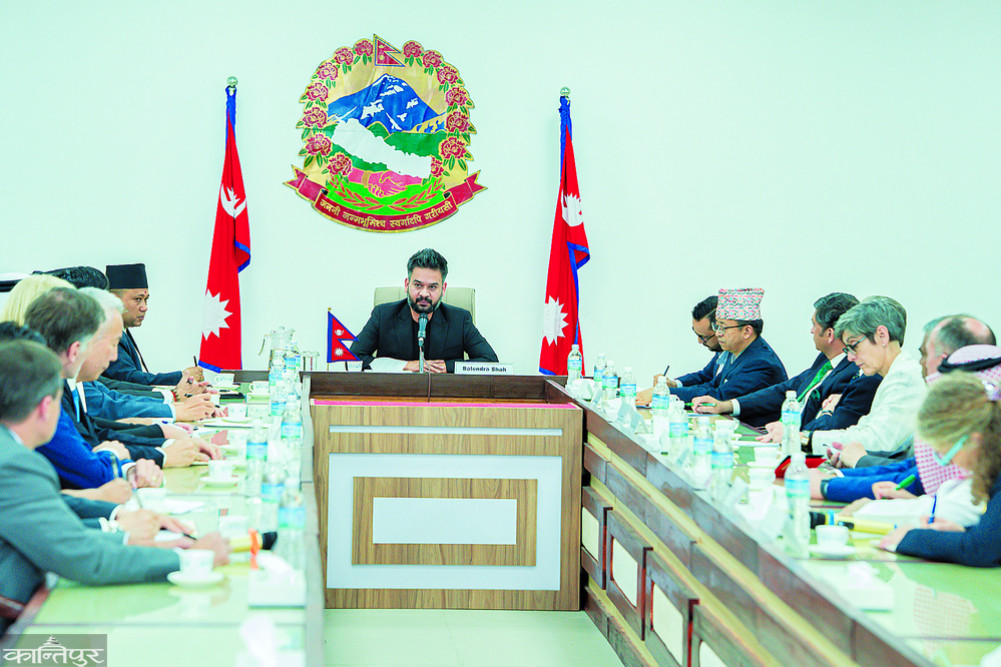
Last week, the media exaggerated the Prime Minister's group meeting with 17 foreign ambassadors and presented it as a miracle in diplomacy. While no new concept came from the Prime Minister. The group meeting he held is commendable. His presentation must also be called good. But more is expected from the Prime Minister of the country.
First of all, that meeting has raised the question of whether it is appropriate or inappropriate for a person of the Prime Minister's level to meet at the ambassadorial level. Ambassadors in most countries are of the civil service level of Joint Secretary. If we follow the norms of reciprocity in diplomacy, it cannot be considered appropriate for the Prime Minister to meet ambassadors in such a way. Meetings of Nepal's ambassadors, with a few exceptions, are limited to the head of the Ministry of Foreign Affairs. Why should our Prime Minister meet ambassadors from such countries?
Meeting ambassadors will not spoil anything, but our Prime Minister's priority should be to expand relations with his counterparts and other influential leaders abroad. In the past, our leaders failed to pay attention to this, and it was seen that Nepal's international relations could not rise above foreign employees. How can relations with higher leadership levels expand after increasing engagement with foreign employees themselves?
Even if we talk about behavior, the plastic drinking bottles on the table of the meeting between the Prime Minister and the ambassador spoiled the beauty of the atmosphere of that meeting. What message did plastic bottles spread across the table when demanding compensation for climate change at the international forum and meeting with international representatives send? The presence of women from Nepal was overlooked in the meeting. While gender equality is a priority for sustainable development of the United Nations. Such behavioral errors are due to the lack of a clear theoretical framework.
The new constitution has provided a basic framework for international relations. It envisions international relations committed to the sovereignty of the nation, the non-aligned policy, the principle of Panchasheel, international law, and the recognition of world peace. But this is just an abstract blueprint. It is not enough. There are many new questions under this broad framework, which should be clarified through the concept of the new government.
In Nepal's changed political situation, what kind of identity should be created for the country among the international community, so that Nepalis gain respect all over the world? How can we expand our international relations, which will have positive results in economic relations as well? At a time when the world is now moving from the single hegemony of the United States to a multipolar system, how can Nepal maintain its sovereignty by balancing power? Should it continue the non-aligned policy formulated in the specific context of the Cold War or adopt a multi-aligned strategy like India in the current world situation? How can we harmonize the country's security, economy, and foreign policy within the broad framework of international relations? Until a comprehensive concept is developed to answer such questions, it seems certain that weak international relations will continue even if a new government comes to power.
If we look at the example of our neighbor, Narendra Modi, upon becoming Prime Minister for the first time, gave high priority to international relations and put forward the concept of the 'Modi Doctrine' in his swearing-in ceremony. It also had a ‘neighborhood first’ policy. Perhaps due to his similar priorities, India is considered to have made great progress in its diplomatic relations. The number of countries granting free visas to India has increased from 52 to 62. Will our new Prime Minister also take a new leap in international relations like him?
New international strategy of the new government?
It is customary in many countries to issue a new strategic concept of international relations after the formation of a new government. This strategy guides the government’s foreign relations under a clear theoretical concept. For example, the principle of ‘progressive realism’ was adopted after the formation of the new government in Britain last time. Similarly, the concept of ‘pragmatic idealism’ was also adopted in Denmark. Such theoretical frameworks provide a clear blueprint for addressing complex international issues. In Nepal, however, such ideological frameworks do not seem to be given any importance.
Therefore, in some cases, it seems that there is a hesitation to adopt the policy that should be adopted. For example, during the Iran War or the Ukraine War, Nepal, which has a commitment to world peace in its constitution, could have raised its voice on the international stage to end the war and resolve the conflict through peace. Even if the powerful countries did not listen to Nepal, Nepal could have made its identity as a country that truly speaks for peace on the international stage. But it seems that our government has lost its confidence to do so. The new government has also not shown the initiative to prepare the necessary strategic concept to strengthen international relations.
Identity of a peace-loving country
Finally, I would like to add a personal incident of my own. A few years ago, a representative of Bhutan and I were together at a school program in Denmark. When the teacher there asked her students, ‘Do you know Nepal?’, the twelve- to fourteen-year-old children were confused. They had never heard of Nepal. But when she asked about Bhutan, the children excitedly started shouting, ‘You know, you know, a happy country, a happy country.’ Even now, remembering that incident, my heart is sad.
Bhutan, which is about 20 times smaller than Nepal, has earned the reputation of a ‘happy country’ and earned respect all over the world, so why shouldn’t Nepal earn its reputation as a ‘peaceful country’? We have abundant potential for this. For example, the Himalayas have been considered the birthplace of knowledge and peace for centuries. The birthplace of Buddha, who produced the wonderful knowledge of peace, is in Nepal.
It may be controversial to call the Nepalese state peace-loving, but there are sufficient grounds for the Nepalese people and society to be peace-loving. Perhaps, despite such diversity, there are few countries in the world like Nepal that are free from violence at the community level and have mutual harmony. To prove this, it is enough to look at the example of our neighbor India. Therefore, no one will object to Nepal establishing its identity as a peace-loving country.
But for that, like in Bhutan, the ‘concept of peace’ (in which justice is paramount) should also be the basis of our internal policy (a separate article is needed to expand on this). Only then will the international community believe and recognize our identity. With a single-party government with a large majority, the opportunity to do such a thing may never come again. But will our young Prime Minister make international relations his priority?
(Rana is associated with the international relations department of universities including Oxford)