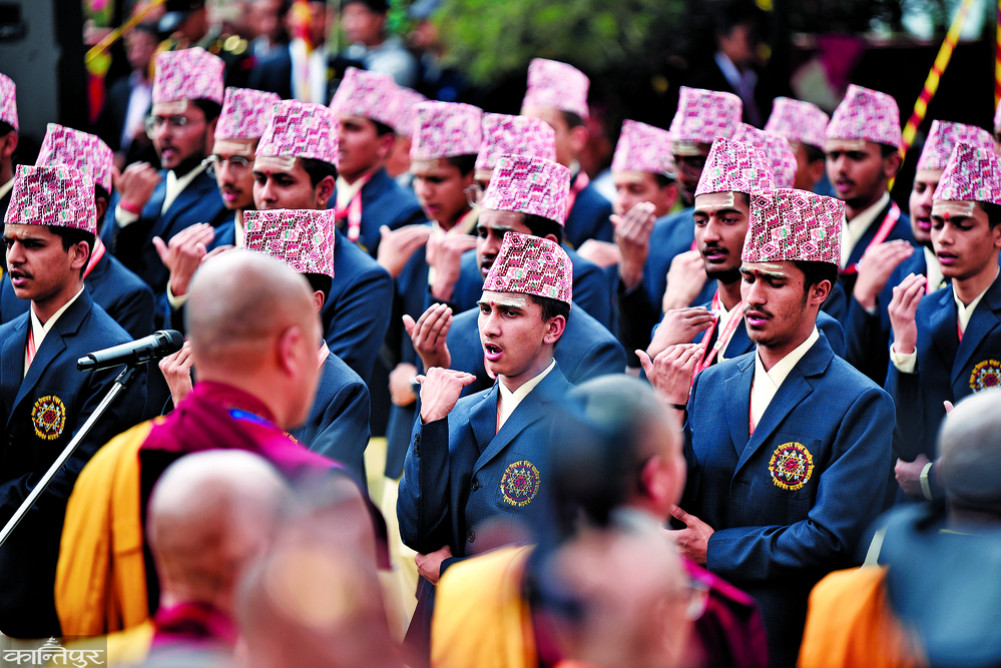
It is not an opposition to the public presence of religion, but rather to say, ”That religion is mine too,” to politicize religion and weaken the religious nationalism that is destroying power.
We use Google Cloud Translation Services. Google requires we provide the following disclaimer relating to use of this service:
This service may contain translations powered by Google. Google disclaims all warranties related to the translations, expressed or implied, including any warranties of accuracy, reliability, and any implied warranties of merchantability, fitness for a particular purpose, and noninfringement.
The religious rituals of Balendra Shah's swearing-in ceremony have left some people in awe, some with a headache. But for the common Nepali, it must have been a unique experience. Because this is the first time they have seen such a complex Batuk and a Buddhist monk standing together and reciting the Swasti.
Balen Chotila, Chokhila does not just write rap songs, he has become a poet himself, which is difficult to understand without explanation. Why is an explanation necessary, he has become the Prime Minister as the center of everyone's hopes and his party is present in the House of Representatives with almost a two-thirds majority.
The sound of nine conch shells, the recitation of the Vedas by 108 Batuks and the recitation of the Swasti by 107 monks are certainly dramatic performances, but limiting it to this is incomplete. It can also be considered a personal expression of a Nepali, his family, environment, and culture. But the reason why this religious and spiritual expression is so unique is that it does not match any religious model. Political expression has emerged in various forms in the politics of South Asia, including Nepal. One can take the Hindutva model of India's Bharatiya Janata Party, which resembles the tendency of politicians in Burma and Sri Lanka to associate the nation with Buddhism and the Islam brought by General Zia-ul-Haq in Pakistan. There are other examples of this. For example, the recent rise of Christian nationalism in the United States during the Trump era, the Ayatollah model in Iran, the Taliban model in Afghanistan, and the Islamic models of some Muslim-majority countries. All these are examples of political religiosity.
Wherever there is such a system or trend, where the religion of the majority is associated with the state or there is an attempt to associate it, there are incidents of discrimination and violence against followers of minority religions. In such places, it is seen that the dominant gender and group keep power and authority in their hands by punishing followers of their own religion according to the 'Stone' age code mentioned in religious texts. In Saudi Arabia, the Sharia law based on the Quran, in Nepal, the 1854 Manusmriti-based Muluki Ain issued by Jung Bahadur, and in Britain, the first Bible-based penal code, and later the doctrine of the Anglican Church embraced by Henry VIII after the Protestant split, have led to many examples of discrimination against Catholics, from imprisonment to death. In Europe, religion was intertwined with the state, and for hundreds of years, wars broke out between states in the name of religion, and even within the same state, persecution and oppression of followers of other denominations (denominations) continued until the eighth century.
The Puritans (purity fanatics) who migrated to America from Britain after 1620 and their descendants not only persecuted non-Christian indigenous peoples, but also expelled scholars and intellectuals like Roger Williams and Ann Hutchinson, who held different views on religious matters, from their colonies. As a result, Roger Williams and later, in the late seventeenth century, John Locke criticized the divine rights of the king and proposed the theory of religious tolerance along with democracy. By the eighteenth century, the Enlightenment philosophers of Europe, such as Rousseau, Hume, Voltaire, Diderot, etc., opposed religion and proposed the theory of modernity, which we call the European Enlightenment. This theory was adopted by the political fathers of America (Jefferson, Franklin, etc.) who embraced the path of deism (believing in a natural God but not in any single path, scripture, or prophet) and implemented the principle of separation between church (religion) and state in the constitution. After the French Revolution, there was a more radical secularism, which prohibited any religious dress or behavior in public places, which has persisted to this day. To understand the secularism of Nepal's 2015 constitution and especially the religiousness of Balen's swearing-in, it is necessary to understand a brief history of this religion and secularism.
On the one hand, authoritarian communists in Soviet Russia and China imposed atheism from above by imposing state power, while on the other hand, military dictators like Kamal Pasha of Turkey, Saddam Hussein of Iraq, Nasser of Egypt, Bourguiba of Tunisia, and later Ben Ali imposed secularism by force. In 2000, when I went to Tunisia to attend a conference with a beard and mustache, not only was there no one with a beard like me in Tunis, but even the shopkeepers there stared at me with wide eyes, wondering if I was a Pakistani Taliban. And, not only was my hotel room ransacked in my absence, my bag was also scattered all over the room. When I returned in the evening, I thought that it might have been done by ‘housekeeping’ and said I would ask later. Then I thought, why did they delay my visa from America? As soon as I left the airport, a young man with ‘clean cut’ hair sat next to the driver in front of the taxi and asked me why? Later, after a four-hour journey from the capital, when I went to the caravan city, why did the shopkeepers and common people of the moufsal welcome me like my own forgotten relative? It seemed that they were eager to see a bearded man in the moufsal, which did not have the strict eyes of the government. It was only after the military ruler Ben Ali issued a decree against beards in Tunisia that I realized this.
But in democracy, secularism has appeared in two forms. One is radical and the other is inclusive. Nehru’s secularism in India was born from his British Fabian socialist ideological and philosophical views, which were similar to the radical secularism of the French Revolution of 1789 in France. Because it was also born from the anti-religious philosophy of the Enlightenment philosophers and the bitter experience of exploitation by religion in alliance with the elite in the French Revolution. But Mahatma Gandhi's secularism was born from the equality of all religions. This idea was formed due to his integral friendship and cooperation with Muslims, Jews and Christians in South Africa. Gandhi's secularism can be compared to American tolerant secularism, because America was founded for religious freedom.
But today, secularism is in crisis almost everywhere in the world. The rise of Hindu nationalism (Hindutva) in India, the power of Islamic parties in Turkey, the strong rise of Christian nationalism in the Trump era in America, etc. have shown that secularism may not be understood by the common people because it was imposed from above. As a result, right-wing religious nationalist parties or groups have succeeded in scaring the common people by giving slogans that religion, culture and nation are in danger and have done politics in the name of it. In this sense, Talibani religious relativism is one extreme, while atheism and anti-religious fanatical secularism have become the other extreme. Since both of these do not resonate with the common people, religious nationalism has succeeded in creating political space in many countries. Yes, it is a different matter for an enlightened person to be an atheist or indifferent to religion on a personal level, but does being anti-religious on a social or national level not push the common people towards religious nationalism? It is time for us to ask ourselves.
Therefore, it is time to think about whether the third option works. That third option is public respect for anthropological religiosity. It seems that Walendra demonstrated this religiosity during his oath-taking. Common people have some faith. That faith accompanies and supports various human activities in the cycle of life—birth, marriage, death, festivals, rituals. It is necessary to think about whether right-wing religious nationalism can be stopped only by respecting such religious presence. In this sense, it is not an opposition to the public presence of religion, but rather to say that that religion is mine and that I also have a claim on it, is to deflate the tires of religious nationalism that politicizes religion and kills power by giving religious slogans. And, it is also to tell the general public that this religion is ours and that there is a place for many religions in our country.
These forms of secularism have been seen in practice in Nepal's democratic republican practice since 2015. The Maoist communists are secularists who do not even perform the Shraddha of their ancestors, while Walendra Shah, with the view that the primitive spiritual faith of religious people is the Hindu-Buddhist Swastivac and during housewarming ceremonies, wears the Silam Sakma, a symbol of the religious faith of the Limbus, and sits together on the Eid of Muslims to break the fast and celebrate Eid. In the very first session of Parliament, Ravi Lamichhane apologizes to the Dalits who have been trapped in discrimination for thousands of years on behalf of the government, something our Congressmen and Communists never imagined doing. All this can be a new, anthropological way of being secular. Because on the one hand, religiosity has created discrimination and persecution inside and outside, has dug a gap between us and others, and on the other hand, it has also given even illiterate people a moral sense of right and wrong, justice and injustice. It has also provided the strength to face the big problems and questions that arise in life and the eagerness to find answers. And it has contributed to the creation of culture and civilization (architecture, sculpture, painting, literature and many other civilizational standards). As the mayor of Kathmandu, Walendra also has experience in preserving the culture-temple, Patipauwa, ponds, etc.
But in a country with a secular constitution, embracing religious traditions in public ceremonies may be a new use of secularism. But in the US, the president taking the oath of office with his hand on a holy book and praying in the cathedral of the capital before that is one thing, but in India or other democratic countries, defining nationality in the name of religion and embracing or trying to embrace a distorted form of religion by defining vote politics, supporting some and excluding others is another matter. Continuous interpretation and analysis of the experimental politics of the Rashtriya Swayamsevak Sangh (RSS) and Wallendra are necessary based on evidence. This anthropological secularism may remain in the future, but it may also be right-wing in times of crisis in electoral politics. Secular citizens, whether they have religious beliefs or not, need to be aware of this and continue to be vigilant. But for now, it is appropriate to give the benefit of the doubt.
(Misra is a professor of literature and theory at Lewis University in the US)