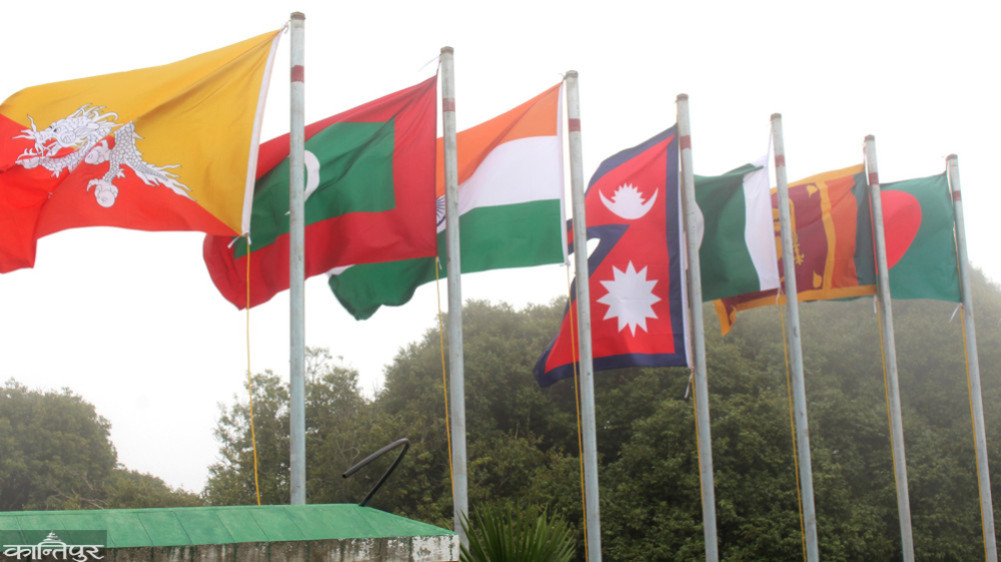
Nepal's long-term security and prosperity depend on two interrelated dimensions—external strategic balance and internal state strength. While maintaining a balance between external forces is important, to succeed, Nepal must strengthen its internal institutions, maintain strategic stability, and build international credibility.
We use Google Cloud Translation Services. Google requires we provide the following disclaimer relating to use of this service:
This service may contain translations powered by Google. Google disclaims all warranties related to the translations, expressed or implied, including any warranties of accuracy, reliability, and any implied warranties of merchantability, fitness for a particular purpose, and noninfringement.
For most of modern history, Nepal’s foreign policy has been guided more by geography than ideology. Situated between Asia’s two great powers, India and China, Nepal has long navigated a complex strategic environment where caution, balance, and adaptability are essential.
Political scientist Leo E. Rose had clearly explained this reality in his famous book ‘Nepal: Strategy for Survival’. According to him, Nepal’s diplomacy has historically been guided by one overarching objective—to preserve its existence as a sovereign state among powerful neighbors.
More than half a century later, Rose’s analysis remains remarkably relevant. But the geopolitical landscape surrounding Nepal has changed significantly. Asia has become the center of global economic growth, competition between superpowers is intensifying, and regional connectivity initiatives are redefining trade routes and strategic equations.
Today, Nepal has to manage not only the traditional challenge of balancing India and China, but also the increasingly complex strategic environment created by the activation of world powers, regional infrastructure projects, and the emergence of new economic corridors.
In this changing context, Nepal needs more than reactive diplomacy—a clear and long-term strategic vision. This can be called the ‘Nepal Survival Theory’ of the 21st century. This theory must acknowledge a fundamental reality—Nepal’s long-term security and prosperity depend on two interrelated dimensions—external strategic balance and internal state strength. While balancing external forces is important, to succeed, Nepal must strengthen its internal institutions, maintain strategic stability, and build international credibility.
This strategic environment is based on five fundamental principles—strategic balance, multidimensional diplomacy, diversification of connectivity, strategic neutrality, and strong internal governance. These principles provide guidance for maximizing opportunities while preserving Nepal’s sovereignty in an increasingly competitive geopolitical environment.
Strategic balance between India and China
The first pillar of Nepal's existential theory is to maintain a strategic balance between India and China. Nepal's geography ensures that relations with these two neighbors will always be at the center of Nepal's foreign policy.
India remains Nepal's largest trading partner and a major transit route for international trade. Open borders, deep cultural ties, and social interactions have deepened the relationship between the two countries.
On the other hand, China's rapid economic rise has opened up new opportunities for Nepal in terms of investment, infrastructure development, and trade connectivity. Cooperation with China has also increased the possibility of expanding Nepal's economic options.
The challenge for Nepal is to avoid appearing to be strategically biased towards either of these powers while expanding relations with these two powers. Strategic balance does not mean passive neutrality. It means active and balanced cooperation with both, keeping Nepal's national interests at the center.
History shows that Nepal has long maintained its autonomy through such a balance. This balance will continue to be the basis of Nepal's strategic existence in the 21st century.
Multidimensional Diplomacy and a Multipolar World
Although relations with India and China are extremely important, Nepal cannot limit its diplomatic relations to just these two countries. Therefore, the second pillar of Nepal's existential theory is multidimensional diplomacy, that is, a policy of diversifying external partnerships.
In today's multipolar world order, Nepal has the opportunity to strengthen relations with countries and institutions such as the United States, Japan, Russia, and South Korea, as well as the European Union, similar to those adopted in the twentieth century. Such partnerships can help expand investment, technology transfer, development cooperation, and access to global markets.
For a small nation, diversified diplomacy is an important tool of strategic autonomy. Diverse international partnerships can help Nepal increase its diplomatic and political influence. By cooperating with many partners, Nepal can reduce the risk of becoming overly dependent on any one external power and expand its diplomatic and economic options.
Connectivity Diversification and Economic Strategy
Nepal is a landlocked country, so its economic development and trade access have historically been limited. For decades, Nepal’s trade routes have been largely dependent on transit systems through India.
While this has enabled economic integration, it has also created structural dependency. Therefore, the third pillar of Nepal’s existential theory is the diversification of ‘connectivity’.
Projects such as railways, highways, energy corridors and digital infrastructure can transform Nepal’s geographical situation from a constraint to an opportunity. For example, initiatives such as the ‘Belt and Road Initiative’ clearly demonstrate the trend of regional infrastructure integration. However, it is necessary to carefully assess how compatible the political and strategic interests behind such initiatives are with Nepal’s national interests. Diplomacy with India and other powerful nations should be seen primarily as an opportunity for development and strategic infrastructure construction, in which no unilateral geopolitical interests should dominate.
The important issue for Nepal is not to be dependent on any one initiative, but to build multiple connectivity routes both north and south. Such a strategy can transform Nepal from a landlocked country into a land-connected bridge between South Asia, the Himalayan region and wider Asia in the long term.
Strategic neutrality in superpower competition
The fourth pillar of Nepal's existential theory is strategic neutrality in superpower competition. In today's geopolitical environment, various initiatives under the concept of the United States' 'Indo-Pacific Strategy' or China's 'Community of Humanity with a Shared Future' are creating pressure on small states to choose between competing power structures.
For Nepal, formally joining any military alliance or security structure could be a risky step that would weaken its strategic autonomy. Therefore, it is appropriate for Nepal to adopt a policy of cooperating with everyone economically and diplomatically but maintaining distance from military alliances. Such neutrality can provide Nepal with the possibility of becoming a bridge of cooperation between them, without having to stand at the forefront of superpower competition.
The foundation of foreign policy
However, all these external strategies can only be successful when a strong foundation is laid within the country. Therefore, the most important aspect of Nepal’s survival theory is internal state capacity.
Nepal’s recent political history shows that internal instability undermines the continuity of foreign policy. Frequent government changes, policy inconsistencies and institutional weaknesses make it difficult to implement a long-term strategy, resulting in political party interests taking precedence over the national interest.
Therefore, Nepal’s survival theory should also include three important internal pillars – institutional capacity, national strategic stability and international credibility.
Institutional capacity is the engine of state power. Strong institutions enable the government to effectively implement policy, manage economic growth and deal with crises. Professional governance, transparent regulatory systems and stable administrative practices ensure policy continuity. All these need to be revised and taken forward by amending the constitution and legal systems.
Another element closely linked to institutional strength is strategic stability. Stability does not mean the absence of political competition. Debate and competition are natural in a democracy. But key national priorities such as economic development, infrastructure development, and foreign policy must continue with political change. In addition, commercial reasons, corruption-free governance, and other diverse national challenges must be addressed from excessive political interference internally.
The final pillar is international credibility. Credibility itself is a strategic asset for small nations. Countries with limited military power build influence through their reputation—the perception that policies are stable, commitments are credible, and institutions are capable. Development, good governance, and credibility must be advanced through politics-diplomacy. When a country's policies are stable and predictable, international partners view that country as a trustworthy partner.
These three pillars are mutually reinforcing. Institutional capacity creates policy continuity, policy continuity creates strategic stability, and stability enhances international credibility.
From power-centric to state-centric politics
Nepal's long-term strategic success depends not only on diplomatic strategy, but also on the quality of political culture. Nepal's political discourse has long been focused on the competition for power—in coalitions, equations, leadership contests, and calculations to form a government. While such competition is natural in a democracy, if politics is limited to a mere struggle for power, the nation's long-term interests may be undermined. Nepal's long-term strategic success depends on a shift from politics for power to politics for the state.
Politics for the state focuses on three priorities—politics for development, politics for good governance, and politics for credibility. A political culture that prioritizes development puts economic transformation at the center. Politics that prioritizes good governance prioritizes institutional reform and strengthening administrative capacity. Politics for credibility ensures that the people of Nepal trust political parties and that policies remain stable, predictable, and trustworthy.
Nepal's strategic path for the future
Nepal's existential theory is not a rigid policy blueprint. It is a guiding vision based on Nepal's historical experience and contemporary geopolitical realities.
Strategic balance between India and China, multidimensional diplomacy, expanding connectivity, and neutrality in great power competition—all these point the way for Nepal to manage its external environment. Institutional capacity, strategic stability, and international credibility are the internal foundations that underpin that strategy.
Nepal’s geography will not change in the 21st century, but the strategic opportunities around it are expanding. Ultimately, Nepal’s survival will depend on a combination of external balance and internal strength. Geography will continue to influence Nepal’s strategic environment, but the country’s future will ultimately be determined by its institutional quality and political maturity.
Five decades ago, Leo Rose called Nepal’s diplomacy a ‘strategy for survival.’ As Rose pointed out, Nepal’s foreign policy is not a matter of choosing sides. It is a strategy to balance relationships, manage dependencies, and preserve national autonomy. But in today’s era, mere survival is not enough. Nepal must build a capable, credible, and development-focused state. When politics serves the long-term national interest, the state becomes strong.
Development must be prioritized over power struggles, good governance over political maneuvering, and credibility over short-term gains. A strong state can be the most reliable foundation for Nepal's survival, autonomy, and prosperity in an uncertain world order. Nepal can not only survive in the changing Asian geopolitics but also create the possibility of achieving prosperity.