As women have enthusiastically reached the decision-making levels of politics and administration, it is equally challenging to set an example by delivering results in line with this. Efforts must continue to establish the dominance of women not only at the central level of the state, but also in remote government mechanisms.
We use Google Cloud Translation Services. Google requires we provide the following disclaimer relating to use of this service:
This service may contain translations powered by Google. Google disclaims all warranties related to the translations, expressed or implied, including any warranties of accuracy, reliability, and any implied warranties of merchantability, fitness for a particular purpose, and noninfringement.
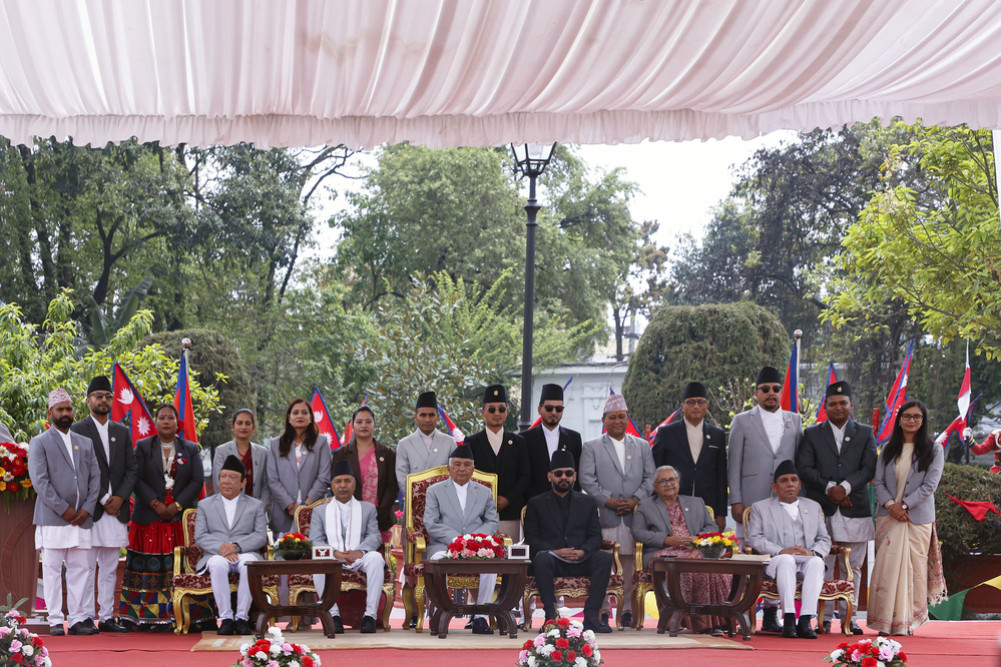
With the increasing presence of women in the state's law and policy-making levels, the reins of the state have also begun to reach women. After the recent political changes, the inclusive participation seen in the governance system is expected to lead to equal representation of women in other areas as well. With the appointment of 5 women ministers in the 15-member cabinet formed on Chaitra 13 and one woman minister on Chaitra 17, 37.5 percent participation of women in the Council of Ministers has been ensured.
After Prime Minister Balendra Shah appointed 6 women ministers in his team, the fundamental right granted by the Constitution of Nepal under women's rights has been implemented for the first time. With this, for the first time, women have had the opportunity to lead more than one-third of the ministries from the newly appointed Prime Minister Shah's team. With the significant participation of women in the parliament, the place of law-making, and in the decision-making chair, there are rays of hope in the field of women's rights.
The seat of women administrators is also becoming stronger in the government's policy-making and implementation mechanism, i.e. in the national administration. In addition, another dimension has been added to women's empowerment. With the increasing presence of women in key government bodies, the path has also been paved for the multifaceted development of women as a whole.
Women who have been holding the reins of national administration have become a means of change in other levels and sectors of the state, while women who have won elections and assumed the responsibility of ministries have become the basis for drawing a blueprint for women's leadership in the entire sector. After the representatives elected by the people reach the decisive level, the public certainly expects them to perform achievement-oriented work. There is also interest and debate about the impact this has on the upliftment of women. It is not certain that women will achieve achievements just because they reach the highest level. However, what kind of person has reached that level and what remarkable work they have done is important.
In the 16-member cabinet led by Shah, Sobita Gautam has become the Minister of Law, Justice and Parliamentary Affairs, Pratibha Rawal the Minister of Federal Affairs and General Administration and Land, Cooperatives and Poverty Alleviation, Sita Badi the Minister of Women, Children and Senior Citizens, Nisha Mehta the Minister of Health and Population and Drinking Water, Geeta Chaudhary the Minister of Agriculture and Livestock and Forest and Environment, and Gauri Kumari Yadav the Minister of Industry, Commerce and Supplies. The Constitution of Nepal stipulates that 33 percent women should be ensured in every body of the state. However, no previous government had implemented this right granted by the Constitution.
No cabinet formed so far had 33 percent women. Although various arrangements were made to increase women's representation at the policy-making level, women's participation was disappointing. Women had received few rights and responsibilities in proportion to the contribution and ability of women leaders in politics.
For the first time, the decision made on the basis of the Constitution in terms of women's participation seems to have increased the enthusiasm and enthusiasm of ordinary women. After a century of continuous struggle, Article 38 of the Constitution of Nepal has provided for 'women's rights' under the fundamental rights. The Constitution, emphasizing gender equality, has provided for ensuring 33 percent women's representation at the federal and provincial levels and 40 percent at the local levels.
However, the discrimination made by political parties in the issue of giving leadership to women had violated the Constitution. After the Gen-G movement held last Bhadra, there has been a significant participation of women in the elected parliament. In the recently concluded elections, 96 women MPs have been elected directly and proportionally to the 275-member House of Representatives, the lower house of the federal parliament. Of these, 61 are from the Rashtriya Swayamsevak Sansthan Party, 16 from the Congress, 10 from the UML, 4 from the NCP, 3 from the Shram Sanskriti Party, and 2 from the RPP. As women's participation in political parties, the legislature, and the government increases, there is a possibility that women's meaningful participation in other areas will also increase.
There have been repeated movements in the country demanding that women's representation be increased at every level and rung of the state. Various political changes have also taken place. New laws have been implemented. As a result, for the first time, women's participation in the decision-making levels of the state has increased enthusiastically. Former Prime Minister Sushila Karki has already set an example that if women reach the decision-making levels of the state, they can perform effectively and give good results. The country has already had a woman Prime Minister for the first time, even if it was for just 6 months.
There is a need for policies, programs, and legal systems to encourage women's participation. The Constitution and various acts and policies have emphasized the meaningful participation and empowerment of women. Every policy of the state is formulated by the civil administration as a permanent government. Policies made by the special category of the administration should reach every hut from Singha Durbar and be a balm to the pain of every class.
Effective and people-oriented policies are formulated only if there is inclusive representation in the policy-making space. As the number of women playing a decisive role at the highest level of government service increases, the possibility of formulating women-friendly policies and programs also increases. Be it economic policies or women empowerment programs, they are emanating from the highest level of administration and reaching the people's level. As women's entry into the highest levels of our administration and politics increases, there are signs that a new blueprint will be set for their social transformation.
Leela Devi Gadtaula, the first woman Chief Secretary in the history of the civil service, led an administration of more than 83,000 civil servants by registering her name. Currently, there are nine women in the 74 special categories (secretaries). According to the Sixteenth Plan, the presence of women in the public service is currently 29.5 percent, while women's representation at the policy-making level of the public service is 13.7 percent. According to the National Library, out of 85,000 civil service employees, more than 24,000, or 28.23 percent, are women.
The special category of the civil service is an important level of policy-making. As the number of women playing a decisive role at that level has increased, economic administration has also started to become women-friendly. However, the bitter reality of women who have reached the decisive level having to sit back and relax due to lack of a comfortable environment to demonstrate their efficiency is also visible in the administration. Women working at the policy-making level have started to move towards progress through excellent work performance, overcoming social, economic, educational, policy and structural discrimination.
The way women have enthusiastically reached the decisive level of politics and administration, it is equally challenging to set an example by giving results in accordance with the way they have enthusiastically reached the decisive level of politics and administration. Efforts should continue to establish the dominance of women not only at the central level of the state, but also in remote government mechanisms. Because a position without responsibility and authority does not allow them to do significant work.
Women have been struggling for decades to achieve equal status and exercise equal rights and power with their male colleagues, but have not been given the opportunity to do so. Even at the highest levels of administration, there is still a tendency to discriminate against women in giving them opportunities and responsibilities and to distrust them in work. It seems that by correctly assessing the capabilities of women and examining the solutions within those problems, it is necessary to formulate women-friendly policies along with women-friendly administration, focusing on improving the trend.
It is necessary to develop a strong leadership style for women to establish an exemplary role, whether in politics or in administration. Not only the quantitative but also the qualitative change of women in the major mechanisms of the state is necessary. The situation where only those with access gain rights and the weak class always remain behind in the current governance system must end.
In our country, where new public management, democracy, inclusion and pluralism are being practiced, women have not yet made enough efforts to hold executive positions and play meaningful roles. If a few women reach high levels in numbers, the welfare, empowerment, social change and development of common women will not be achieved. It seems that attention should be paid not only to increasing the numerical participation of women, but also to giving important responsibilities to those who have reached that position and building their corresponding capacity.