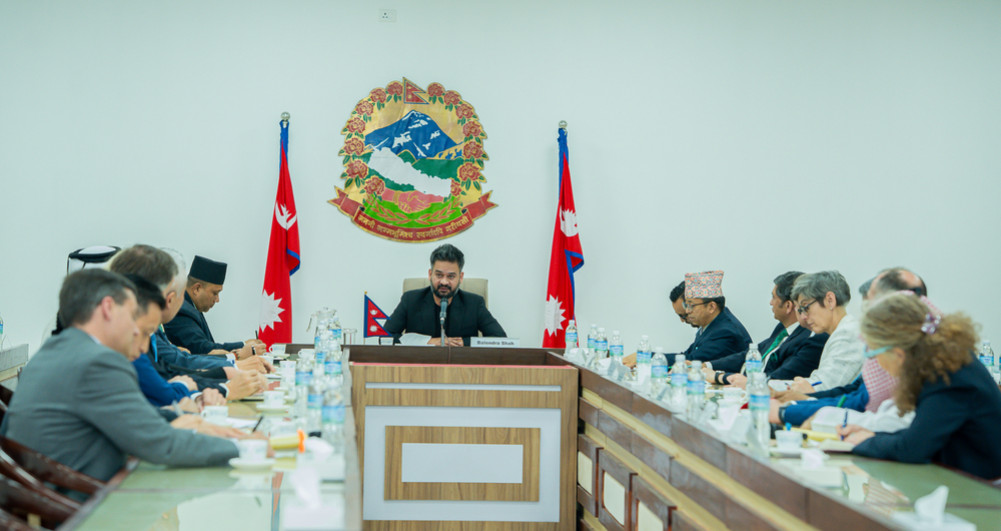
Through group meetings and information on diplomatic conduct, the government has sent a message that it is trying to move forward on the path of diplomatic restructuring. It is necessary to continue positive practices and efforts.
We use Google Cloud Translation Services. Google requires we provide the following disclaimer relating to use of this service:
This service may contain translations powered by Google. Google disclaims all warranties related to the translations, expressed or implied, including any warranties of accuracy, reliability, and any implied warranties of merchantability, fitness for a particular purpose, and noninfringement.
Two problems in Nepal's diplomatic practice are felt at the civilian level. First, the closeness is revealed as soon as the government is formed. It could be felt who the government is prioritizing in meetings, which country it is trying to be part of its grand plan, and with whom it is thinning its relations. The second problem is that ambassadors of various countries were easily meeting the Prime Minister and ministers of Nepal.
The government led by Balendra Shah has shown signs of solving both the aforementioned problems together. On Wednesday, Prime Minister Shah met with 17 ambassadors simultaneously. In addition, on Wednesday itself, the Ministry of Foreign Affairs has separately informed all ministers about Nepal's diplomatic code of conduct for the first time. Through the group meeting and information about the diplomatic code of conduct, the government has sent a message that it is trying to move forward on the path of diplomatic restructuring. It is necessary to continue positive practices and efforts.
The Prime Minister's group meeting on Wednesday was attended by ambassadors/heads of missions from India, Pakistan, the Republic of Korea, the United Kingdom, Qatar, Switzerland, France, Israel, Japan, Bangladesh, Germany, Egypt, Sri Lanka, Saudi Arabia, China, the United States and the United Nations. Previous prime ministers used to pay courtesy calls to foreign ambassadors individually.
They also held 'diplomatic briefings' collectively as needed. However, indirect signals and messages were already established through courtesy calls. Extra effort had to be made to break them. This time, the government has made courtesy calls from the very beginning, that too collectively. Through group meetings, Nepal has established the message that it gives equal priority to all countries and wants friendship with all. This practice will help move towards a unified and state-centric diplomacy.
It is not that the Prime Minister should always meet ambassadors collectively, but in the coming days, he will also have to meet ambassadors individually. It may be necessary to meet ambassadors of countries that are Nepal's development partners, economic partners, and potential investors and 'convince' them of their agenda. It may be necessary to reach common conclusions on bilateral interests and interests. That is a regular practice. But it would be better to have the initial courtesy meeting collectively. After such a practice, it can be expected that our diplomatic behavior will become more systematic in the coming days. If the next government can adopt similar behavior, a positive message will be sent to the citizens.
It is not that the Prime Minister should always meet ambassadors collectively, but in the coming days, he should also meet ambassadors individually. It may be necessary to meet ambassadors of countries that are Nepal's development partners, economic partners, and potential investors and 'convince' them of their agenda. Another big problem was the practice of foreign ambassadors meeting Nepal's Prime Ministers and Ministers whenever they wanted. As soon as someone was certain to become Prime Minister, personal meetings would begin. Even after the government was formed, the ambassadors used to meet the Prime Minister and Ministers directly on their own initiative. Especially since 2063, prime ministers have often held courtesy meetings with ambassadors individually. Such a practice has been criticized for being a clear deviation from the diplomatic approach and for being limited to the influence of the person in power in foreign policy. A code of diplomatic conduct has been issued to prevent the tendency of anyone to meet the ambassador at any time. Although such a code of conduct was last issued in 2077, it has not been implemented in practice. The government has shown clear signs of changing such a practice since Wednesday.
Although a representative of the Ministry of Foreign Affairs should be present in diplomatic meetings, it has not been put into practice. The Prime Minister of Nepal himself used to be interested in meeting alone. Ministers also used to adopt it. Due to this, looseness in diplomacy had become strong. When meeting in person, it was criticized for asking for projects, ambulances, school buses, etc., and this raised questions about Nepal's image. Therefore, the strictness that the current government is trying to adopt in adhering to the code of conduct is not only inevitable, but also a determination to make Nepal's diplomatic behavior disciplined and practical.
Similarly, the practice of not having a representative of the Ministry of Foreign Affairs in important diplomatic meetings and not keeping records of the dialogue has been going on. Due to which, initially, the state has not been aware of the discussions, agreements and commitments made in such meetings. Since the record of the dialogue is not kept, it does not remain in the institutional memory either. Whereas, by having a representative of the Ministry of Foreign Affairs and keeping a record of the dialogue, such dialogues remain in the institutional memory. No one can make false claims.
There is also no confusion and distrust. Dialogue and agreement can be established in the relationship of the state rather than in personal relationships. Due to which, Nepal's profile in conducting diplomacy increases. The continuity of dialogues held in bilateral relations is maintained. It becomes easier for subsequent dialogues. Meetings through the Ministry of Foreign Affairs help to strengthen this ministry. It ultimately benefits the country.
A new practice has been started by courtesy meetings held collectively. This should continue. On the other hand, adherence to the diplomatic code of conduct is not a new creation, but a commitment to comply with written provisions. This is not the final diplomatic achievement. But such efforts have raised hope that we can move in a good direction. Many issues will be determined by continuity and practice.