The law itself is conflicting as to who will approve the fees and classify the schools. The argument is that since the authority over school education lies with the local level, it should do so. However, the School Education Act does not recognize the municipality, and since it does not recognize it, it cannot do so. As a result, who will regulate and take action if there is arbitrary fee collection or non-compliance with the guidelines? There is confusion.
We use Google Cloud Translation Services. Google requires we provide the following disclaimer relating to use of this service:
This service may contain translations powered by Google. Google disclaims all warranties related to the translations, expressed or implied, including any warranties of accuracy, reliability, and any implied warranties of merchantability, fitness for a particular purpose, and noninfringement.
In Nepal, the desire of parents to send their children to private schools is increasing. However, the fees that have to be paid for that are a source of stress for them. Parents do not get information about which school can charge how much and whether it is appropriate to charge that much. They are forced to pay the fees that the school asks for for various reasons. In addition, there is a tendency to enroll before the start of the academic session. Due to this, the Supreme Court ordered to enroll students only after the start of the academic session last week.
After complaints started coming in on these issues, the Ministry of Education has shown proactivity. Through the Ministry of Federal Affairs, the Ministry of Education has issued a circular to all 753 local levels to take action against schools charging additional fees. If this issue is addressed, parents will get great relief. For that, the government should be clear about the spirit of the constitution, legal provisions and its policies and show firmness in its implementation.
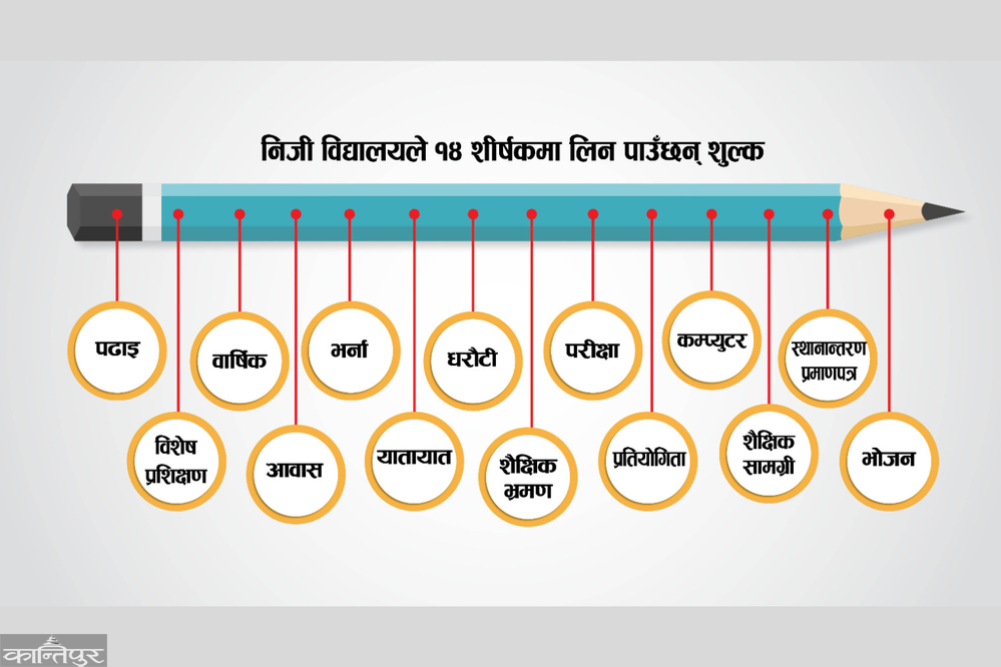
According to the Private School Fee Determination Criteria Directive-2072, private schools have been allowed to charge fees under 14 different headings. According to which, it is mentioned that fees can be charged for monthly tuition, annual, admission, deposit, examination, computer, transfer certificate, special training, accommodation, food, transportation, educational tours, inter-school competition and educational materials.
But the fees under these headings are arbitrary and additional fees are also being charged. For example, in the case of admission, it is said that it can be charged only once and such amount should be equal to one month's monthly fee. There is also a provision that the school must get the fee approved by the concerned local level. But admission fee is charged per class and many more fees are charged than the monthly fee. There is a practice of not even approving it.
Private schools are being arbitrary in the non-implementation of the directive. But there is also a legal and policy problem. When the Education Act, Education Regulations and the directive made in 2072 were prepared, the central government (later the federal government) had the right to school education. With the implementation of federalism, the right to school education has reached the local level. But the act, regulations and directive do not recognize the local level. That has also created difficulties. Similarly, the law states that private schools are classified and fees are also classified accordingly.
The law itself is contradictory as to who will approve the fees and classify the schools. The argument is that since the right to school education lies with the local level, it should do so. However, the School Education Act does not recognize the municipality, and since it does not recognize it, it could not do so. As a result, who will regulate and take action if there is arbitrary fee or guideline compliance? There is confusion.
According to the Private School Fee Determination Criteria Directive-2072, private schools have been allowed to charge fees under 14 different headings. As per the Supreme Court order, the Ministry of Education has asked not to admit students before the academic session has started and not to charge excessive fees. Similarly, the Ministry of Federal Affairs has also issued a circular to local levels to monitor the charging of fees. A ‘help desk’ has been opened at the Education and Human Resource Development Center under the ministry to file complaints about fees. According to the constitution, all this work must be done by the local government.
But the Ministry of Education is doing this work by citing the Education Act, 2028. Which has also created confusion about the scope and use of rights and has led to difficulties in achieving results. The Federal Education Act is indispensable to remove such complications and facilitate the implementation of one's own rights.
The debate has arisen at this time about under what heading and at what rate fees can be charged. But the Constitution of Nepal and the Compulsory and Free Education Act, 2075 BS, state that education up to grade 8 is compulsory and up to grade 12 is free. But students have not been able to get free education. Community school students also charge fees. The federal government itself charges the fees for the SEE and grade 12 examination fees and educational certificates. Private schools have also been charging them.
Similarly, even though education up to grade 8 is said to be compulsory, 70,000 school-going children are out of school. The Compulsory and Free Education Act stipulates that schools should be within half an hour. Therefore, the state's activeness and a clear policy for that are essential to comply with the spirit of the constitution.
When discussing the issue of free education, the issue of investment in private schools often comes up as a complicated issue. First, the law on which private schools were opened makes the issue of investment protection justified. Because, private schools are older than the constitution. Second, the investment made by the state in community schools, which are currently under the responsibility of the state, is insufficient.
It may be difficult for the state to bear the burden of private schools. But there is a constitutional provision that education up to grade 12 is free, and the implementation of the constitution is the responsibility of the state. Therefore, a clear blueprint or law should be brought on how to implement this issue. The Ministry of Education had previously proposed that the state create an educational fund to bear educational expenses and create a basket by combining federal, provincial, local, parents, education enthusiasts, taxes, and donations. This could be an option or a new option could be adopted.
Since private schools are here to make a profit and they naturally make a profit, the government should be clear about the way forward. Should private schools be left purely for profit and given the freedom to spend whatever they earn, or should they be service-oriented and non-profitable, or should they be allowed to operate as state property after a certain period of time? What should be done with those that have already opened? The state needs to be clear about all such aspects.
For that, the practices of the concerned bodies and other countries can be looked at. But the work of always being indecisive and keeping the operation of private schools with large investments in limbo should be stopped. Overall, even though the issue of fees has been raised at this time in the first half of the academic session, a Federal Education Act is necessary to make the entire school education in line with the spirit of the constitution. Before that, the currently implemented acts, regulations and guidelines should be firmly implemented. And, a permanent solution should be found for all issues including fees.