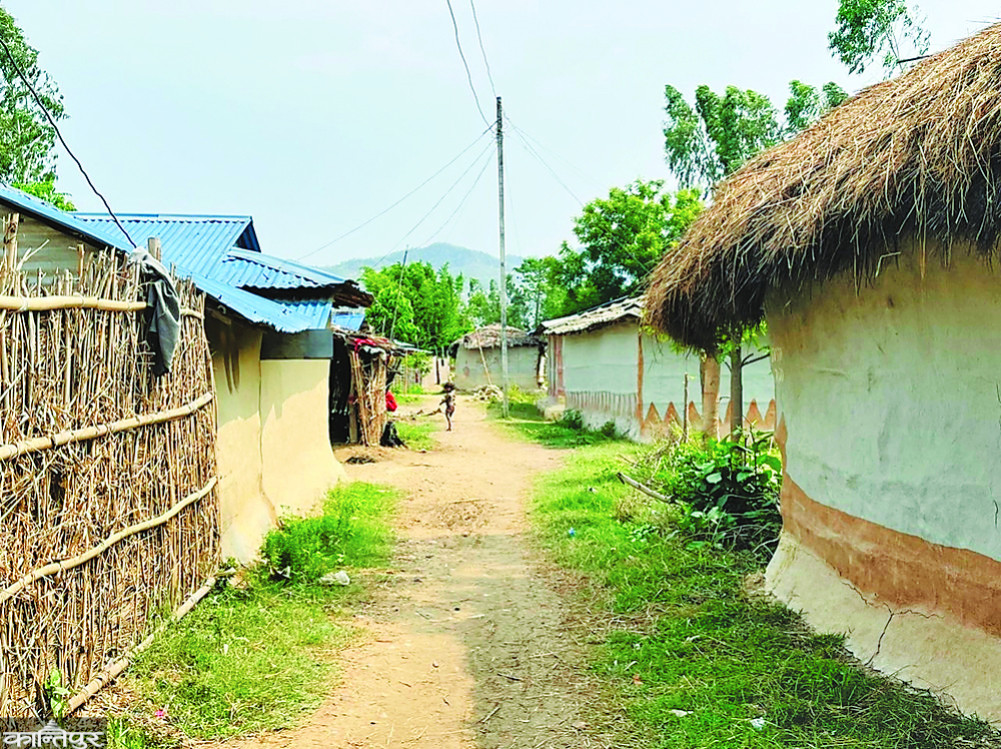
It is welcome that the government has prioritized the issue of ‘landless squatters and unorganized settlement management’ in its agenda of hundred-point administrative reforms. However, the government’s commitment stands both as a door of opportunity and a wall of challenge.
We use Google Cloud Translation Services. Google requires we provide the following disclaimer relating to use of this service:
This service may contain translations powered by Google. Google disclaims all warranties related to the translations, expressed or implied, including any warranties of accuracy, reliability, and any implied warranties of merchantability, fitness for a particular purpose, and noninfringement.
Land ownership determines the identity, dignity, power and prosperity of individuals and families. Although access to and ownership of land is essential for ensuring basic rights, landless and irregular settlers are continuously deprived of this right.
Landless squatters are often forced to live on unsafe land. Making a living is difficult, uncertain and a struggle. They are almost deprived of government services and facilities. Even in cases where they need to get some facilities, they are forced to complete more procedures than those who have land. This is why the education, health, livelihood and social status of landless squatter families have become weak. There are many reasons for landlessness. The feudal land system is its main source. It concentrated land ownership in the hands of a few people. And, in particular, made Dalits, indigenous peoples, minorities and marginalized communities landless. As a result, poverty, inequality and food insecurity increased.
Ending landlessness
Ending landlessness is an important mandate of the Comprehensive Peace Agreement. This is not only a policy issue but also a question directly linked to the implementation of fundamental rights. The Constitution of Nepal has clearly ensured this. Under Article 40 of the Constitution, in the case of Dalits, it is mentioned that ‘the state shall provide land to landless Dalits once and shall arrange for housing for houseless Dalits’. Similarly, under Article 51 (j) of the Social Justice and Inclusion Policy, it is mentioned that ‘the freed Kamaiya, Kamlari, Harwa-Charwa, Haliya, landless and squatters shall be identified and provided with houses and arable land or employment for their rehabilitation and livelihood.’ These constitutional provisions make it clear that it is the mandatory responsibility of the state to solve the problems of landless Dalits, squatters and unorganized settlements. Since the right to housing is also closely related to land, the full implementation of the right to housing is not possible without ensuring land rights. However, in reality, thousands of citizens are still forced to live in a landless situation. Even after a decade of the promulgation of the Constitution, no significant progress has been made towards solving the problem of landlessness, especially for the Dalit community. This situation is a continuation of a kind of structural injustice.
Therefore, there should be no delay in ending the apathy seen in implementation. The problem of landlessness is not an optional issue. It is a constitutional obligation that the state must address.
New environment, revival of hope
Landless and unorganized settlement management was one of the most frequently raised issues by voters when candidates went door-to-door before the general elections on Falgun 21. From Kanchanpur to Jhapa, all candidates, mainly in the districts of Terai and inner Madhesh, listened to the voices, requests and complaints of the voters. And, they have also promised to resolve them. In line with the promise made by the current Prime Minister Balendra Shah to the landless voters of Jhapa-5, it is welcome that the issue of landless squatters and unorganized settlement management is given priority in the 100-point administrative reform agenda passed by the government.
It has been said that an integrated digital data of landless squatters and unorganized settlements will be collected and verified within 60 days. However, is this possible? Some have raised questions. However, it is not impossible if you work consciously. The land commissions formed since 2077 are collecting and entering data on landless and unorganized settlements under the leadership of the local government. So far, about 600 local levels out of 753 have collected data. The collected data has also been entered into the information system used by the commission. Some of them have also verified the data.
Therefore, it is possible to do the data verification of the 600 local levels where the information has been collected within a maximum of one month. The verification work is a very important work. The information collected by the local level based on the scientific questionnaire has been entered into the computer. And, it has been kept in digital data. However, it is meaningless if it is not verified by the local executive meeting. And, the process of collecting applications becomes endless. Therefore, the work of verifying by setting a specific period is very important.
The remaining 153 local levels have also collected partial data. However, the computer entry is yet to be done. Some of them also have to collect data. This is possible if we work as a campaign for this. However, the work of data collection should not be made an optional subject. It should be made a mandatory subject. And, if necessary, financial and necessary human resources should also be provided. If data collection and verification of all 753 local levels can be completed in this way, an important stage in the management of landless Dalits, landless squatters and unorganized settlements will be completed.
The agenda includes a household survey in coordination with the local level to solve the landless squatter and unorganized settlement problem within 1,000 days, and implementing clear criteria (cut-off date, income level, other property ownership) for identifying the actual beneficiaries. This is clear in the previously formulated regulations, procedures and questionnaires. No new homework will have to be done. The Land Act, 2076 has considered Magh 28, 2076, the date of the ratification of the Act, as the 'cut-off date'. It is also reasonable to plan to provide land to the landless in a planned manner.
Opportunity for compensation
Formally acknowledging the injustice, discrimination and deprivation inflicted on Dalits and historically excluded communities by the state, society and the structure, the government has announced to bring a reform program with a formal apology within 15 days for social justice, inclusion and reconciliation. Providing housing to Dalit landless
(non-farmers) and landless farmers with housing and land for agriculture should also be included under this reform program. Addressing Dalit landlessness is a mandatory compensation for the oppression of Dalits.
Dalits have been living a landless life for centuries due to structural discrimination. Due to social discrimination, exclusion and a series of legal-political reasons, they have not been allowed to come out of landlessness. According to the latest study conducted by the ‘Community Self-Reliance Service Center’, 41 percent of the total Dalit households do not own the land on which they live, they are living on government or public land and are at high risk. The rest have only their own houses and no arable land. This has made their livelihood difficult.
Minimum limits for housing and agriculture must be set for landless Dalits. The two-three acres of land they are currently living on cannot be resolved by registering them. In addition, families with private land less than the required area for housing should also be considered landless and provided with the necessary land.
Opportunities and challenges
The government's commitment has opened up both doors of opportunity and walls of challenge. There is a strong legal basis for addressing landlessness. 88,895 applications of landless Dalits, 168,441 applications of landless squatters, and 872,181 applications of unorganized settlers have been entered into the computer system. The local level has established land branches and recruited contract manpower. The local level is an important opportunity for this work. The organization of the landless and their conscious mobilization are also opportunities.
However, the major challenge is that most of the areas where the landless have been living are forest and buffer zones, which have not been mapped, and their lack of cooperation in registering land. The availability of land required for the landless living in risk areas can also be a challenge.
Result-giving structure
Finding alternatives to the data collection and verification work of landless Dalits, landless squatters and unorganized settlers will not fulfill the government's objective. Therefore, the 'Land Problem Resolution Commission' should be instructed to complete the data collection work within 60 days and submit the verified details
. The ministry should monitor whether the work has been completed on time every day.
It is necessary to evaluate the work done by the commission so far and find out the reasons for the failure. The practice of dissolving, dismissing or restructuring the commission with the change of government in the past should not continue. Therefore, it is very important to pay attention to its management without dissolving the commission. Restructuring it, if necessary, along with evaluating the work of the commission's officers and members, would be an appropriate step. Even if the current commission cannot work, there is no way to go for an alternative without changing the law. The option of forming a tight commission of experts in the union and not having district committees can be considered. Currently, the local level is carrying out data collection, verification, certification, surveying, etc.
The local level land department can complete all the procedures and prepare the land ownership certificate. In this way, the provision for verification and approval by the Land Revenue and Surveyor before distribution of the prepared land ownership certificate can be made. However, there should be a provision for approval by the Land Revenue and Surveyor within 15 days of the recommendation by the local level.
(Deuja is a land rights activist and land expert)