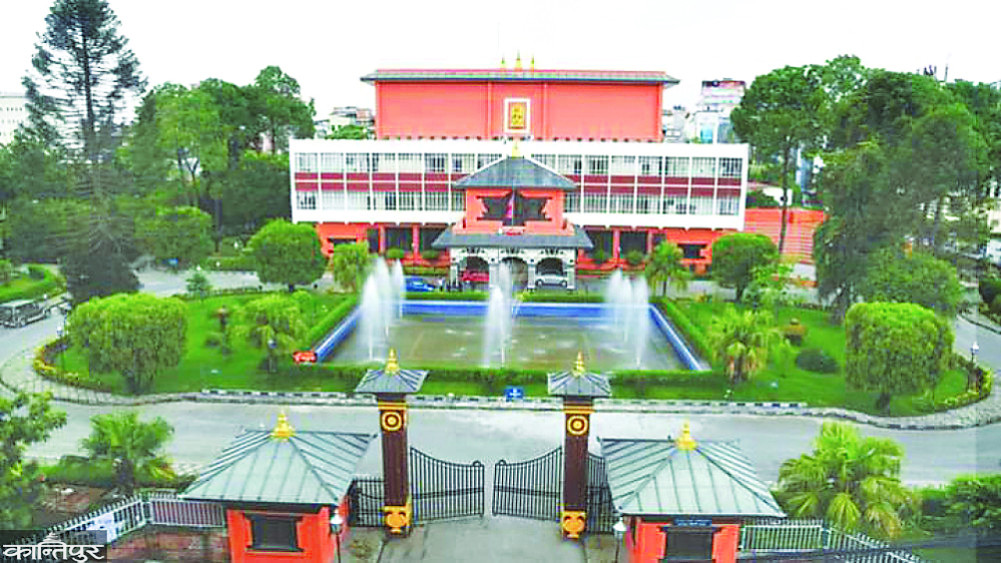
With the Supreme Court dismissing the writ petition filed by the life members of Nepal Academy who were receiving dual benefits on March 1, a new precedent regarding dual benefits is set, and provisions related to this will definitely be included in the upcoming Civil Service Act and Regulations and other related acts and regulations.
We use Google Cloud Translation Services. Google requires we provide the following disclaimer relating to use of this service:
This service may contain translations powered by Google. Google disclaims all warranties related to the translations, expressed or implied, including any warranties of accuracy, reliability, and any implied warranties of merchantability, fitness for a particular purpose, and noninfringement.
The provision regarding double benefits seems to have started for the first time in 2035 BS. In the fourth amendment to the Civil Service Regulations-2021, Rule 7.5 was added to it, stating that ‘a person receiving a pension under this rule shall not receive a pension under this rule for the period during which he is appointed to a corporate body wholly or mostly owned or controlled by His Majesty’s Government and remains in such an institution.’ This provision was removed after 2046 BS. Also, the provision regarding double benefits was not included in the newly enacted Civil Service Act-2049 BS and the Civil Service Regulations-2050 BS.
On 2061.07.18, the Minister of General Administration in the then Prime Minister Sher Bahadur Deuba Cabinet, Krishnalal Thakali, had decided not to receive double benefits by making a ministerial decision, and this decision had even been circulated to all public bodies.
On 2061.10.19, the direct rule of the King began. At that time, the Civil Service (Second Amendment) Ordinance, 2062 BS was issued. This ordinance added sub-section (6) to Section 37 of the Civil Service Act, stating that ‘If a person who has retired from any government service or an institution wholly or partly owned by His Majesty’s Government and is receiving a pension is appointed to any post in a constitutional body or His Majesty’s Government or an institution wholly or partly owned by His Majesty’s Government or any body operated with a grant from His Majesty’s Government, the pension to which he would be entitled shall be deducted and the remuneration shall be paid to him for as long as he continues to hold such post.’ The said ordinance could not take the form of an Act.
The Ministry of General Administration prepared a proposal on double facilities on 2072.10.07, citing the decision and circular dated 2061.07.18, and the directive dated 2071.07.21 issued by the Commission for the Investigation of Abuse of Authority regarding the non-grant of double facilities. At that time, the Prime Minister was KP Sharma Oli, and the Minister for General Administration was Rekha Sharma. The proposal was passed by the Cabinet meeting on 2072.10.08 with some amendments.
The two-point decision passed by the Cabinet is as follows:
1. Newly appointed officials to public benefit positions or government service receiving monthly remuneration shall choose the higher of monthly remuneration and pension within one month and currently serving officials shall choose the higher of monthly remuneration and pension within one month from the date of this decision and make arrangements to keep a record of this information by informing the Pension Management Office through the relevant body to which they were appointed.
2. If an official is enjoying the dual benefits of remuneration and pension while holding a public benefit position, the pension authorization letter shall be issued only after the amount received for either of these two benefits has been deposited in the government fund.
In this same Cabinet meeting, the then Prime Minister Oli had also directed the then Chief Secretary to make the necessary laws to implement this. The government had also published a notice calling on employees who were receiving double benefits to self-declare. At that time, 19 reappointed employees had self-declared. Among those who self-declared were also special category employees.
Meanwhile, Kayodevi Yami, who was made a member of the Public Service Commission on 2065.11.05 when her sister and son-in-law were in power and became the acting chairperson of the commission, and former members of LOSEA Tikadutta Niraula and Rajendra Prasad Sah, approached the Supreme Court with separate writ petitions alleging that their constitutional rights were violated by the decision of the Council of Ministers.
The situation regarding double benefits seems to have deteriorated here. The writ petitioners have claimed that they are special people with special abilities to work in the Constitutional Commission. The petitioners also argue that they cannot be compared to lower-ranking employees like Ram Bahadur Mahat, a patrol attendant of the Nepal Army, who has already withdrawn one of the two benefits after the authority ordered them to return one of the two benefits. The court's decision has also confirmed this argument of the petitioners. The decision states, "In fact, people are all the same and in the eyes of the law, everyone should be treated equally. There is no need to dispute this matter or engage in detailed arguments. However, if this means that everyone should be treated equally in all situations, it is not logical. The opponents' argument that the same criteria adopted for attendants should also be adopted for constitutional officials seems unrealistic, illogical and prejudiced in itself. There is a difference between the post of constitutional official and the post of attendant from every perspective, such as responsibility, liability, conditions of service, facilities, qualifications and abilities required for official performance, etc.."
As explained in the judgment, the qualifications, capabilities, services, and facilities of a patrol officer and the head of a constitutional body are not the same. But shouldn't the court be a partner in the effort to establish such a policy position that the state is starting after a long time and will have far-reaching effects and impacts? If the petitioner wanted to speak, the decision of the Council of Ministers could have been continued by doing so. However, it was not done. Since then, a country with a small economy like ours has been forced to bear the burden of double facilities for an entire decade.
With the dismissal of the writ petition filed by the life members of the Nepal Academy who were receiving double facilities by the Supreme Court on Chaitra 1, a new precedent is going to be set regarding double facilities, and provisions related to this will definitely be included in the upcoming Civil Service Act and Regulations and other related acts and rules.
This legal provision from 2035 BS was almost dead due to the greed and political interests of the bureaucracy. It is not that some political leaders in the middle did not try to do it. Sometimes party leaders and sometimes even the king himself seem to have tried to include this provision. However, there is a recent history of the judiciary and sometimes the bureaucracy appearing uncooperative. The last time the government's decision could not be implemented. We were ten years late. This was an attempt at long-term policy-level good governance.
The latest decision of the Supreme Court to end the dual privilege of lifelong members of the Academy will have a far-reaching impact not only on the Academy, but also on Nepal's entire judicial history, administrative deviations, and economy. (Vimli is an advocate)