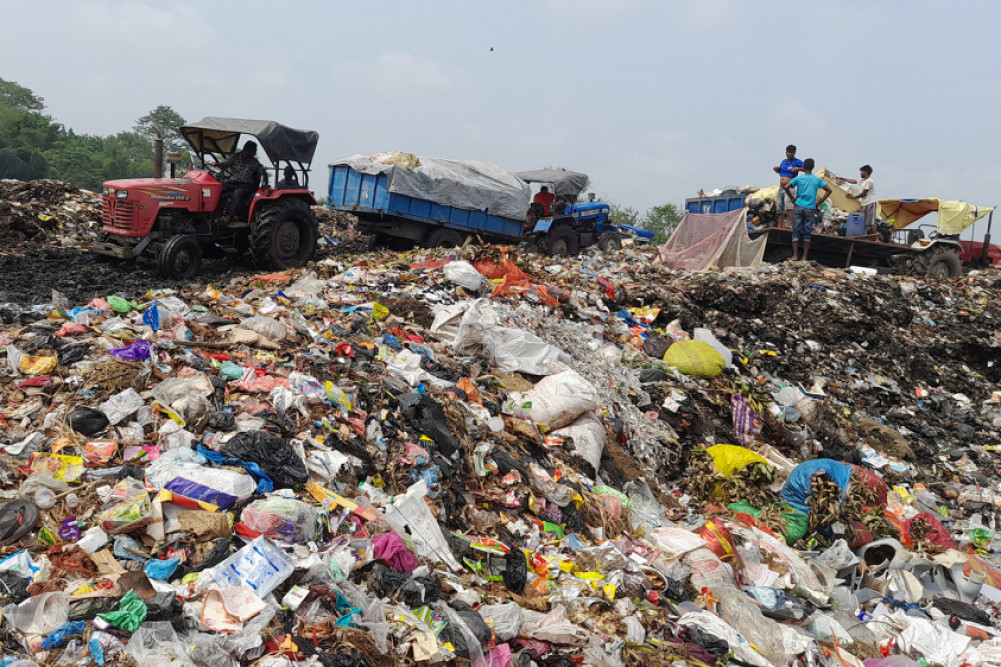
Clean-up campaigns help remove visible waste, but the repeated appearance of the same brand of plastic bags in the collected waste raises serious questions: Is plastic pollution just a consumer problem? Or should producers be equally responsible?
We use Google Cloud Translation Services. Google requires we provide the following disclaimer relating to use of this service:
This service may contain translations powered by Google. Google disclaims all warranties related to the translations, expressed or implied, including any warranties of accuracy, reliability, and any implied warranties of merchantability, fitness for a particular purpose, and noninfringement.
The waste we produce tells the story of our consumer culture. The plastic bags strewn across rivers, roads and public spaces are not just signs of individual carelessness, they are reflections of deep weaknesses in our market structure and policy arrangements. Clean-up campaigns being conducted across Nepal are helping to remove visible waste, but the repeated appearance of bags of the same ‘brand’ in the collected waste raises a serious question – is plastic pollution only a consumer problem? Or should producers also be equally responsible?
Urbanization is increasing in Nepal. People are increasingly preferring to live in cities and markets than in rural areas. Some may want to do this, while others are forced to. This increasing urbanization has brought about changes in people’s consumption patterns. With such rapid changes, the challenge of waste management is becoming more complex.
According to studies, municipalities in Nepal produce more than 3,000 tons of solid waste daily. A significant portion of this is plastic waste. The share of plastic waste is even higher in large urban areas like the Kathmandu Valley, where most of the waste is made of packaging materials that are difficult to recycle or of low value. Even as the volume of waste increases, the management system seems to be weak in terms of resources and means. Resources are focused on collection and disposal rather than ensuring waste reduction and responsibility.
For years, we have spent a lot of energy on the message of ‘let’s not litter’. Thousands of volunteers, students and civic organizations have collected tons of waste from communities, rivers and highways. However, plastic pollution has increased instead of decreasing. The reason for this is clear – we have focused on littering behavior, but ignored the system that produces waste.
During the clean-up campaign, some noodles, chips, biscuits and water bottle shells are seen in large numbers in the waste collected. This is no coincidence. It shows not only the market reach of these ‘brands’, but also the nature of their packaging. The use of single-use plastics and non-recyclable small packets clearly shows that companies are not taking responsibility for the final state of their products. Thus, the burden of waste is being imposed on municipalities, communities, and ultimately nature.
An effective means of exposing this situation with evidence is the ‘brand audit’. A ‘brand audit’ is the process of identifying which ‘brand’ or company the plastic and packaging materials found during a clean-up campaign or waste collection belong to. It goes beyond the question of ‘how many tons of waste were collected?’ and brings the question of ‘how much waste was generated by which company?’ to the center. In this sense, a ‘brand audit’ is not only an effective means of identifying the amount of waste, but also its source and responsibility. It also helps create positive pressure on the relevant company to be accountable and responsible.
Its basic concept is – extended producer responsibility. This means that a company must also take responsibility for managing the waste generated by the products it sends to the market. In Nepal, concepts such as Extended Producer Responsibility (EPR) are mentioned in the Solid Waste Management Act and the Plastics Directive, but their implementation in practice is still weak. Even now, most of the burden of waste collection, transportation and management is borne by local governments. While companies are shirking their responsibilities by making profits from cheap plastic packaging.
The impact of this situation is not limited to the environment. Its social and human health implications are also serious. Plastic gradually breaks down into tiny particles (microplastics) and enters the soil, water and food chain, and can eventually reach the human body. The toxic fumes emitted from open burning of waste cause serious respiratory problems, especially for children, women and senior citizens. In addition, informal sector workers who work directly with waste are forced to work in hazardous conditions without adequate protection, identification and income security. Thus, the burden of plastic pollution is not evenly distributed. It is affecting the poor and marginalized communities more.
The Government of Nepal has taken some positive initiatives in recent years. Efforts such as bans on thin plastic bags, source-separation campaigns, and the development of solid waste management guidelines have shown institutional interest in the problem. Some local governments have also implemented door-to-door waste collection, composting, and public awareness programs. However, these efforts are still mainly focused on ‘downstream’ (latest-stage solutions such as waste collection and management). ‘Upstream’ interventions related to production and packaging (the initial stage of waste generation) have not been sufficiently developed.
Although the potential of ‘brand audits’ is great, it has not yet become part of the formal system in Nepal. Some environmental organizations and volunteers have introduced it, but these efforts are limited in scope. Most local levels are still limited to indicators of ‘how much waste is collected’. There is a lack of a system to collect facts about ‘which brands are responsible for increasing waste’. This has led to the real sources of pollution being overshadowed in policy and debate.
International experience clearly shows that change is possible. Campaigns like ‘Free from Plastic’ have identified some multinational companies as the world’s leading plastic polluters through ‘brand audits’. Many European countries have strictly implemented the issue of ‘producer responsibility’, forcing companies to take back their packaging or pay for its management costs. This has gradually shifted the market towards recyclable, reusable and less plastic use.
Now it is imperative for Nepal to move towards similar systemic change. First, ‘brand audits’ should be formally incorporated into national and local waste management systems. Second, the ‘polluter pays’ principle should be put into practice by strictly implementing producer responsibility (EPR). Third, the government should come up with clear targets and incentive policies to reduce single-use plastics and promote sustainable packaging.
Similarly, it is imperative for the private sector to accept its responsibility and redesign packaging, invest in reusable and recyclable systems, and collaborate with waste management systems. The role of civil society and the media is equally important in this work. Instead of limiting clean-up campaigns to one-off activities, ‘brand’ companies themselves should be transformed into accountability campaigns that publicise the facts, raise awareness and create public pressure.
Plastic pollution is not just the result of individual carelessness. It is the combined result of production systems, market practices and weak policy implementation. While clean-up campaigns are important, they cannot provide long-term solutions if they are not linked to systemic change. Therefore, ‘brand audits’ can be an important basis for this change.
(Lamichhane is an activist on environmental sustainability and plastic pollution)