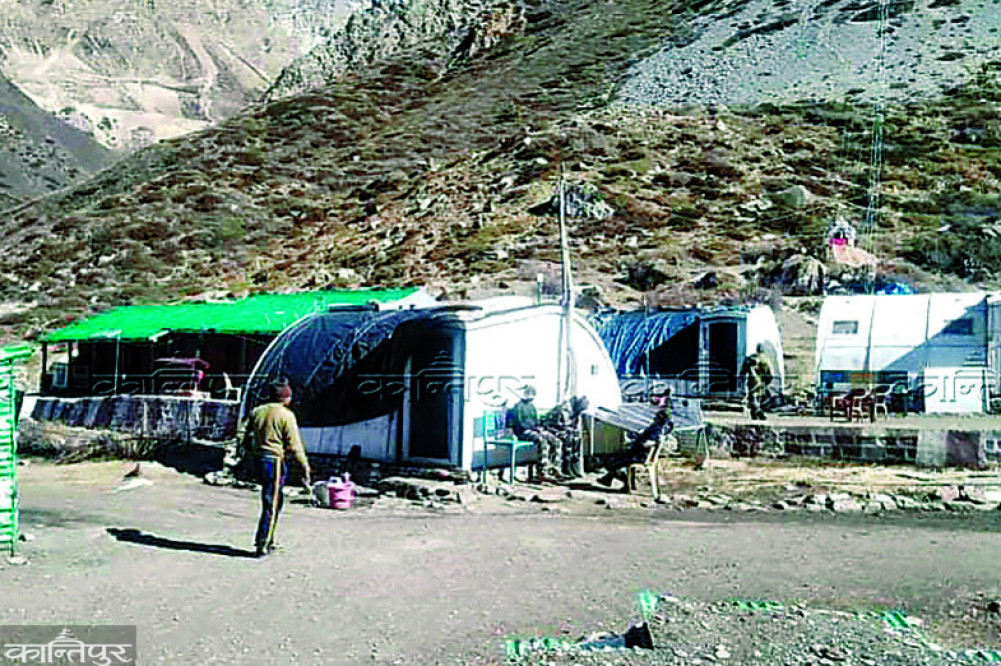
The origin of the Mahakali River, which originates from Limpiyadhura, can be determined geographically and legally based on customary law, treaty law, and international court decisions.
We use Google Cloud Translation Services. Google requires we provide the following disclaimer relating to use of this service:
This service may contain translations powered by Google. Google disclaims all warranties related to the translations, expressed or implied, including any warranties of accuracy, reliability, and any implied warranties of merchantability, fitness for a particular purpose, and noninfringement.
Nepal's new Foreign Minister Shishir Khanal, in his message when he took office, said that Nepal's foreign policy will remain unchanged. He said that it will be based on the Constitution and focused on sovereignty, territorial integrity and national interests. He also said that there are plans to focus on the security of Nepali citizens in conflict-affected areas of West Asia, modernize consular services with digital technology and prioritize foreign service delivery.
At the time of writing, the Foreign Minister has not issued a statement calling for an immediate ceasefire in West Asia and urging all warring parties to uphold humanitarian principles and UN values. It may seem easy to remain silent now, but it may also be counterproductive, without even calling for peace, given the fact that Nepalis are facing hardships and some have been killed in West Asia. Nepal had clearly opposed Russia's invasion of Ukraine. It had criticized Russia's invasion by voting in favor of Ukraine in resolutions and other decisions of the Human Rights Council.
Some may say that international law is dead. But the civic nature of the state is dying, not the law. Some may say that the UN is inactive. But it is the only institution that needs to be active. If we cannot speak for peace, what are we living for? In a world dominated by powerful nations, it is particularly challenging for small countries to raise their voices. Yet, in his speech to the UN General Assembly in 1960, BP Koirala spoke boldly for small countries. He advocated an independent foreign policy and emphasized Nepal’s commitment to peace, justice, and the principles of the UN Charter. Therefore, it must be acknowledged that even small powers can shape the global debate through principled engagement. Commitment to UN principles and international law is essential for sovereignty, territorial integrity, and national interest. Nepal’s border disputes with China and India are an example of this.
Nepal-India border dispute at the International Court of Justice
India is illegally occupying the northwestern territories of Limpiyadhura, Lipulekh, and Kalapani in Nepal. The illegal occupation of the territory of one country by another country must be resolved through negotiations, inquiries, mediation, conciliation, 'arbitration' or regional means in accordance with the Charter of the United Nations. If the dispute resolution through the mentioned means fails, a judicial solution is necessary. This article will focus on the issue of judicial resolution. Compulsory solutions such as a special court that the Security Council can establish to resolve the dispute will not be discussed in this article.
Against the mentioned illegal occupation, legal arguments will be made based on publicly available facts and evidence, treaties and agreements, the 'source' and 'watershed' of rivers, and the decisions and principles of international courts. The arguments are made based on facts and law, not the affiliation of the author. It is believed that these arguments will be useful not only in diplomatic negotiations, but also in the event that Nepal has to file a case in an international court.
The physical and legal facts to be discussed are as follows - Is the map attached to the treaty or not? If so, have the parties to the case accepted the map or not? If the border river is accepted, is the source of that river mentioned in the treaty or not? In cases where the source of the river is not mentioned in the treaty, which is the main river and the tributary? Such factual questions as well as the right to sovereignty and territorial integrity against historical occupation, etc.
Physical and legal facts
Nepal has collected the census and electoral voter list in the past in the Limpiyadhura area (Kuti, Navi and Gunji) and the receipt of tax and toll bills paid by the residents of that area to the government until the Panchayat period are useful evidence. During the Sino-Indian war of 1962, the letter allegedly written by Indian Prime Minister Nehru to King Mahendra seeking permission to establish a temporary military post in Kalapani may be evidence in Nepal's favor.
The 1816 Sugauli Treaty between the East India Company and Nepal has accepted the Kali (Mahakali) River as the Nepal-India border. It has granted Nepal territorial sovereignty over the territory east of the Mahakali River. The source of the river, i.e. the source, is not mentioned in the Sugauli Treaty. However, based on the ‘catchment area’, ‘main flow’ and ‘length’ of the Mahakali River, it is a geographical fact that Limpiyadhura is the source of the Mahakali. In terms of international law, the Mahakali River originating in Limpiyadhura, which has more length, water and watershed area, is the border river between Nepal and India.
The Mahakali River coming from Limpiyadhura and the Lipukhola coming from Lipulekh merge at a place called Gunji. 385 square km of land from Limpiyadhura to Kuti, Navi, Lipulekh, Kalapani, Gunji is in the possession of India. The total watershed area of the Mahakali and Lipukhola up to Gunji Dobhan is 750 square km. Of this, the watershed of Lipukhola coming from Lipulekh is 185 square km, while the remaining 555 square km of watershed area is occupied by the Mahakali River coming from Limpiyadhura. The length of the Mahakali River, which originates in Limpiyadhura, is 52 km and the average flow is 22 cubic meters per second, while the length of the Lipukhola is only 22 km and the average flow is only 7 cubic meters (Ratan Bhandari, ‘Limpiyadhura Lipulekh in the grip of encroachment, 2016).
The ‘watershed area’ of Limpiyadhura is key to the demarcation of the Nepal-India border. The Nepal-China Border Treaty of 1961 has accepted the bilateral border from the ‘watershed of the Kali and Tinkar rivers’ (Limpiyadhura) in the west to the Jinsang Chuli/Jongsong peak in the east. This proves that the ‘source’ of the Mahakali River is Limpiyadhura.
The legal provisions regarding the Nepal-India border maps are as follows. According to the International Court of Justice (discussed below), only the boundaries established by treaties and the maps formally included in them have binding legal force. That is, maps that are not explicitly included in the treaty lack binding effect. Mutual consent is required for the recognition of maps drawn after the treaty. Maps drawn after the treaty are considered to lack the consent of the parties, whether they are included in the subsequent agreement or not. Because the boundaries cannot be changed unilaterally. The above-mentioned issue should be taken seriously in the context of the Sugauli Treaty and the maps made after it.
The list of maps published after the Sugauli Treaty is as follows. From the first map published in 1819 to 1856, about a dozen more maps have been published. The maps published until 1856 show the source of the Mahakali River at Limpiyadhura, while Kuti, Navi and Gunji to the east, Lipulekh, Kalapani are all clearly included within the borders of Nepal. All these maps state that the entire territory east of Limpiyadhura belongs to Nepal.
However, after 1856, the maps published by the Survey of India of British India changed the northwestern border of Nepal to Limpiyadhura and showed the border towards Kalapani. Unilaterally, the British map published in 1879 tried to shift Kalapani towards India by referring to the Kali River originating in Limpiyadhura and the Lipukhola flowing from Lipulekh as the Kali River. There is no agreement from Nepal on the unilaterally published British maps and there is no legal justification.
It is said that Nepal accepted the only map of 1856 that Nepal and the East India Company showed the origin of the Mahakali as Limpiyadhura. Currently, India has also ignored the map of 1856. India published its own maps in November 2019 and Nepal in May 2020. Therefore, new maps have been added. The latest map published by Nepal is based on the map published in 1856 based on bilateral agreement. The map, which considers Limpiyadhura, recognized by the Sugauli Treaty, as the source of the Mahakali.
The map published by India in 2019 is against the spirit of the Sugauli Treaty. Even if we assume that all maps not attached to the Sugauli Treaty are authoritative, the latest Indian map does not match the boundaries specified by the Sugauli Treaty. India's latest map violates the 'pacta sans servanda' principle of international law that treaties must be respected.
Historical ownership and occupation
It is heard that India argues that Nepal has had historical ownership of its land since 1956. On the contrary, under international law, illegal occupation of land does not give a foreign power historical rights. Nepal's 'right of territorial sovereignty' under international law takes precedence over India's 'right of historical occupation'.
The 'law of occupation' over land that no one owns could have been acceptable before the development of international law. Such an argument is illegal under modern international law. In international law, historical rights do not generally apply to the territories of another state because the principle of territorial integrity prohibits a state from exercising jurisdiction over the territory of another state.
Historical rights, whether maritime or land, are generally claimed to assert or consolidate sovereignty over its own territory, not to illegally occupy the sovereign territory of another. An example of what constitutes illegal occupation is provided by the International Court of Justice in its 2024 legal opinion, which declared Israel's occupation of Palestinian territory illegal.
Mainstream principle
Under traditional international law, the delimitation of international rivers is based on the main stream of the river. The limit of a river that can be used for navigation is considered to be the deepest point of water under the 'thalweg' principle. Unless otherwise specified by treaty, the delimitation of rivers such as the Mahakali, which are not navigable, is based on the 'mainstream', which is often determined by geographical conditions and the dynamic flow of the water. The International Court of Justice ruled in the 'Waters of the Silala River' dispute (Chile v. Bolivia, 2022). This decision established that the waters of the Silala River originate in Bolivia on the basis of geographical watershed.
Under the rules of interpretation of Article 31 of the Vienna Convention on the Law of Treaties, 1969, the general meaning of ‘river’ refers to a continuous watercourse that is the longest and has more water than any other tributary. Based on hydrographic criteria, the International Court of Justice appears to have applied three methods to determine a main river – 1) the longest continuous flow, 2) the highest water flow and 3) the use of historical waterways.
The origin of the Mahakali River from Limpiyadhura can be determined geographically and legally based on customary law, treaty law and decisions of the International Court of Justice.
Jurisdiction of the International Court of Justice
The International Court of Justice does not have ‘sumoto’ jurisdiction like national supreme courts. If the disputing states have accepted the compulsory jurisdiction of the International Court of Justice, one party is allowed to bring a dispute unilaterally before the International Court of Justice against the other. वैकल्पिक क्षेत्राधिकारअन्तर्गत विवादित राज्यहरूबीचको विशेष सम्झौतामार्फत वा कुनै विशेष सन्धिमा उल्लेख क्षेत्राधिकारमार्फत अदालतसमक्ष विवाद ल्याउन अनुमति हुन्छ । द्विपक्षीय सीमा विवादको न्यायिक समाधानका लागि नेपाल र भारतले अन्तर्राष्ट्रिय अदालतको क्षेत्राधिकार स्वीकार गर्नुपर्ने हुन्छ ।
अन्तर्राष्ट्रिय अदालतले राज्यहरूबीचको कानुनी विवादहरू निर्णय गर्छ । राष्ट्रसंघका अंग र एजेन्सीहरूको अनुरोधमा कानुनी प्रश्नहरूमा सल्लाहकार राय दिन्छ । भूभाग कब्जाको विवाद अन्तर्राष्ट्रिय फौजदारी अदालतको क्षेत्राधिकारभित्र पर्दैन । युद्ध अपराध, नरसंहार र मानवताविरुद्धको अपराध सम्बन्धमा फौजदारी अदालतको विश्वव्यापी क्षेत्राधिकार हुन्छ ।
अन्तर्राष्ट्रिय अदालतका फैसलाहरू
अन्तर्राष्ट्रिय अदालतले १९८६ मा बुर्किना फासोविरुद्ध माली सीमा विवाद समाधान गर्दा ‘युटिआई पोसिडेटिस ज्युरिस’, अर्थात् औपनिवेशिक शक्तिबाट स्वतन्त्रता प्राप्त गरेपछि औपनिवेशिक प्रशासनले गरेका सीमा सन्धिहरूको सम्मान गर्नुपर्छ भन्ने सिद्धान्तलाई स्वीकार गर्यो । यस सिद्धान्तका कारणले नेपाल उपनिवेश नभएको स्वतन्त्र मुलुक पनि सुगौली सन्धिको सम्मान गर्न बाध्य छ । यसैका कारणले भारत बेलायतको उत्तराधिकारी बन्यो ।
बुर्किना फासो–माली सीमा विवादमा नक्साको भूमिका उल्लेखनीय छ । यस मुद्दामा फ्रान्सेली औपनिवेशिक नक्साहरू अन्तर्राष्ट्रिय अदालतमा प्रस्तुत गरिएका थिए, तर अदालतले पक्षहरूले स्वीकार नगरेसम्म नक्सामा बाध्यकारी हुँदैन भन्दै सीमा ठहर विशेष सम्झौताका आधारमा गर्यो (निर्णय, अनुच्छेद १७९) । अर्थात्, पक्षहरूले विवाद गरेमा औपनिवेशिक नक्साहरूले कानुनी सीमा स्थापित गर्न सक्दैनन् । यो निर्णयलाई सुगौली सन्धिसँग जोडेर हेर्दा सो सन्धिमा नक्सा संलग्न छैन र नेपालले १८५६ पछिको ब्रिटिस नक्सा र पछिल्लो समयमा प्रकाशित भारतीय नक्सा अस्वीकार गर्नु बुर्किना फासोविरुद्ध माली सीमा विवादमा अन्तर्राष्ट्रिय अदालतले गरेको निर्णय अनुरूप छ ।
कम्बोडियाविरुद्ध थाइल्यान्ड ‘प्रिह विहार मन्दिर’ सीमा मुद्दा अन्तर्राष्ट्रिय अदालतले १९६२ मा निर्णय गर्दा फ्रान्सेली औपनिवेशिक नक्साले मन्दिरलाई कम्बोडियन पक्षमा देखाएको थियो । थाइल्यान्डले सुरुमा फैसला स्वीकार गर्यो । फ्रान्को–सियामी सन्धि १९०४ अन्तर्गत थाइल्यान्डले अन्तर्राष्ट्रिय अदालतको क्षेत्राधिकारमा सहमति जनाएको पाइयो । नक्साबारेमा थाइल्यान्डले आपत्ति नजनाएको पाइयो । सो फैसलाले उक्त सीमा समाधान गरेन । विवाद २००८ मा फेरि भड्कियो । कम्बोडियाले २०१३ मा निर्णयलाई स्पष्ट पार्न अन्तर्राष्ट्रिय अदालतलाई व्याख्याका लागि अनुरोध गर्यो । वार्ताको प्रयासको बाबजुद थाइल्यान्ड–कम्बोडिया सीमाद्वन्द्व फेरि चर्कियो । द्विपक्षीय झडपपछि कम्बोडियाले जुन २०२५ मा अन्तर्राष्ट्रिय अदालतमा सीमा विवाद मुद्दा पेस गर्यो । थाइल्यान्डले अन्तर्राष्ट्रिय अदालतको अनिवार्य क्षेत्राधिकारलाई मान्यता स्वीकार गरेको छैन र संयुक्त सीमा आयोगमार्फत द्विपक्षीय समाधानलाई प्राथमिकता दिने भएकाले यसमा भाग नलिने बताएको छ ।
बोत्स्वानाविरुद्ध नामिबिया ‘कासिकिली/सेदुदु टापु’ मुद्दा अन्तर्राष्ट्रिय अदालतले १९९९ मा निर्णय गर्यो । विवाद ‘चोबे नदी’ मा रहेको कासिकिली/सेदुदु टापुको सार्वभौमिकताबारेमा थियो । अदालतमा बेलायत र जर्मन औपनिवेशिक नक्साहरू प्रस्तुत गरिएका थिए । पक्षहरूबीच नक्साबारेमा सहमति नहुँदा अदालतले नक्साहरूको सट्टा १८९० को सन्धिको शब्द र नदीको भौतिक भूगोलका आधारमा निर्णय गरेको थियो (निर्णय, अनुच्छेद ८८) ।
अन्तर्राष्ट्रिय अदालतले २००२ मा क्यामरुनविरुद्ध नाइजेरिया मुद्दालाई १९१३ को एंग्लो–जर्मन सन्धिका आधारमा निर्णय गरी ‘बकासी प्रायद्वीप’ को सार्वभौमिकता क्यामरुनको भएको फैसला गर्यो । अदालतमा बेलायत, फ्रान्स र जर्मन औपनिवेशिक नक्साहरू पेस गरिएका थिए, तर नाइजेरियाले नक्साहरूको आधिकारिकतामाथि विवाद गर्यो । अदालतले सम्झौतामा जोड दियो ।
विधिशास्त्र
अन्तर्राष्ट्रिय अदालतले राज्यको सिमाना निर्धारण गर्न औपनिवेशिक नक्साको वैधतामा विधिशास्त्र विकास गरेको छ । सो अनुसार औपनिवेशिक नक्साको कुनै स्वतन्त्र कानुनी बल हुँदैन र नक्साहरू आफैंमा बाध्यकारी कानुनी उपकरणहरू होइनन् । नक्साहरूलाई प्रमाण मानिन्छ, कानुनको स्रोत होइन । तिनीहरूको वजन तिनीहरूको सिर्जना, प्रयोग र पक्षहरूद्वारा स्वीकृतिको परिस्थितिमा निर्भर गर्दछ । औपनिवेशिक अधिकारीहरूद्वारा एकतर्फी रूपमा तयार पारिएका नक्साहरू निर्णायक हुँदैनन्, जबसम्म तिनीहरू औपचारिक रूपमा सन्धिमा
समावेश गरिएका हुँदैनन् वा दुवै पक्षहरूद्वारा निरन्तर भर परेका हुँदैनन् । ब्रिटिस प्रशासनले १८५६ पछि एकतर्फी गरेको नेपालको भौगोलिक नक्सा परिवर्तन अन्तर्राष्ट्रिय विधिशास्त्र अनुसार स्वीकार्य हुँदैन । भारतले २०१९ मा प्रकाशित गरेको नक्साले सुगौली सन्धि कार्यान्वयन सम्बन्धमा ‘असल नियत’ व्यवहारको अभाव देखाउँछ । नेपालको भूभागलाई आफ्नो भूभागमा समावेश गर्ने भारतको नक्साको कानुनी वैधता देखिँदैन । नेपाल र भारत महाकाली सन्धि १९९६ मा नदीको स्रोत पहिचान गरिएको छैन । त्यसैले लिम्पियाधुराबाट उत्पत्ति भएको मूलधार महाकाली नदीका आधारमा नेपाल–भारत सीमा निर्धारण गरिनुपर्छ ।
नेपालको भूभागमाथि नियन्त्रण गरेर वा ‘प्रिस्क्रिप्सन’को सिद्धान्तका आधारमा भारतको सार्वभौमिकता परिपक्व हुँदैन । भारतले नेपाली जनगणनाकर्ताहरूलाई लिम्पियाधुरा, लिपुलेक र कालापानी क्षेत्रमा प्रवेश गर्न निषेध गरेको छ । यस्तो अवरोध गैरकानुनी छ । नेपाली नागरिकहरूलाई भारतीय कब्जा बन्धनबाट मुक्त हुने जन्मसिद्ध अधिकार छ । यस क्षेत्रका जनताको सेवा–सुरक्षा गर्न सक्रिय हुनुपर्ने नेपाल सरकारको पनि जिम्मेवारी छ ।
(मल्ल स्टकहोम सेन्टर फर इन्टरनेसनल ल एन्ड जस्टिस, स्टकहोम युनिभर्सिटीका सिनियर फेलो हुन् )