Nepal's politics has repeatedly called for a 'fresh start'. Every new government claims to be better than the last. The seeds of aspiration sprout, but the fruit never ripens. And, a dream is dashed again.
We use Google Cloud Translation Services. Google requires we provide the following disclaimer relating to use of this service:
This service may contain translations powered by Google. Google disclaims all warranties related to the translations, expressed or implied, including any warranties of accuracy, reliability, and any implied warranties of merchantability, fitness for a particular purpose, and noninfringement.
Chaitavar folk songs (Chaita Geet) are expressed with great richness in some languages of the Terai. The word Chaitavar means – related to Chaitra. Chaitavar folk songs are songs of the season (transition from spring to summer). When winter ends, new leaves grow on the trees, mangoes start to blossom and nature is filled with a new energy. This is a song of that time.
The folk cultural image of Chaitavar, where the innovation of nature and the separation of the mind walk side by side. It can be a very powerful metaphor to interpret the current politics of Nepal. This image brings us face to face with a situation where there is greenery outside, but restlessness inside, there is a voice of change outside, but trembling inside.
In Chaitavar, the mango tree has already blossomed, which is a sign of future fruits. In Nepali politics, new aspirations (new government, new faces, new slogans) are created time and again, but they do not develop into fruits that are ripe. Right now, politics is blooming again, but the fruits are still far away.
The voice of the cuckoo is sweet in Chaitavar, but it is just a sound. There is no concrete change. Politics until yesterday reminds us – the sweetness in the speeches, declarations and slogans of the leaders used to be scattered in this way. The people listened every time, got emotional and eventually became disappointed. In the Chaitavar folk song, one emotion is ‘separation’.
The voice of the cuckoo is sweet in Chaitavar, but it is just a sound. There is no concrete change. Politics till yesterday reminds us – the sweetness used to be infused in the speeches, announcements and slogans of the leaders. The people used to listen every time, get emotional and eventually get disappointed. In the Chaitavar folk song, one emotion is ‘birah’. The beloved is far away, there is an aspiration for union. The people remained in separation from their own state. There was democracy but there was no belonging, there were representatives but the sense of representation remained weak. Chaitavar is a time of transition. Neither a full spring, nor a full summer. Nepali politics has also been in a period of transition for a long time, even after the constitution came, there was a lack of stability, institutions were incompletely mature and the rule of the arbitrariness! The country remained stuck in the unforgiving Chaitavar. Here lies the eternal curiosity – will this wish turn into fruit? Or is it just a seasonal illusion?
In Nepali politics, ‘new beginnings’ are repeatedly called for. Every new government claims to be better than the last. However, the wheel of time makes it clear that this process of change is superficial. Lack of accountability prevents this ‘muna’ from becoming a tikola (chichila). Deep doubts do not arise among the people. The buds of aspirations bloom, but that fruit does not even manage to become a chichila. And, a dream ends up being dissolved again.
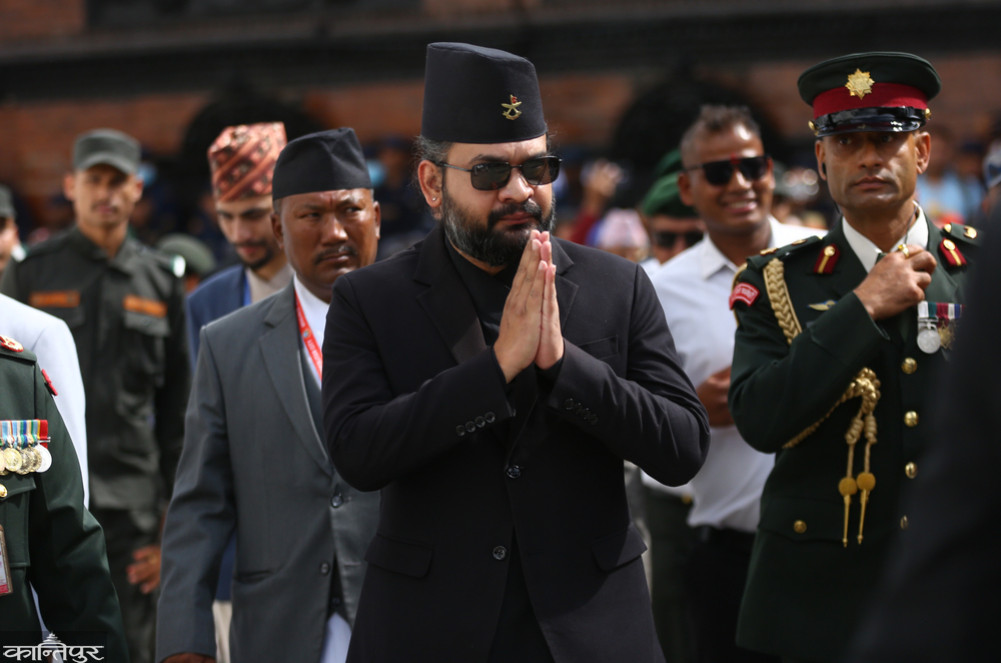
This election result should always be remembered in the history of Nepali democracy. Because the reason for this is that politics became structurally dominated by one party. A single party-majority situation emerged in the House of Representatives. Looking at the behavior of the government led by Balendra Shah, which lasted only a week, it seems that he is practicing 'non-partisanship' in a multi-party system. During the Panchayat, people of other political ideologies contested elections and reached the then parliament. Looking at Balendra's working style, it seems that he is not serious about harmonizing with the party system. He has prioritized the politics of work instead of party politics, and results instead of ideology. He is doing politics, but he refrains from calling it 'politics'. Leaders with a non-partisan character often engage in 'dopamine politics'.
The newly elected federal government is currently presenting itself in the language of announcements, actions, and reforms. Everything in the document appears systematic, attractive, and change-oriented - digital governance, transparency, accountability, improvement in service delivery, and administrative reorganization. Broadly speaking, the current federal government seems serious about its role. However, when one goes out of this glittering propaganda and goes to the villages and countryside, one is faced with a question, ‘Is this government seeing the people on the ground or is it just imagining them?’ Yes, this is where the question of ‘ground reality’ begins. Until the difference between a paper country and a real country is understood, everything is just ‘up-up’.
Decisions made sitting in Singha Durbar are often based on the imagination of a ‘special class of citizens’. That group who are educated, have easy access to government information, can use digital means and their problems can be managed with administrative efficiency. Whoever leads a government that targets this group, it basically bears the character of a ‘dopamine government’. In the digital age, ‘dopamine’ has become a metaphor.
For things that attract immediately, give quick gratification. The epithet of ‘dopamine’ government will remain as long as the current government depends on quick, showy and emotionally satisfying steps. When it shapes institutional dignity, parliamentary quality and long-term reforms to transform the chichila into fruit, then over time the common people will also change the epithet.
The benefits of patronage activities are mostly enjoyed by the ‘privileged’ group of urban and semi-urban people. And, for such groups, Nepal is just like a ‘pincode address’. This group only expects from the government that after pressing ‘OTP’, there should be easy access to government services. From the government’s vision reflected in the first week, it seems that this government is focusing more on the ‘problem of privilege’. However, the real citizens of Nepal who live in remote villages have a different world.
If the common man is not at the center, then the policy becomes an ‘elite project’. A policy is successful only when the needs of the common man are met and there is a qualitative improvement in their lives. A person standing in the last row does not think about how fast digital services have become? He thinks – is the wage available today or not? He does not ask whether the government portal is working or not? He wants to know – is medicine available at the nearest health post or not? Is there a health worker as per the schedule? As long as the ground situation is ignored, it is considered that decisions are being made only in an ‘imaginary country’.
Digital governance continues to transform people into ‘data’. It forgets the vitality of the individual. It keeps telling us ‘so and so percent of the people got the service’, but it is unable to tell us what the experience of the proposed services was like? Will it be respectable? Will it actually be useful or effective? Such questions can establish the credibility of the government. Every elected ruler says that the voice of the people is paramount. But, the main question is – is it being ensured that the voice of the common people is heard? Or is it only being decided in their name?
Digital governance continues to transform people into mere ‘data’. It forgets the vitality of the individual. It is telling us ‘so and so percent of the people received services’, but it is not able to tell us what the experience of the services offered was like? Will it remain respectful? Will it actually be useful or effective? The meaning of ‘listening’ in today’s politics is changing. Watching reactions on social media, reading survey reports, gathering information from artificial intelligence or meeting some representatives is considered to be the voice and aspirations of the people. However, this is a dangerous simplification. Nepal stands at a crossroads today, where it has both opportunities and dangers.
The opportunity is that it can take democracy to a deeper, more inclusive level. The danger is that it can be limited to a mere formal framework. Therefore, the greatest need is for the government to understand democracy as a living experience, not just as ‘management’. Data-driven governance makes statistics, surveys and indices the basis for policy making. However, this process creates a significant problem, which in the language of social science can be called the ‘epistemic gap’, i.e. the growing gap between knowledge creation and actual experience. Policy documents are based on the concept of the ‘average citizen’. Whereas real society is made up of multi-level inequality, cultural diversity and geographical heterogeneity. If the government really has the will to ‘do something’, it must choose meaningful means of getting acquainted with the lived reality.
The traditional theory of democracy assumes that elected representatives represent the aspirations and interests of the people. However, past experience has been mixed. In practice, this representation often ends up being ‘formal’ and not ‘meaningful’. This trend has continued to grow, leading to the centralization of decision-making within the ruling party, the limited social base of leadership and the insufficient presence of local experience in policy making.
This has led to the government being led by different parties. As a result, democracy remained a ‘representative structure’, but it was unable to adequately express the experiences of a wide section of society. Will this government consider this aspect? This question is not just a moral appeal, it has become a central element of democratic legitimacy.
The voice of the grassroots is often presented as a simple and natural concept. However, it is a complex socio-political construction. Who can speak? Whose voice can be heard? Through what means can the voice reach the Singha Durbar? All of these are intertwined with power relations. The previous regime gave everyone the opportunity to speak, but not everyone’s voice had the same impact. This government must now ensure that the ‘discursive inequalities’ of the recent past must be eliminated.
In a tea party in Gaur, Rautahat, it was heard, ‘Why is Balendra Shah now practicing to give a glimpse of independent status despite being associated with a particular party?’ This conversation indicated that democracy should not be understood as a procedural system alone. Previous governments had accepted elections, institutions, and rules and regulations. However, public expectations did not consider that enough.
How does an ordinary citizen experience the state in daily life? What is the quality of services? How much is their dignity being respected? Governments have not been able to adopt an experimental approach, which has created a terrible gap between the state and the people and led to turmoil. Unless today’s government works to reduce the gap between knowledge creation and experience, the same government structure as in the past will remain. However, it is losing confidence in itself.
Ultimately, what is needed today is for the government to be able to hear the call of Chaitavar. It should understand the growing rift between the people and the state. If there is a sincere effort to eradicate it, then Chaitavar can truly become the beginning of a new season. Otherwise, it will be just another song of unfulfilled hope.
Let us recall a line from Chaitavar, ‘Rama Chait ki nindiya badi bairinyan.’ The meaning is – this sleep of the month of Chaitavar is the biggest enemy. Today’s majoritarian times are challenging democracy and debate. Civil society cannot sleep at such a time. Vigilance, surveillance and conscious intervention – these are the basis for saving democracy. Otherwise, the politics of separation will continue to repeat itself forever within the illusion of greenery.