Article by Kalpana Nepal Acharya -The three tiers of government should prioritize the work of transforming subsistence agriculture into modern, mechanized, scientific, green, and commercially profitable enterprises.
We use Google Cloud Translation Services. Google requires we provide the following disclaimer relating to use of this service:
This service may contain translations powered by Google. Google disclaims all warranties related to the translations, expressed or implied, including any warranties of accuracy, reliability, and any implied warranties of merchantability, fitness for a particular purpose, and noninfringement.
According to the National Agricultural Census 2078, 62 percent of households in Nepal are engaged in agriculture. Ten years ago, this number was 71 percent. The data shows that the number of households based on agriculture is decreasing. According to the Economic Survey of Nepal 2080/81, about 66.7 percent of the total population of Nepal is in agriculture-based households. This comes to about two-thirds of the total population. The available data shows the need for comprehensive reforms in the agriculture sector.
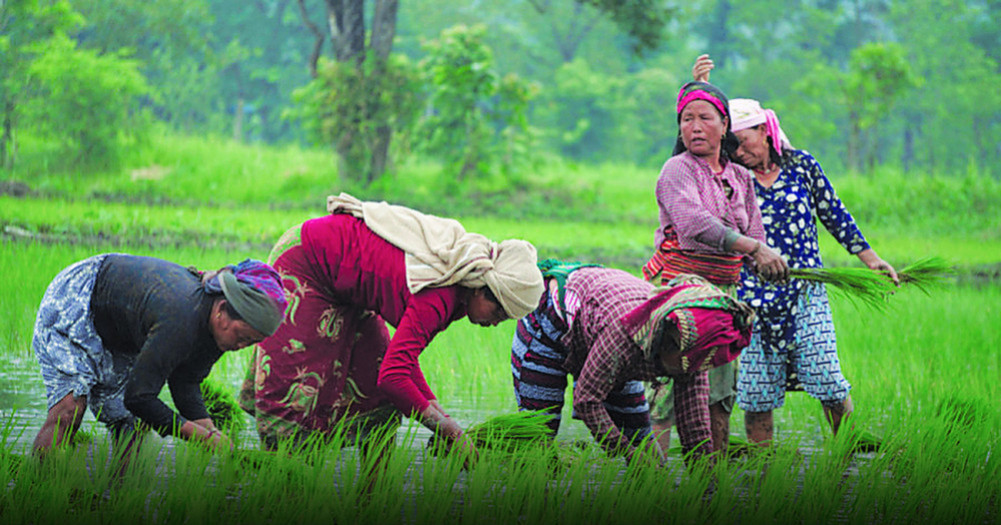
Women's involvement in agricultural work is more than 50 percent. But women's access to land ownership and decision-making processes is still low. Therefore, attention should be paid to women's participation. Only 25 percent of the farming households emphasize production for commercial purposes. The rest practice subsistence farming. Therefore, agriculture should be commercialized.
Emphasis should be placed on ensuring timely fertilizer, seeds, and irrigation. To end the shortage of chemical fertilizers during the farming season every year, a 'fertilizer supply calendar' should be implemented and provided to farmers on time. To eliminate the compulsion to rely on rainwater for irrigation, priority should be given to the development of small and medium irrigation projects and shallow tubewells in the dry areas of Madhesh. Emphasis should be placed on the development of suitable advanced and climate-friendly local seeds after soil testing, and a plan should be brought to make the country self-reliant in seeds.
Production-based subsidies and cheap credit arrangements should be ensured. Access-based subsidies should be abolished and 'production-based cash subsidies' should be provided. Agricultural loans should be provided to genuine farmers without collateral or at low interest rates.
To prevent land fragmentation, a policy of 'Chaklabandi' should be introduced and incentives should be given to commercial farming on a large scale. Small farmers should be given concessions in purchasing agricultural tools and machinery. To end the situation where farmers have to throw their produce on the streets without getting a fair price, a minimum support price should be fixed before planting the crop and the government should guarantee its purchase. An insurance program should be introduced to protect against damage caused by natural disasters, diseases or wildlife for agricultural insurance and risk reduction. A special package of 'seed money' and technology transfer should be introduced to attract youth who have returned from foreign employment to agriculture. A 'limited farmer card' and pension can be arranged to change the conservative social thinking that considers agriculture a 'low-level profession or job'.
Similar strategies should be adopted to solve problems according to the nature of this and other areas, geography and crops.
Nepal has a high population but low production. Now the future goal of the federal, provincial and local governments should be to reduce 66 percent of the population from agriculture and shift it to other industries or to increase agricultural productivity by 10 times. Irrigation and competition in border markets are the main problems in Madhesh. The three-tier government should give priority to electricity tariff exemption and domestic production in deep boring. The main problem in the hills is the shortage of wild animals and manpower. To address this, the issue of emphasizing collective farming and the use of modern machinery should be included. The main problem in the mountainous region is transportation and storage. Special emphasis should be placed on cold storage and mountainous branding. Plotting and concreting of land in urban areas is the main problem. Cultivable land should be designated as 'agricultural area' and the division should be banned. The three-tier government should prioritize the work of transforming subsistence agriculture into modern, mechanized, scientific, green and commercial profitable enterprises. Only then will the dream of prosperity for the country and its people be fulfilled.