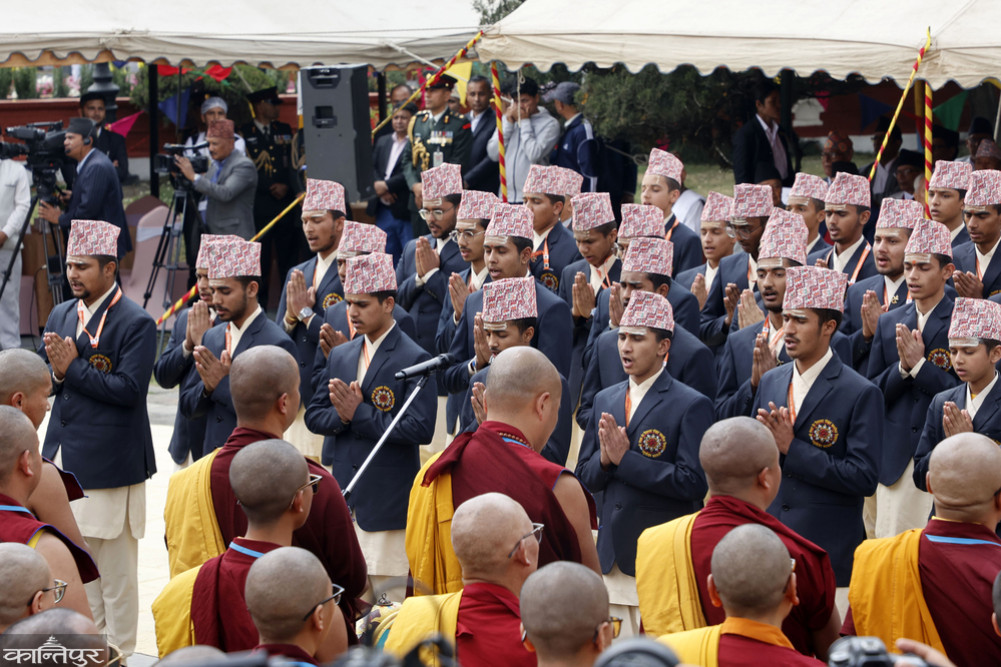
How can non-Hindus who voted for him understand the oath-taking ceremony, which is like a religious ritual, performed using state resources by a person who became the Prime Minister by garnering public support according to the secular constitution?
We use Google Cloud Translation Services. Google requires we provide the following disclaimer relating to use of this service:
This service may contain translations powered by Google. Google disclaims all warranties related to the translations, expressed or implied, including any warranties of accuracy, reliability, and any implied warranties of merchantability, fitness for a particular purpose, and noninfringement.
After Balendra Shah started to chant Hindu rituals during his swearing-in ceremony, I looked at some of the opinions on social media about what the common people were saying. Some argued, ‘Balen was right, it is a good thing to protect our religion and culture.’
What they had forgotten was that the Prime Minister is the highest public figure (institution) in the country. According to the secular constitution, how can non-Hindus who voted for him understand the religious ritual-like oath-taking ceremony performed by a person who became the Prime Minister by gathering public opinion and using state resources? Does this show a Hindu ‘trailer’ of Nepal’s future? Ballen’s monotheistic style cannot be ignored or explained as personal freedom. A religion that acts unilaterally is not fair. This article will argue why the intention to challenge the political and constitutional changes that have come with great pain, relying on the majority vote, is unacceptable for the social diversity of Nepal.
The power-politics of 'Swasti Shanti'
The tendency to easily accept the oath, which appears to be a Hindu ritual, as 'our culture' is problematic and intellectually hollow. This is not just a matter of culture, which is understood with deep reflection in sociology, but also a question of how power is displayed and how legitimacy is gradually built. In a multi-religious, diverse Nepali society, the public 'gestures' (gestures) shown by the ruler are the language of the state. And, when that language has to be transmitted by the highest figure of the state, it should be seen as reflecting an egalitarian society, not politics. If it is not presented in this way, it is not culture, but politics. The state should see everyone as equal, as George Orwell said, 'Nobody is more equal' for anyone.
In secular Nepal, the oath is not a place to demonstrate personal faith. The oath is a constitutional act, which is formed on a boundary that reflects personal faith and publicness. An oath is a contract made by the state with its citizens, like a promise that ‘I belong to all of you’. However, the fact that a person who is able to take office as the Prime Minister with a Tilsami vote makes the moment of the oath shocking with Hindu mantras, Batuk priests and religious rituals means that the state started breaking its own promise at that very moment. Even if it does not say it directly, it is a hint that it is saying, ‘I am closer to some, a little further away for others.’
How can the Rashtriya Swayamsevak Sangh (RSS), which showed the creativity of ‘contract agreement’ with the people during the elections, be biased in the contract agreement made with the people as an entire state through an oath?
This issue is not as simple as it is being made out to be. It is not ‘targeted towards anyone’ as it appears on the surface, but it is an attempt to show a mirror of the future by frightening a handful of marginalized common people. What does a Muslim citizen or a Dalit youth (who has suffered a lot through the caste system from Hinduism) see when they look at that oath? How do they see Swasti Shanti and the presence of Batuks? Do they see the state as their own or as someone's private property? We must ask this question honestly. Because the feeling of being a citizen is created not only by law, but also by symbols.
The argument that ‘Nepal is historically a Hindu country’ or ‘what is wrong with believing in an eternal religion’ is even more dangerous. Because that same history had made the state a heaven for some and a hell for many. That same history had legitimized casteist insults in the name of religion. Secularism was at a critical distance from that history. Now, returning that same history to the state as ‘tradition’ or ‘cultural tableau’ is not just a memory – it is the restoration of the old barbaric and biased state. It is an aspiration to push the state, which has come a long way on the path of secularism, back to barbaric history by holding on tightly.
The truth is that an excuse has been made here to save culture, but in reality a power restructuring is taking place. Once the state tries to ‘fill the music’ with religious tones, it will not be easy to return it. Today's culture, tomorrow's decision, tomorrow's policy—that influence permeates everything. And, we are still deceiving ourselves—saying, 'This is nothing.'
Majoritarianism: The beginning of the right wing
Right wing political projects never appear all at once in a big way. They are slowly and quietly built from decisions that seem 'normal'. Today, the Hindu-style oath is normalized, mocked, or suppressed as 'cultural' or 'traditional'. Tomorrow, a religious history is given priority in the school curriculum in the name of 'national identity'. In the institutions of the state, some groups are given priority in the name of 'tradition.' And, before we know it—the character of the state has already changed!
This same process is already beginning! And, what is even more dangerous—this process is not coming from a genuine and established right wing leader, but from a person like Balen Shah who carries a 'new', 'technocrat', 'non-political' image. This is its real power.
When these things come to the surface from someone like Balen, it is easy to resist. That is, coming from someone who does not have a long ideological background, it seems normal. But, from here on, things change. This is what Gramsci called ‘hegemony’, where an ideology is made so normal that it is uncomfortable to question it. For Balen, who has just risen to the top in politics and has reached the peak all at once and is almost untested, people are suffering from the mentality of ‘this will do something, let’s not be soft now’. This religious jolt of the new regime is deepening and reaching far and wide, which cannot be said to dare to easily dissolve the hard struggle of this beautiful secularism of Nepali society. If such a style spreads in the form of cultural or religious hegemony, there will be no greater social challenge than this.
Let us look at the context of South Asia, the thread of religion and nationalism is slowly entangling many countries. Sometimes in language, sometimes in textbooks, sometimes in politics over citizenship laws, as religion is slowly merging with politics, the minority common people have had to live in a state of servitude. Are the tax rates paid by the minority and the majority different for the state? Otherwise, what is the meaning of the religious upheaval seen in South Asia? If Nepal can keep itself separate from this, many will adopt it. Otherwise, when will the common people reach the conclusion that the current political change is not 'alternative politics' but only 'political options'!
The least talked about aspect in this debate is caste. Hindu culture is not an egalitarian, inclusive practice. It is historically hierarchical. Who gets to recite mantras? Who gets to touch here and there? Whose presence is considered 'pure'? These questions are not just religious, they are deep reflections on power relations. When the state adopts such a culture, it normalizes not only religion, but also the inequalities within it. For Dalits, this ritualistic oath-taking ceremony is not just a culture, but a reminder of the structures that have always kept them out.
And, we are dismissing it as ‘no big deal’. This is where the ‘soft coup’ is born, which is neither loud nor aggressive. But, it is like a continuous landslide. If the point of alert is further away, there will be no place to stand.
Secularism, equality and the future of Nepal at stake
Today’s debate is not just about the method of an oath. It is about the inner heart of Nepal. Secularism here is not a luxury idea, it was a necessity born of struggle. It was the promise according to which the state would no longer be owned by any one religion, caste or culture. However, the current trend is making that promise hollow. The most worrying thing is, this process has been made so normal that many have stopped seeing the danger! If we let the state speak through religious rituals today, tomorrow it will start making decisions through that religion. If we turn a blind eye today saying ‘this is just tradition’, tomorrow that tradition will start determining rights.
Do we really want a future where citizenship does not mean equal rights, but is determined by whose culture is compatible with the state? Where a special religious-cultural closeness is necessary to be a ‘true Nepali’?
The argument of ‘respecting all religions’ is also misleading here. Because, in doing so, the state becomes an arena of competing religious identities. In this way, each group demands its own place. And, ultimately, the citizenship of the citizen is fragmented, according to religion, according to caste.
True respect is distance from the state. Only when the state does not adopt any religion are all religions safe. But, we are moving in the opposite direction. Slowly, quietly, without debate! And, this is the biggest fear. Democracy does not collapse with a big blow! It crumbles with small compromises. Moreover, the Prime Minister’s special religious ritual needs to rise above the narrow political game. Today’s seemingly small decision can become the basis for tomorrow’s structural injustice. And then we will say, ‘How did this happen?’ But the truth is that it is already starting. We saw it, we understood it, but we did not take it seriously. ‘The best time to plant a tree was 20 years ago, the second best time is right now.’ Let us relate the Chinese proverb to this issue.
And finally, if the state cannot maintain impartiality in its symbol, it will not maintain it in its power either. And, on that day, secularism will not be a living reality but a disarming word written in the constitution.