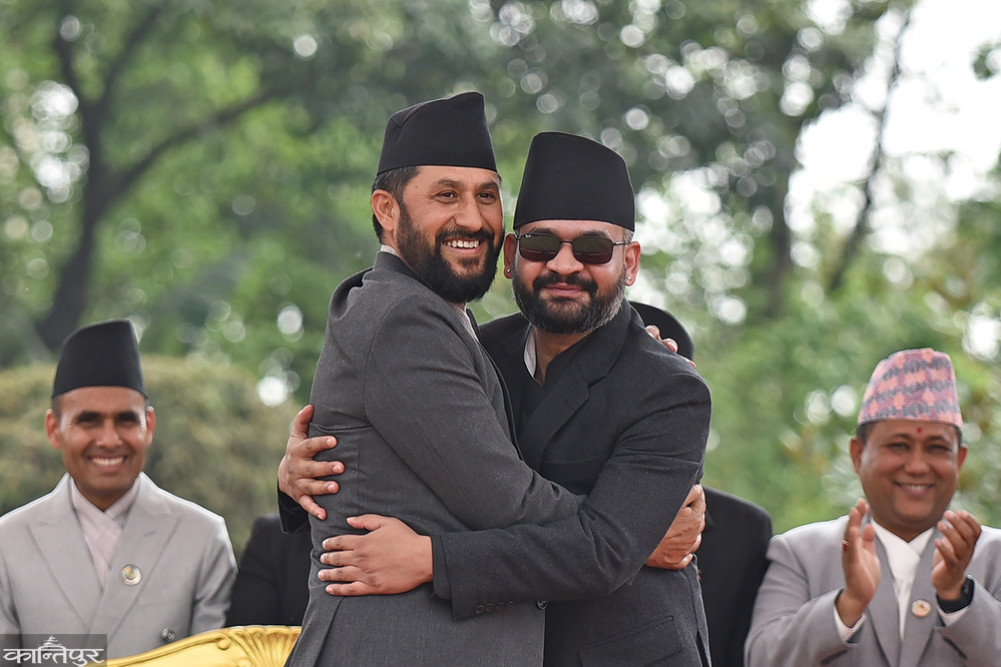
Holding both positions by the same person allows for quick and integrated decisions to be made in a short period of time, which benefits the country. However, the challenges of long-term institutional strengthening, time management, and balancing interests make this model risky. How to balance the ‘benefits’ and ‘challenges’ in the context of Nepal? It depends on the vision of the leadership and the internal culture of the party.
We use Google Cloud Translation Services. Google requires we provide the following disclaimer relating to use of this service:
This service may contain translations powered by Google. Google disclaims all warranties related to the translations, expressed or implied, including any warranties of accuracy, reliability, and any implied warranties of merchantability, fitness for a particular purpose, and noninfringement.
In the first parliamentary election of 2015, the Nepali Congress won two-thirds of the seats. Then, in the House of Representatives election on Falgun 21, the National Independent Party (NISP) won 182 seats in the 275-member House of Representatives and formed a government with a single and clear majority of about two-thirds. NISP has given the responsibility of Prime Minister and parliamentary party leader to Balendra Shah (Balen). The party president is Ravi Lamichhane.
We usually get election fever, that is, the election covers Nepalis with its heart. Not only while waiting for the day of voting, but also weeks after the voting is over, the 'post-election fever' does not leave us. In this situation where a new government has been formed, what will be the collaboration between Prime Minister Balendra Shah and NISP President Rabi Lamichhane? It seems that the people are worried about whether it will last for a long time or not. Generally speaking, the friendship of two friends, one who seems to be introverted and the other who seems to be extroverted, is seen to guide the future of the country. And, this has now become the topic of discussion in Nepal's chautaras, tea shops, restaurants, and squares. At a time when the public is curious about the effectiveness or negative aspects of having the party chairman and the prime minister/parliamentary party leader as the same person or as different people, this article has attempted to analyze the experience since 2048, international practice, and the current structure of the Rashtriya Swayamsevak Sangh (RSS).
It is not possible to imagine an ideal model in political structure. Naturally, both models have their own challenges and opportunities. Overall, based on experience, the leadership divided into two positions and two individuals has led to a power struggle due to constant personality clashes. The concept of two positions for one person has hindered institutional development, centralizing authority in leadership, and individualism has become dominant over the system. And, it seems that his working style will not be effective . The current curiosity is about what kind of coordination this experiment of the RSVP will provide in the future . Let's look at some past experiences:
Incident: 1- Koirala and Bhattarai
The Nepali Congress, which was in high spirits in the 2048 election, won a comfortable majority The by-election marked the climax of the Koirala-Bhattrai conflict. A 17-minute speech read by Prime Minister Koirala on Radio Nepal a week before the election in the constituency where President Bhattarai was a candidate took a new turn. After Koirala's speech targeting Bhattarai and another Nepali Congress leader Ganeshman Singh, 56 MPs within the party rebelled against Koirala. As a result, Bhattarai was defeated in the by-election and Madan Bhandari's wife, Vidya Bhandari, won. It is said that Koirala's supporters did not vote for Bhattarai and Bhattarai, who was considered an ideal figure, unexpectedly suffered a defeat. The seeds sown at that time are still visible in the Congress.
That incident showed that power was divided into two places and a competition to see who was more powerful within the party began. The situation became complicated when the Prime Minister did not take the party decision seriously and the factionalism (Ganeshman Singh-Bhattrai-Koirala triangle) became stronger. Later, the same power struggle between Sushil Koirala, Sher Bahadur Deuba and Gagan Thapa-Deuba has not ended. And, the result of this came on the streets in the elections of Falgun 21. The commentary that one person should hold both positions became strong within the Congress. However, stability could not be achieved.
Incident: 2- Oli and Prachanda
In 2075, the UML and the Maoist Center merged to form the CPN, shocking not only the communists of Nepal but also some neighboring countries. And, in the name of balance of power, a new trend began with Oli and Prachanda becoming the presidents of both parties. A verbal agreement was made for the unification in which Ganesh Oli would take the oath of office of Prime Minister and then hand it over to Prachanda. However, when Oli refused to hand over the post of Prime Minister, the conflict reached its peak.
An event that will always be mentioned as a root cause of political instability in Nepal's history occurred on December 20, 2077. The then Prime Minister Oli recommended the dissolution of the House of Representatives. Oli said that he was 'besieged by the party' and chose the path of easy dissolution of the parliament using the authority of the Prime Minister. However, when the Supreme Court declared the dissolution unconstitutional on February 20, 2078 and restored the parliament, the conflict split the party within two years and political instability ensued. The remnants of that moustache fight still remain.
Both bitter incidents of the past and those that have a long-term impact on Nepal's politics have proven that when different people hold positions, there is a lack of coordination, factionalism and institutional instability. However, the responsibility of learning from the past mistakes of their own country and not repeating them in their own country has now fallen to the young leaders Balendra and Ravi, who are expected to learn from their own country's past mistakes and not repeat them. For this, let's also look at international examples that we can learn from:
Alternative model of coordination: A story beyond borders
Few Nepalis know that the BJP president in our neighboring country, India, is 46-year-old Nitin Naveen, who is about 30 years younger than Modi. Whether it is the former JP Nadda or the current Nitin – both names rarely come into the news. Prime Minister Narendra Modi's popularity is unlimited in the world. It is said that the relationship between Prime Minister Modi and his close friend Home Minister Amit Shah is warm and exemplary. Shah leads the party organization, candidate selection and campaign together with the party president, while Modi has run a successful government.
Then, the conflict between Modi and the BJP's parent organization, the Rashtriya Swayamsevak Sangh (RSS), comes to the surface from time to time and that is why the BJP has not been able to appoint a president for a long time. The RSS is heard expressing dissatisfaction with Modi, saying that Modi has run the government and the party arbitrarily by appointing a weak party president. In India, it is not easy to elect a president without the tacit consent or 'green signal' of the RSS. Nitin was made the president only last year, extending Nadda's tenure for a long time without getting the green signal from the RSS.
Despite this, Modi has been providing stable and powerful leadership to India as the Prime Minister for 12 consecutive years. This seems to be just an imagination for Nepal, which has had one prime minister in a year on average.
In the BJP, some key parties seem to work in collaboration with the president and the prime minister. First, the prime minister looks after the administrative and development work of the government, while the BJP president manages the organization expansion and political activities of the party. Second, they regularly discuss and advise on the political situation of the country, election strategy and party issues. Third, there is constant communication between the president and the prime minister to maintain coordination between the party's policies and the government's line of action. Fourth, during elections, the prime minister takes charge of publicity, while the president focuses on activating the party's organization and managing elections. This is how a clear division of labor occurs.
Now let's talk about America, which has the oldest and most mature democratic system in the world. The current national chairman of the Republican National Committee of the American Republican Party is Michael Whatley. In America, the influence, power, and authority of President Donald Trump are naturally more important than the name of the formal chairman of the Republican Party. However, due to the coordination of the party and the government, disputes like those in Nepal are not heard in America. In America, the main job of the party chairman is to raise funds, manage elections, and mobilize grassroots organizations. The president or the main candidate is supreme in policy and political decisions.
The above examples show that when different people hold different positions, a clear division of authority, role, responsibility, and strategic unity is necessary.
What are the advantages and disadvantages?
When the party chairman and the leader of the parliamentary party are the same person, there are also positive aspects in terms of convenience in the political system. In this, the Prime Minister can spend more time on running the state when there is no need to manage cadres. Another benefit is consistency and stability in the decision-making process. From policy formulation to implementation, there is no conflict or contradiction between the party's organizational vision and the government's executive decisions. The government can move forward quickly and effectively without being affected by debates or disagreements within the party.
This facilitates quick decision-making, especially in times of crisis or when immediate policy changes are required. For example, when the party and the government share the same view on issues such as large infrastructure projects or economic reforms, delays in implementation are reduced.
Clarity of accountability can be seen as another benefit. Since the public gives credit or blame for success or failure to a single person, there is a greater chance of making the leadership more responsible and creating a sense of accountability. The opposition also clearly targets and criticizes a single person. This helps to make political debate focused and people-oriented. In a parliamentary system, the position of the Prime Minister is accountable to the parliament, which makes it easier.
However, looking back, there are also disadvantages to this structure. The biggest problem is time management. When the Prime Minister is divided between daily administration, international relations, cabinet management, and parliamentary meetings, which should be attended to, strengthening the party organization, cadre management, preparation for the general convention, and reconciling factions, time management appears to be a major challenge.
If the Prime Minister is unable to make both roles fully effective, the risk of weakening the party organization or delaying the implementation of government policies increases, which Nepal has experienced. The example of leaders in the past in Nepal not being completely successful in controlling dissatisfaction and factionalism within the party when they held both positions proves this challenge.
In Nepal, the government is often run from Baluwatar, not from Singha Durbar. Government decisions are sometimes made to please party cadres and balance the frayed factions. And, when party cadres are appointed over qualified individuals, the conflict of interest is clear. When one person has to balance both, there is a bias or weakness in the decision-making. This can weaken the internal democracy of the party in the long run and also affect the image of the government.
When both key positions are concentrated in one person, the possibility of leadership development of second-tier leaders within the party and the government is reduced. This also carries the risk of hindering overall institutional development. It makes the organization person-centered, which can be detrimental to long-term stability in a country with political instability like Nepal.
Overall, when one person holds both positions, quick and integrated decisions can be made in a short period of time, which benefits the country. However, the challenges of long-term institutional strengthening, time management, and balancing interests make this model risky. How to balance the ‘benefits’ and ‘challenges’ in the context of Nepal? It depends on the foresight of the leadership and the internal culture of the party.
The new structure of the Rashtriya Swayamsevak Sangh (RSS) party: Opportunities and risks
There are some potential challenges to the leadership structure of party President Ravi Lamichhane and Prime Minister and parliamentary party leader Balendra Shah. Since Balendra and Ravi are both strong personalities, many Nepalis are now worried that they will not be able to move forward in the long term. Therefore, there is a possibility of personality clashes in this structure. Similarly, how will there be coordination in policy-making, organization strengthening, and how will there be clarity of roles? This curiosity is also being raised. How clear will the views of both of them be on sensitive issues like federalism and secularism? It is not unnatural to be interested in this.
The basis for the success of the collaboration of 50-year-old Ravi and 36-year-old Balendra, who are eager to build the country, is also visible. Both the youths do not have the opportunity to repeat the mistakes made by the Congress and the UML, knowingly or unknowingly, in the past. This time, the tsunami of votes was also given on the same belief. Ravi's hold on the organization and Walendra's public appeal and good governance image can complement each other and make up for their weaknesses. The historic majority of 182 seats will force both of them to cooperate to take the country on a positive path. If we learn from international experience, whether it is India or America, only a clear division of roles and trust can avert potential conflicts.
A test of cooperation
With the election of Falgun 21, 2082, both Ravi Lamichhane and Walendra Shah have come forward as symbols of the people's aspirations. Only through complementary cooperation, not personal competition between the two youths, is it possible to achieve 5 years of political stability and country development in line with the people's expectations. Only if the party president focuses on strengthening the organization and the Prime Minister focuses on good governance and policy implementation, can the two Rathis set a new standard in Nepali politics.
May the honeymoon of Ravi and Balendra not be marred by any trouble for at least five years and may Nepal's political stability and prosperity take a positive turn in the coming 5 years. There is no chance that this experiment of the Rashtriya Swayamsevak Sangh (RSS) will fail. May the country move forward on the path of development by becoming an excellent example of coordination.