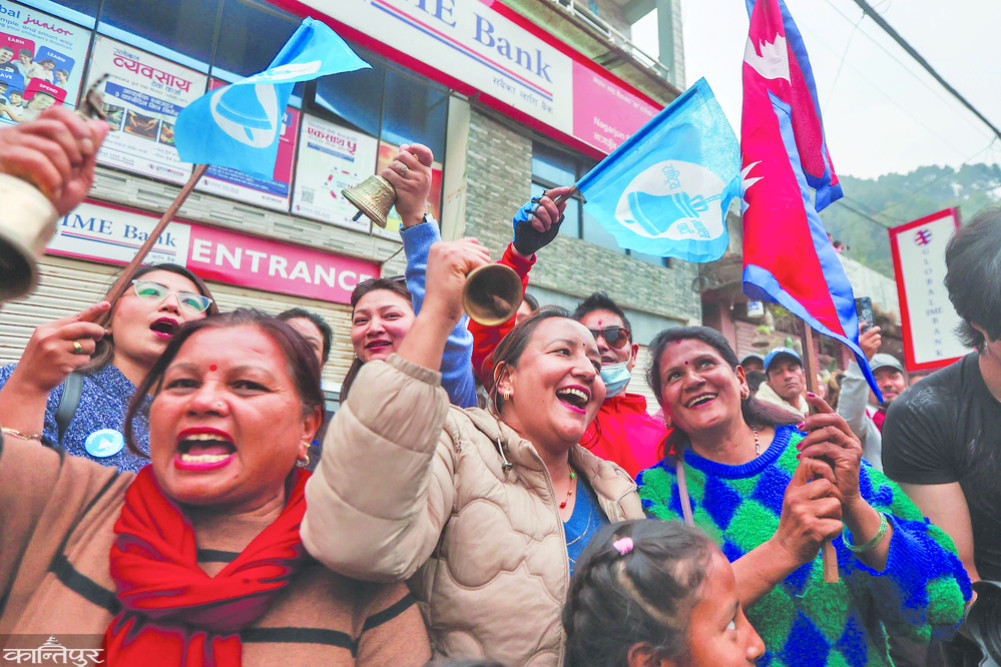
The Rashtriya Swayamsevak Sangh (RSS) went to the people with agendas like corruption control, good governance, service delivery, and economic development. The people voted for them more than they had imagined. This now seems to be the beginning of policy and agenda politics in Nepal.
We use Google Cloud Translation Services. Google requires we provide the following disclaimer relating to use of this service:
This service may contain translations powered by Google. Google disclaims all warranties related to the translations, expressed or implied, including any warranties of accuracy, reliability, and any implied warranties of merchantability, fitness for a particular purpose, and noninfringement.
A new political debate has begun after the Rashtriya Swayamsevak Sangh (RSS) won nearly two-thirds of the seats in the House of Representatives elections held on 21 Falgun. The shameful defeat of the Congress, UML, and NCP, which have played a special role in the democratic movement and are considered the mainstream until now, and the unprecedented victory of the Rashtriya Swayamsevak Sangh (RSS) have given a meaningful message.
This election has unexpectedly reshaped the traditional commentaries, standards, and indices about politics, political parties, and elections. Even the traditional political debate that has been going on for a long time has become irrelevant. International media outlets, including CNN, BBC, and the New York Times, which were rare in the past, are widely discussing this election and its results.
In particular, the miraculous rise of Balen Shah and his popularity and the defeat of the communist parties seem to be the main concern and priority of the international media. How did the Rashtriya Swayamsevak Sangh (RSS) manage to gain so much popular vote less than four years after its establishment and without even holding its first general convention? Is this Balen's victory or the Rashtriya Swayamsevak Sangh's? Why were the parties including Congress, UML, NCP and others defeated? For their own political health and future, not only the parties including Congress, UML, NCP and others, but also the Rashtriya Swayamsevak Sangh (RSS) need to find answers to these questions.
In the opinion of the columnist, there has been a 'tectonic shift' in Nepali politics. That is, there has been a fundamental change in ideological, structural and generational perspectives. Such a shift will have immediate and long-term effects. But how did such a shift come about? What are the reasons for it? What impact will such a shift have in the future? These are the main questions at present. Objective study, research and debate are needed on this.
There are seven main reasons for such a shift. From ideology to agenda Nepal's politics has now shifted from ideology (ideology or ideology) to agenda. Parties including Congress, UML, NCP and others have been doing politics on the basis of ideology. They have been chanting ideologies and jargons like nationalism, socialism, communism, liberalism, anarchism, capitalism, authoritarianism, imperialism, expansionism like Gayatri mantra.
In this election too, these parties gave priority to ideology. But the people had no attraction towards the abstract philosophy, ideology, arguments, and principles that they had been listening to for years. That is why these parties were shamefully defeated. But the Rashtriya Swayamsevak Sangh (RSS), which has been giving priority to the agenda over ideology, arguments, and philosophy, went to the people with agendas like corruption control, good governance, service delivery, and economic development.
Supporting that agenda, the people gave more votes to the RSSS than they had imagined. Analyzing from this scenario, it seems that the politics of policy and agenda has begun in Nepal. The current election results are the result of this. But another harsh reality is that there was no expected debate about the agenda during the election.
There was only a series of accusations and counter-accusations between the old party and generation versus the new party and generation. Based on facts not on commentary, emotion not on vision, and propaganda not on agenda, the misleading and populist commentary that ‘be it party or generation, all the old are bad and all the new are good’ was established. Like the advertisement that said ‘Cold is Coca-Cola’, the people silently voted for Ghanti, hypnotized by the commentary that ‘Change is not the prime minister’.
Since the publication of the much-loved book ‘The End of Ideology’ by American political scientist Daniel Bell in 1960, there has been a global debate about the end of ideology. Bell argues, ‘The major ideologies that dominated the 19th and 20th centuries, communism, Marxism, fascism, feudalism, authoritarianism, totalitarianism, and absolutism, are becoming irrelevant and failing.’ He concludes, ‘The era of ideology has gradually ended and the era of policy, agenda, and reform has begun, and the future of democracy also lies in this.’
How relevant and appropriate are arguments, ideologies, and theories in the post-modern, post-ideological, and post-truth era of the 21st century? The question itself is a matter of debate and controversy. But as Bell predicted, the era of ideology has not ended. Because even now, there is intense debate about ideology worldwide. World politics is being polarized on the basis of ideology, and studies, research and teaching about ideology are being conducted in renowned universities in America and Europe.
Because ideology and theory are a process of continuous development, modification and updating. Political ideology guides states, governments and parties. On the other hand, not only political, but also economic, social, cultural, linguistic agendas have gained equal importance. Agendas such as economic development, good governance, corruption control, education, health, employment, environment, climate change, social justice, gender equality, sustainable development have gained prominence.
Therefore, it seems that the current and popular agendas have gained priority over traditional and political ones. Alternative stream from mainstream Another political shift is – alternative stream from mainstream. Currently, globally, the mainstream, middle-of-the-road, liberalism is becoming unpopular and defensive, while populist, conservative, nationalist trends are becoming dominant. After the establishment of democracy in 2046 and its entry into the mainstream in 2063, the people had been trusting the legacy of the mainstream parties such as the Congress, UML, and Maoists.
That is why they have been running the state power till now. But the mainstream that was considered until now has now become defensive and the alternative stream is being established as the mainstream. The Rashtriya Swayamsevak Sangh (RSS) has succeeded in establishing the narrative of being an alternative stream party. The defeat of the Congress, UML, and NCP and the victory of the Rashtriya Swayamsevak Sangh (RSS) is proof that politics has shifted from the mainstream to the alternative stream. The credit for establishing the alternative stream thus goes to the Vibeksheel Party and Ujjwal Thapa.
Now, not only mainstream politics, parties, and leadership, but the mainstream as a whole has become defensive and weak. There has been widespread criticism and negative comments on mainstream media, editors, intellectuals, writers, and activists. Similarly, it seems that the ‘discourse’ of society, including political, economic, social, cultural, linguistic, and literary, is shifting from the mainstream to the alternative stream. In this way, alternative and new media, i.e. social media and digital platforms, have played a role in the establishment of alternative streams.
From organization to social media and algorithms The main basis of party building is principles, ideas, organization and leadership. Until the 19th and 20th centuries, leaders and cadres would go to the people with the party's principles, ideas and policies. On that basis, public opinion was gained by organizing. Although the media was the medium for any party to reach the people to some extent, it was basically only the leaders and cadres.
However, in the era of digital and algorithms of the fifth industrial revolution of the 21st century, such traditional methods, processes and styles have changed fundamentally. Now, parties are formed not through traditional methods, but through non-traditional methods. Due to the development of educational level, awareness, information technology and social media, a new chapter in party building has begun.
Now, a digital environment has been created in which parties and leadership can be established that can directly communicate with the people through media, social media and digital platforms and gain the support of the people. Now, the era of developing a party based on a clear vision, policy and agenda and leadership based on vision and image has begun. This is a remarkable achievement in terms of party building and leadership development.
Now, through this process, the party, leadership and cadres are directly communicating and interacting with the public. It has become an effective and popular medium in terms of political communication and dialogue. Now, an environment is developing where ideas are created and narratives are established through independent intellectuals, celebrities, social media 'influencers', social workers and enlightened citizens.
The social media and algorithm departments are becoming more powerful and influential than the party's organization department. A new practice and strategy has begun to win elections and weaken competitors by managing the media, digital media and social media. Now, there is a growing trend of establishing sponsored and populist commentary promoted by algorithms on social media rather than the real agenda of the people.
Following this strategy, the Rashtriya Swayamsevak Sangh (RSS) has established itself as a popular party. What will be the long-term impact of such a trend? That is a separate debate. But this is the harsh reality of the present. From cadres to the people Another important dimension is the shift in politics from party leaders and cadres directly to the people. Until now, politics was done by party leaders and cadres. There was a big wall between the leaders and cadres of any party and the people. That wall was created by the party leaders and cadres themselves. But this election has broken that wall.
This is a positive aspect from the perspective of building a people-based party. Therefore, now a policy of making 'few cadres, many members and supporters-well-wishers' should be adopted. Now an environment has been created where many cadres are a burden to the party and many members and well-wishers are assets. The image of the intellectual community, civil society, social activists, celebrities is positive, they have credibility and the people listen to them. But the image of party leaders and cadres is also not positive and the people do not trust them.
In order to end autocracy and establish democracy and a republic through revolution, movement and struggle, in the context of the time, parties needed to be based on cadres and full-time cadres were also needed. But with the establishment of a democratic republic and the democratic and constitutional process in place, there is no need for revolution or struggle, except for exceptions.
On the other hand, cadre-based is the communist organization system. Despite being a democrat, the Congress has become a semi-cadre and semi-people-based party, influenced and inspired by the communist system. Therefore, not only the Congress, but all parties should be transformed into a people-based party by following an open and liberal system.
On the one hand, there are a large number of leaders and cadres, on the other hand, they are not financially self-sufficient. In some cases, there are more brokers, middlemen and commission agents than leaders and cadres. It seems that they are not contributing to the party, but are only using the party for the purpose of exploiting the state. This is why the party and leaders have become visible and invisible sources and protectors of corruption.
Should the party be made an exploitative body or a body that serves the people? Where will such a tendency and character lead the party? From the old or 'established' generation to the new generation, politics seems to have fundamentally shifted through this election from the old and established generation to the new and young generation.
New leadership with generational transition was the main agenda of the people, especially the young generation. This agenda was established after the Gen-G rebellion. The office bearers of the Rashtriya Swayamsevak Sangh (RSS), which is considered a relatively young and new generation party, are mostly around 50 years old, while 36-year-old Balen is being appointed Prime Minister today. About 100 MPs under the age of 40 have been elected in this election. Out of which 13 are Gen-G.
More than half of the MPs are under the age of 45. The average age of direct and proportional MPs is about 45. This is a revolutionary generational transition and transformation of Nepali politics. The credit for this goes to Balen and the RSS. Congress President Gagan Thapa had been raising the issue of generational transition for a long time.
He could not implement it or did not have the time. But Balen and the RSS did it. तर यसको ठीक विपरीत एमाले, नेकपा, राप्रपालगायतका पार्टी पुरानो पुस्ताले नेतृत्व गर्दै आएका छन् । लामो बहस र विवादपछि पुसमा भएको विशेष महाधिवेशनबाट थापा कांग्रेसको सभापति हुन सफल भए । अब १५औं महाधिवेशनमार्फत केन्द्रदेखि वडासम्म कांग्रेसको नेतृत्व पुस्तान्तरणसहित नयाँ नेतृत्व स्थापित गर्नु अपरिहार्य भएको देखिन्छ । त्यसपछि बल्ल कांग्रेसले पुनर्जीवन पाउनेछ ।
केवल कांग्रेसले मात्रै होइन, अन्य सबै पार्टीले पुस्तान्तरणसहितको नयाँ नेतृत्व स्थापित गर्नु अपरिहार्य छ । होइन भने पुनर्जीवन पाउने सम्भावना छैन । यथास्थितिवादबाट परिवर्तन यस पटकको निर्वाचनमा जनतामा परिवर्तनको उत्कट आकांक्षा थियो । यो केवल युवा पुस्तामा मात्रै होइन, सबै पुस्तामा थियो । त्यसैले यस पटक परिवर्तन राष्ट्रिय आकांक्षा भयो । कांग्रेस, एमाले, नेकपालगायतका पार्टी यथास्थितिवादी भए ।
जनताका अधिकार र लोकतन्त्र स्थापनाका लागि गरेको संघर्ष सुनौलो र गौरवपूर्ण भए पनि ती पार्टी र नेताहरू अतीत र इतिहासमुखी भए । अर्कोतिर ती पार्टी सत्तामा आएपछि मौलाएको कुशासन र भ्रष्टाचारका कारणले जनतामा अत्यन्त अलोकप्रिय भएका थिए । विशेष महाधिवेशनबाट नयाँ नीति र नेतृत्वका साथ जनतामा गए पनि कांग्रेसले उक्त भाष्य स्थापित गर्न सकेन ।
त्यसैले बदलिएको कांग्रेस पनि सोही भाष्यको सिकार भयो । तर जनताले अतीत र इतिहासमुखी होइन, परिवर्तनकामी र भविष्यमुखी पार्टी र नेतृत्व खोजेका थिए । रास्वपालाई जनताले परिवर्तनकामी र भविष्यमुखी पार्टीका रूपमा आत्मसात् गरे । विशेषगरी जेन–जी आन्दोलनका प्रेरक र संरक्षक मानिने बालेन रास्वपाबाट प्रधानमन्त्रीको उम्मेदवार भएपछि यस्तो भाष्य स्थापित भयो ।
त्यसको एकल र अधिकतम राजनीतिक लाभ रास्वपाले हासिल गर्न सफल भयो । यद्यपि रास्वपा परिवर्तनकामी र भविष्यमुखी तथा वैकल्पिक धारको पार्टी हो कि होइन ? त्यो पृथक् बहसको विषय हो । तर अहिलेको स्थापित भाष्य यही हो । नेपाली समाजले पनि भिजनरी र उत्तरदायी नेतृत्व होइन, तिलस्मी नायक वा जादुगर खोजेको खोजेको प्रतीत हुन्छ । लोकतन्त्रका लागि योभन्दा ठूलो दुर्भाग्य अरू के हुन सक्छ ?
उदारवाद र बहुलवादबाट अनुदारवाद र पपुलिजम अहिलेको राजनीति उदारवादी तथा बहुलवादी धारबाट क्रमिक रूपमा अनुदारवादी तथा पपुलिस्ट धारतर्फ उन्मुख हुँदै गएको छ । यस्तो केवल नेपालको मात्रै होइन, विश्वव्यापी लहर हो । नेपालको सन्दर्भमा यस्तो अनुदारवादी तथा पपुलिस्ट धारको नेतृत्व रास्वपाले गरेको छ । अर्थनीतिका दृष्टिले उदारवादी भए पनि राजनीतिक, सामाजिक, सांस्कृतिक, भाषिक दृष्टिले रास्वपाले अनुदारवादी धारको नेतृत्व गर्छ ।
बालेन नेतृत्वको रास्वपाको सरकार थप अनुदार र अनुत्तरदायी हुने सम्भावना देखिन्छ । अमेरिकाको नोट्रेडम विश्वविद्यालयका प्राध्यापक प्याट्रिक डेनिनको सन् २०१८ मा प्रकाशित बहुचर्चित किताव ‘ह्वाई लिब्रालिजम फेल्ड’ नेपालका पार्टीका नेता–कार्यकर्ताहरू विशेषगरी लोकतन्त्र र उदारवादमा विश्वास गर्ने कांग्रेसजनहरूले पढ्न आवश्यक छ ।
लामो अध्ययन–अनुसन्धानपछि उदारवादको असफलताका बारेमा लेखिएको उक्त पुस्तकका तथ्य, तथ्यांक र निष्कर्षलाई आत्मसात् गरी उपयुक्त नीति र मार्गचित्र अनुसरण गर्नु आवश्यक छ । उदारवाद असफल भएको धारणासँग सहमत भएर अनुदारवादी धारतर्फ उन्मुख हुनुपर्छ भन्ने पंक्तिकारको निष्कर्ष होइन । तर उदार लोकतन्त्र र उदारवादको सुधार र सान्दर्भिकताका लागि पनि विगतका असफलताबाट शिक्षा लिनु अपरिहार्य छ ।