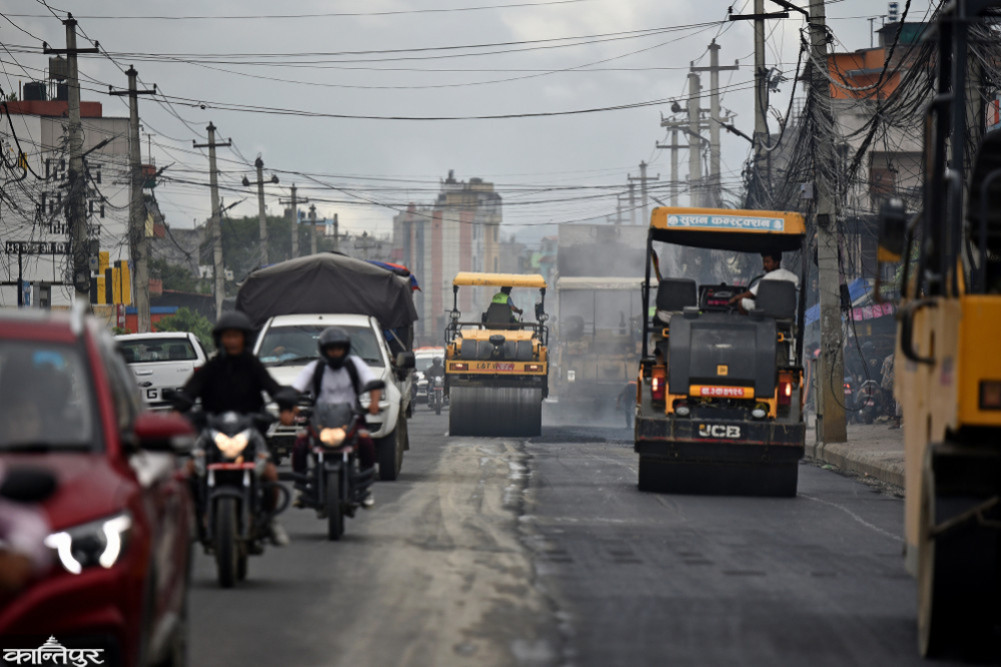
Administrative expenses have increased in Nepal, and the capacity to spend capital on development has shrunk. Capital allocations have also not been spent at the right pace. The trend of spending 40 to 60 percent of the budget only in the last two months of the fiscal year has become an institutional 'chronic disease' for decades.
We use Google Cloud Translation Services. Google requires we provide the following disclaimer relating to use of this service:
This service may contain translations powered by Google. Google disclaims all warranties related to the translations, expressed or implied, including any warranties of accuracy, reliability, and any implied warranties of merchantability, fitness for a particular purpose, and noninfringement.
In Nepal, an annual investment of 8 to 12 percent of GDP is required to bridge the gap between infrastructure investment and needs. Out of the current per capita expenditure of 93 US dollars in urban areas, only about 47 is being spent. A World Bank report has pointed out that investment should be increased to 10 to 15 percent annually to achieve the goal of becoming a middle-income country by 2030.
Capital expenditure refers to the investment made by the government for the construction of physical infrastructure, the creation of permanent assets and capital formation. This type of expenditure helps increase the country's production capacity and generate income or returns in the future. Nepal's 16th Plan and the 'Easy Transformation Strategy' have emphasized public-private partnerships in infrastructure to increase production capacity and meet the challenges that may arise in foreign trade. Investment focused on transport, energy, information technology and urban infrastructure is needed.
The government has allocated a budget of Rs 1964.11 billion for the current fiscal year, of which only 20.8 percent is the capital budget - Rs 407.89 billion. As of March 20, only 18.75 percent has been implemented. Out of the target of 1.48 trillion rupees, only 48.41 percent (716 billion rupees) of revenue has been collected.
Capital expenditure refers to the government's investment in physical infrastructure construction, permanent asset creation, and capital formation. This type of expenditure helps increase the country's productive capacity and generate future income or returns.
Increasing public expenditure is considered essential for rapid economic growth in developing countries. There are vast and diverse resources in a state of underutilization. Weak infrastructure, lack of technical knowledge, growing population, and most importantly, lack of capital. Capital construction and overcoming the lack of capital are matters of strategic importance. Government studies have shown that the reasons for low capital expenditure in Nepal include bureaucratic laxity, complexity of the public procurement process, and lack of preparation for projects. This article has been prepared in the context of spending the small capital portion of the budget in a way that maximizes returns.
Nepal's context
Public and government expenditure are generally used interchangeably. However, in a more detailed view, public sector also includes government-owned enterprises. In Nepal, ‘current expenditure of a capital nature’ is kept under the headings of ‘fiscal transfer’ and ‘conditional grant’.
Even though the budget given to the road board for road maintenance is under the heading of ‘current’, it is considered to be of a capital nature. A large part (about 60-70 percent) of the ‘conditional grant’ given to the lower levels from the central government’s account is spent on development but appears as ‘current expenditure’. About 20 percent to 25 percent of the current expenditure is actually of a capital nature.
Importance of capital expenditure
The proportional analysis of Nepal’s 15th Plan has expected a solid contribution of up to 3.55 percent to poverty alleviation work due to investment in capital expenditure and development activities. A 15 percent increase in capital expenditure will have a positive impact on poverty alleviation.
An important objective of the expansionary fiscal policy that Nepal has been practicing is to achieve significant economic growth, the most specific tool of which is public expenditure.
Interrelationship of expenditure
An important objective of the expansionary fiscal policy practiced by Nepal is to achieve significant economic growth, the most specific tool of which is public expenditure. Capital expenditure helps increase production and income by creating a 'multiplier effect' in the economy. An economic growth of 0.58 percent for a one percent increase in expenditure shows that there is a positive and meaningful relationship between government capital expenditure and GDP. However, the average economic growth rate of only around 4 percent shows that the relationship between expenditure and achievement is weak.
The trend of capital expenditure and its impact on the economy are directly linked to the timing and quality of expenditure. Expenditures made up to the month of Poush are considered 'timely expenditure', which has a positive impact. When money reaches the market from the treasury on time, there is no shortage of investable funds in banks. When expenditure is low in the initial month, there is a shortage of money in the market. 'Crowding effect' means that when the government spends on time, enthusiasm in the private sector also increases and demand for construction materials increases, which keeps economic activity moving. Timely expenditure is also considered planned and ensures the quality of infrastructure.
Administrative expenses have increased, the capacity to spend capital for development has shrunk. Capital allocation has also not been spent in the right rhythm and proportion. The trend of spending about 40 percent to 60 percent of the budget only in the last two months of the fiscal year seems to be institutionalizing as a 'chronic disease' for decades. It is believed that the assets created by the trend called 'unsustainable development' are not sustainable. There is a lack of financial discipline in work such as only arranging paper processes. When work is done in advance and payment is delayed and then a large amount is released into the market at once, inflation increases and the monetary balance deteriorates, which puts temporary pressure on the economy.
Spending in Pus is considered like 'fuel' for a machine, but spending only in Jestha/Asar is considered like a 'flood'. Therefore, the current evaluation system that only looks at what percentage has been spent each year needs to be changed to address the rhythm and trend of spending.
Impact of the budget freeze system
The government has adopted a system of mandatory freezing of all types of budgets, including the consolidated fund. A clear picture of the actual expenditure and remaining cash is known. Since it has to be approved again by the parliament, legislative control is strengthened and there is pressure to complete the work on time. The government has adopted a system of mandatory freezing of all types of budgets, including the consolidated fund. A clear picture of the actual expenditure and remaining cash is known. Since it has to be approved again by the parliament, legislative control is strengthened and there is pressure to complete the work on time. However, fear of budget freezing increases unproductive expenditure and work is stopped even in multi-year projects until a new budget is received.
Due to the freezing system, the Ministry of Finance gives 'source consent' but the cycle of money in the market is stopped due to lack of disbursement management, which discourages development agencies. Resources are given with the condition of making a mandatory proposal in the upcoming budget. However, due to low ceilings, even projects of national pride are 'underfunded'.
For development by adopting flexibility in capital expenditure, the practice of allowing carry-over of a certain percentage or condition is popular in Australia, New Zealand, Canada and some Scandinavian countries. In India, there is a system of ‘on-account payment’ in large projects. After a certain percentage is completed and verified, it goes directly to ‘liability’ and is paid from the first allocation of the next year. Administrative expenses are frozen in almost all countries. Industrialized countries have adopted a mixed system.
Even if a provision is made to allow only a few percentages of capital expenditure to be ‘carried over’ for at least 2-3 months, the problem of unsustainable development and payment can be addressed. Only the capital budget of national pride and large infrastructure projects can be kept on the list that cannot be frozen. Next, by adopting ‘accrual accounting’, not only the amount remaining for payment will not be frozen, but rather it will be considered a ‘created liability’ and paid at the beginning of the next year. The current M.L.P. form system, which has not become a ‘guarantee of payment’, will have real meaning.
Changing budgeting system
Instead of looking only at the annual budget, there is a growing trend of 'flexible and result-oriented' budgeting based on 3 to 5-year plans. The current nominal medium-term expenditure structure should be changed. A debate should be started on freeing up the 'time limit' of one year and allocating funds for the entire duration of the project at once.
The practice of making immediate payments according to the progress of work through digital and real-time reporting at the end of the year to reduce the pressure should be adopted in Nepal, as practiced elsewhere. To stop Nepal's old practice of cutting the development budget when revenue is low, let's use 'flexible' treasury like 'contingency fund' or 'overdraft facility' so that payments for ongoing projects are not stopped.
Compulsion to transfer funds
The problem is not the transfer of funds, there is a law that allows transfer of funds within 10 percent, but due to the nature of transfer of funds, it is considered undisciplined. It is imperative to empower the implementing body to move the budget system from ‘control’ to ‘management’. However, as is the case now, the Ministry of Finance does not always have to carry the wheel of change. Change has not been a tool to remove obstacles, in fact, it is a ‘project’ in itself.
Review of Line Item Budget
It is imperative to empower the implementing body to move the budget system from ‘control’ to ‘management’. ‘Line Item Budget’, which is believed to have originated in Britain in the 18th century when it was considered necessary to have strict control of government expenditure by the parliament, is still used as the main basis in developing countries. Developed countries have emphasized performance budgets and program budgets since 1950.
‘Line Item’ is kept for internal administration and results-oriented budgets are adopted at the policy level, while in some cases it is mixed with program budgets. ‘Line Item’ remains an obstacle due to insufficient allocation and central control. The budget that has a surplus in a ‘component’ cannot be spent on the same project.
Unilateral responsibility
The Economic Procedures and Financial Responsibility Act, 2076 is the legal basis for budget formulation, disbursement, expenditure, accounting, etc. The responsibility of the spending officials and agencies is strictly defined. However, it is so unilateral that the responsibility of the agencies and officials that make the allocation and transfer of funds mandatory is not defined. There is silence on the responsibility to release funds after giving the source consent. This has not only discouraged the practice of allocation efficiency, but has also opened the budget to the political arena. If the created liability has not been made clear, it is not possible to prioritize the much-hyped projects.
Practice and contradiction
Previously, the budget authority would reach the Development Office only in Mangsir, so the first quarter would be without achievements. Therefore, it was written in the constitution that it must come on Jestha 15. This means that the expenditure can be planned and prepared from Jestha 16 itself.
The budget mentioned in the Ministry-level information system, i.e. LMBIS, was considered the authority. Paperwork was removed. However, due to the Ministry of Finance-centered system and itemized budget, the implementing ministry does not have the flexibility to transfer one rupee.
It is mentioned everywhere that there is not enough preparation, but what does this mean and how much? It seems that a 'discourse' must be used. Only projects that have budgetary arrangements, including land purchase, from a separate fund or budget heading, should be considered ready.
There is also experience that when donor agencies allow contracts to be issued only after 100 percent preparation, contracts have not been issued for many years. Therefore, contracts have been started after 80 percent or similar preparation is completed.
Functional and stylistic 'space'
There is also an experience that when donor agencies allow contracts to be issued only after 100 percent preparation, contracts have not been issued for many years. Therefore, contracts are started after 80 percent or similar preparation is completed. Due to the constitutional limit of Jestha 15, since the beginning of Baisakh, when the Ministry of Finance has been busy with the new budget, the productive 2-month budget transfer almost comes to a standstill. Even if this is facilitated by creating a regular 'desk' or 'task force', it can be very productive.
The issue of the stability of the project head has always been raised, but the stability and orientation of the heads of the 'desks' that look at the budget within the Ministry of Finance should also be a policy issue. The 'communication barrier' is created by the decision-making process of level-wise comments, and there is a psychological gap between the Ministry of Finance and the development office. Guidelines and standards are issued with stricter points than those stipulated in the law. These issues are at a level that requires the direct supervision of the Minister of Finance.
The most necessary tool for Nepal is the honest implementation of the project bank and multi-year appropriations. The source and name of multi-year projects should be determined from the budget by eliminating the non-budgetary source assurance that is outside the parliamentary vision. The project bank should not just be a list, but should be developed as a 'study center'. This is an improvement, but when the budget and 'norms' for 'consultation services' and 'studies' required for preparation are low, projects will always remain in a 'raw' state. This is seen as 'unproductive or wasteful expenditure'. Trying to save money in preparation will weaken the foundation of the project. It seems necessary to understand it as an investment rather than an expense and mobilize sufficient budget and expert manpower.