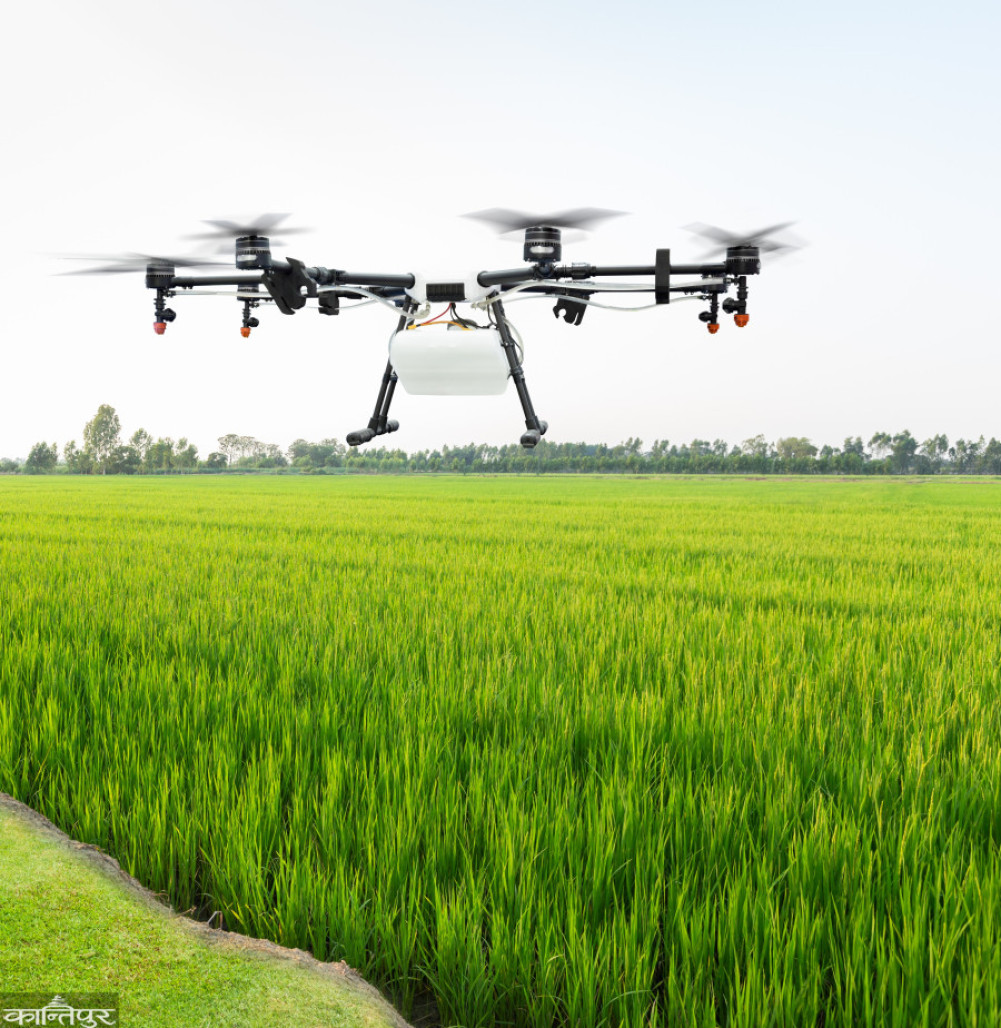
The challenge for Nepal today is not to forcefully attract youth to farms, but to turn farms into income-generating opportunities. It is necessary to transform agriculture into a business rather than a ‘subsistence agriculture’. The next government should think about making youth ‘agri-preneurs’ instead of ‘farmers’.
We use Google Cloud Translation Services. Google requires we provide the following disclaimer relating to use of this service:
This service may contain translations powered by Google. Google disclaims all warranties related to the translations, expressed or implied, including any warranties of accuracy, reliability, and any implied warranties of merchantability, fitness for a particular purpose, and noninfringement.
According to the data recently released by the National Planning Commission, 400,000 to 500,000 youth enter the labor market in Nepal every year. This is a challenge and an opportunity for a developing country like ours. Currently, Nepal's economy can only support about 100,000 people in the formal sector. Most of the youth are unable to find income-generating, reputable jobs in the country. As a result, about 2.7 million youth are currently forced to sweat on the streets and in unskilled jobs in the Gulf countries (Ministry of Labor, FY 2080/81).
The agricultural sector has provided economic security to 60 percent of the country's labor force. However, considering the above facts, agriculture can be declared a ‘problem sector’. The government’s attitude towards this sector shows an anomaly in Nepal’s economic policy. Those youth who do not have the capital to go abroad are forced to be confined to the informal and less productive sectors within Nepal or in big cities in India. According to the data released by the Ministry of Finance in the fiscal year 2081/82, the service sector dominates Nepal's economy. This sector contributes 66 percent of the gross domestic product (GDP). However, it is based on remittances from foreign employment. This source is likely to shrink further in the era of AI.
The industrial sector contributes only 13 percent of the gross domestic product, which has created only a small amount of employment in the formal sector. The agriculture sector still employs the majority (about 60 percent) of the labor force, but this sector contributes only 21 percent to the GDP. The gap of almost 40 points between employment and production shows a big problem in Nepal’s agricultural sector, i.e. it indicates that there is low productivity in agriculture.
The agricultural sector has provided economic security to 60 percent of the country’s labor force. However, considering the above facts, agriculture can be declared a ‘problem sector’. The government’s attitude towards this sector shows an anomaly in Nepal’s economic policy. In the budget for the fiscal year 2081/82, infrastructure received the largest share at 18 percent, and general administration accounted for another 11 percent, but agriculture and allied sectors, considered the engine of the labor force, received only 3.5 percent.
This kind of budget allocation may build roads and some infrastructure, but it will not develop agri-preneurs. It may pay the salaries of government employees, but it will not solve the question of how to stop 500,000 youth from leaving the country. Nepal cannot build its future on concrete and consumer goods alone. Therefore, the next government needs to revive the relationship of Nepalis with their land. And, agriculture must be revived.
Today's youth in Nepal are not very interested in transforming traditional farming into an income-generating opportunity. This does not mean that the youth are not interested in hard work, but that they do not want to live a subsistence-oriented life, with the risk of uncertain monsoons. Today's youth are not interested in being 'just a village farmer' in the age of the Internet, mobile, Instagram and globalization. Today's youth do not want to be limited to traditional subsistence crop farming methods and fragmented land production of maize, wheat or rice.
The smartphone-obsessed and ambitious generation is not attracted to backbreaking work for low returns. Therefore, the challenge for Nepal today is not to force the youth to the farm, but to turn the farm into an income-generating opportunity. It is necessary to transform agriculture into a business instead of 'agriculture for survival'. The next government should think about making the youth 'agri-preneurs' instead of 'farmers'.
High utilization of geographical diversity
Changing the way we look at agriculture in this way can bring capital, technology and prestige back to the rural economy. Nepal does not (nor can it) compete with the productivity of grains produced in the plains of Punjab or India. Instead, it should move towards high-value, low-weight products that take advantage of its unique geographical diversity.
In the Terai, attention should be paid to the production of rice, maize, etc. and in the hills, to geographically specific products (such as orthodox tea, high-altitude coffee, off-season vegetables, medicinal and aromatic herbs such as timur, chiraito, panchaunle, jatamsi, etc.). These are such items that can fetch high prices in the Kathmandu supermarkets and international markets and can turn even a small plot of land into a profitable enterprise.
Maximum use of modern technology – smart farming
Another cornerstone of the transformation of the agricultural sector is the maximum use of modern technology. Today's youth are the generation of the digital age, who are attracted to new technology and not to the old hoes and spades. This means that the future of Nepal's agriculture lies in 'smart farming'. Back-breaking manual labor should be replaced with the efficiency of machines.
The government needs to adopt a policy of subsidizing power tillers and brush cutters designed for farming in the hills. Drones can be used to spray pesticides in tea gardens and large agricultural farms, which is faster and safer.
AI and mobile apps help farmers identify plant diseases, which helps them feel transformed from a laborer to an expert. Simple technologies like plastic tunnels and polyhouses can protect crops from the effects of unpredictable weather and help in off-season farming. And, help transform agriculture from a risky gamble based on monsoons to a sensible business. The government needs to take a policy of subsidizing power tillers and brush cutters designed for hilly crops. Drones can be used to spray pesticides in tea gardens and large agricultural farms, which is faster and safer.
Systematic distribution system
The most discouraging issue for farmers is the lack of a proper post-harvest distribution system. This is a loss that is estimated to be 25-30 percent in developing countries. If one-third of the produce rots before it reaches the consumer, then a productive agricultural economy is meaningless.
A 30 percent loss in the agricultural sector (which accounts for about 21 percent of GDP) means a loss of about 6–7 percent of the total GDP. Therefore, the solution should be to build a national network of cold storage and food processing parks at strategic transport points (such as Madan Bhandari Highway, Pushpalal Highway and near major hydropower project sites) using cheap, reliable hydropower and solar energy.
These parks should be powered by the national grid. These processing parks are labor-intensive. As shown by various studies, a single tomato processing unit (making paste, ketchup, juice) employs 5 times more people than a tomato farm per unit of production. It acts as a bridge between production and marketing and creates a situation where additional farm workers can move to food processing factories in the same area.
In this Ilam speech, the proposed future Prime Minister Balen Shah raised the right issue of how to reach the people of the Terai with vegetables, fruits, etc. produced in the hilly areas and how to distribute rice, wheat, etc. from the Terai to the hills. A strong agricultural distribution system and network should be built to commercialize agriculture. Our south-facing hills are suitable for solar power generation. Therefore, investment should be made in solar-powered cold storage and processing centers at the village level. This type of distribution system is an important bridge between the farm and the market. For this, it is necessary to formulate policies such as government subsidies, changes in the tax system, etc.
Coordination between rural labor, land and urban technology and capital
The average land holding of Nepalis is falling below 0.5 hectares, making individual farming often economically unviable. This can be solved through the promotion of cooperatives or agricultural production companies. These commercial organizations can help bring land, capital, and labor together.
The situation of having to rush from village to city to claim insurance money should be ended. If hail destroys crops, the claim should be paid within a week. This type of arrangement enables agricultural entrepreneurs to invest in machinery, negotiate directly with hotel and supermarket chains, and access credit. It helps to commercialize the agricultural sector. The important issue here is the crisis of trust between land, labor in the village, and technology and capital in the city. It is absolutely necessary for the new government to coordinate between labor, land, technology and capital in the village, even if it is a guarantee in the middle, to create an environment of trust between each other. The current
Provision of bank loans and compulsory insurance
It is not possible to attract young investors to agriculture without reducing the risk. Banks are hesitant to provide loans to agriculture. The main reason for this is the uncertainty of monsoon-based agricultural production.
The government should provide interest subsidies for young agri-preneurs, and crop insurance should be made mandatory and hassle-free. The current situation of having to run from village to city to claim insurance money should be ended. If hail destroys crops, the claim should be paid within a week. It is also necessary to adopt measures to protect agricultural produce from monkeys and other wild animals. For this, timely amendments are required in the existing legal provisions. In addition, some changes are needed in Nepal's agricultural education. Instead of producing extension officers like the current ones, agricultural colleges should produce graduates with degrees in export management, food technology and digital marketing for agriculture. In this way, the new government can increase the income of the nation by adopting modern agricultural systems and liberate the young workforce from the cheap labor market by making them 'agripreneurs'. The biggest thing for this is the need for willpower and commitment in the leadership. It is necessary to comprehensively improve the points of the law, taking into account the opinion of experts that the existing laws of the concerned bodies are seen as obstacles to completing the above-mentioned work.