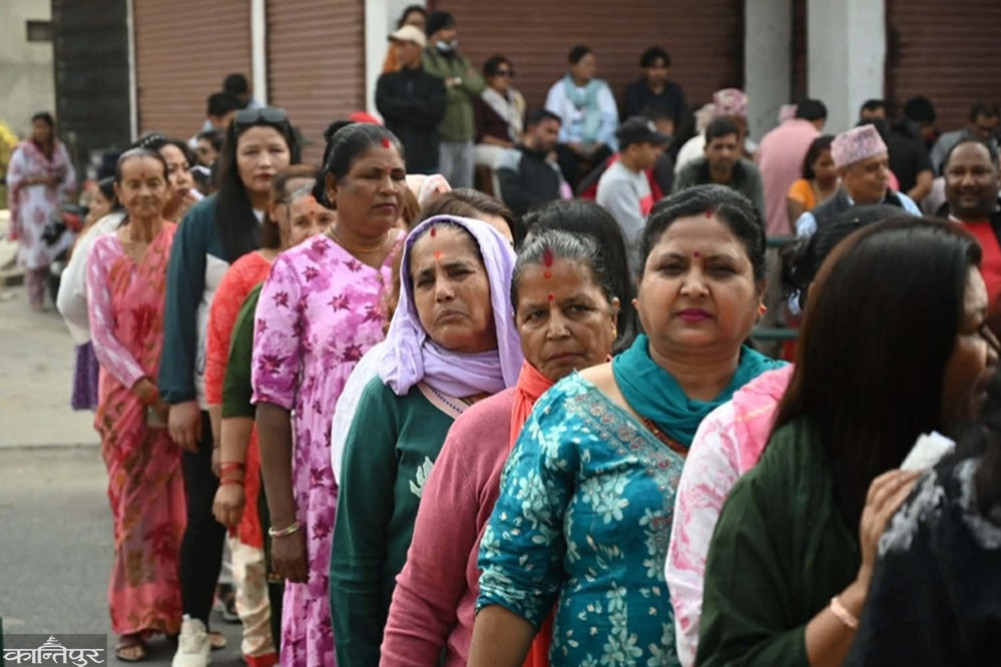
If this responsibility given to the new alternative power is not properly fulfilled, if the governance cannot demonstrate transparency, stability, and the ability to deliver results, Nepali voters will not hesitate to once again quietly but decisively change their minds.
We use Google Cloud Translation Services. Google requires we provide the following disclaimer relating to use of this service:
This service may contain translations powered by Google. Google disclaims all warranties related to the translations, expressed or implied, including any warranties of accuracy, reliability, and any implied warranties of merchantability, fitness for a particular purpose, and noninfringement.
The results of the 2082 mid-term elections have added an extraordinary and unexpected chapter to Nepal's electoral politics. This result was so unexpected that perhaps even the victorious party itself had not imagined such a result. All the big political analysts, surveys and election calculations failed this time. This election was not just an election to change the government, it also revealed a profound change in the psychology of Nepali voters. This time, voters seem to have voted above the traditional bases - person, idea, work, money and party.
This time, voting has been done in the name of change without any compromise. When talking to a taxi driver, he said that even though one of the two old parties had borne the expenses of going to Ramechhap to cast his vote, he had voted for the new one. This is just one example, the rest is shown by the results. When it comes to the Madhesh elections, it was analyzed that money and caste equations would play a big role, but this time the people saw neither caste nor any other context. The people, who were fed up with the old parties, made the new national independent party win with almost a two-thirds majority in the name of change.
The most interesting aspect was that despite the competition between many candidates in 165 constituencies, one name dominated the minds of the voters - Balen. Balendra Sah, who entered politics only about three years ago, was so successful in making a place in the minds of the people that when he traveled across the country for elections, thousands of people would gather in a moment just to see him. Many estimated that Balen's popularity would not fully translate into votes, but the results showed that in many places, voters preferred a symbolic leadership over the personal profile of the local candidate, ideological background, or the organizational strength of the party.
This time, ideology also did not get the expected importance. The leftist, democratic, monarchist, Madheshist or other ideological debates that have been defining Nepal's politics for a long time have not been decisive in the decision of the voters. It was seen that the 'desire for change' worked more than ideas. In this election, the people have voted in favor of change without making any compromises. For this reason, the biggest blow has been to the old parties. Nepal's traditionally powerful parties - Congress, UML, CPN, RPP and Madheshist - have found themselves in serious trouble this time.
The Congress was seen to be entangled in its own internal disputes and the debate on the special general convention. The Congress estimated that it would be easier for them to go to the elections after the leadership change. It was also an opportunity for them to go to the elections without an alliance after two election cycles. They believed that the slogan 'We have changed the Congress, we have changed the country' would attract voters. But the reality turned out to be the opposite. Dissatisfied groups within the party infiltrated, the organization appeared weak, and most importantly, it became clear that the people had lost faith in the Congress. As a result, the Congress failed to even preserve its historical reputation.
The situation of the UML became even more challenging. Its influence in many areas was noticeably weakening. The dissatisfaction seen especially among the youth and the 'Gen-G' movement had created deep distrust towards the UML leadership. The UML under the leadership of KP Oli could not understand the psychology of the changing generation, nor could it assimilate the essence of that movement. As a result, this time the UML not only lost the election, but also lost a large part of social acceptance.
In the case of the RPP, the agenda of monarchism and Hindu Rashtra failed to attract voters as expected. Despite the wave of political dissatisfaction, that dissatisfaction could not be transformed into the RPP's agenda. This means that the people are not trying to go back to the monarchy. In the case of the Madhesh parties, the crisis was even deeper. The agenda of identity and rights that had been raised for a long time was weakening due to their own ineffectiveness, division and power-centered politics. In such a situation, the emotional and political message that the Madhesh identity was presented in a new way - that the country could get its first Madhesh Prime Minister - had a huge impact. This created a direct challenge in the base area of the traditional Madhesh parties. And, as a result, the Madhesh parties won zero seats this time. In this way, this is not just an electoral defeat, it is also a collective expression of the ideological, organizational and moral crisis of the old parties.
Even money and economic power could not be decisive this time. Traditionally, economic resources are considered important in Nepali elections, but this time it did not show the expected effect. The evaluation of work also did not become decisive this time. Even some leaders who were known to have done well in the past were defeated. This shows that the voters' decision is not based solely on the evaluation of performance. If leadership and change had not been prioritized, perhaps the candidates who had shown good performance would have won, but that is not the case this time. In this wave, some honest and winning candidates from other parties also had to suffer defeat.
This time, the election results also gave another important message, many veteran leaders of Nepal, who had not suffered defeat in their constituencies for years, also suffered defeat. A major change was seen at the top leadership level. Except for Balen, all other contenders for the prime minister's post suffered defeat. Hark Sampang's party, which presented itself as the prime minister, remained very small. Ultimately, with a few limited exceptions, most of the old powerful faces were defeated.
Despite this, the victory of the victorious forces was not easy. In many places, the competition was fierce and victories were possible only after a difficult struggle. This shows that the voters did not blindly support the new option. Rather, they made a balanced decision between dissatisfaction with the old power and the expectation of change.
Therefore, it is not enough to look at the 2082 election only from the perspective of ‘who won’. This election has given a big political message, Nepali voters have challenged all the traditional bases. But now the real question is another – is this vote just an expression of temporary dissatisfaction or does it indicate a long-term structural change in Nepali politics? The answer to this will be given by the governance, working style and political maturity of the coming years.
This is not the first time that the Nepali people have given a chance to a completely new power by putting aside the old power. In the 2064 Constituent Assembly election, the people gave unprecedented support to the Prachanda-led CPN-Maoist. That support was not just for political change, but also for state structure transformation, inclusiveness, good governance, and a vision of a new Nepal. But over time, those hopes gradually waned. Due to instability in the governance, internal disputes, opportunistic political behavior, and failure to implement the expected reforms, the Maoist power shrank with each election. The power that seemed invincible is now steadily losing its base. This history is not just for remembrance, it is a warning.
The mandate received by the new alternative power today is not just support, but an expression of the accumulated dissatisfaction, frustration, and intense desire for change over the years. The people have once again trusted us, but that trust is not unconditional. If the new alternative power does not fulfill this responsibility properly, if it cannot demonstrate transparency, stability, and the ability to deliver results in governance, Nepali voters will not hesitate to change their decision silently but decisively.