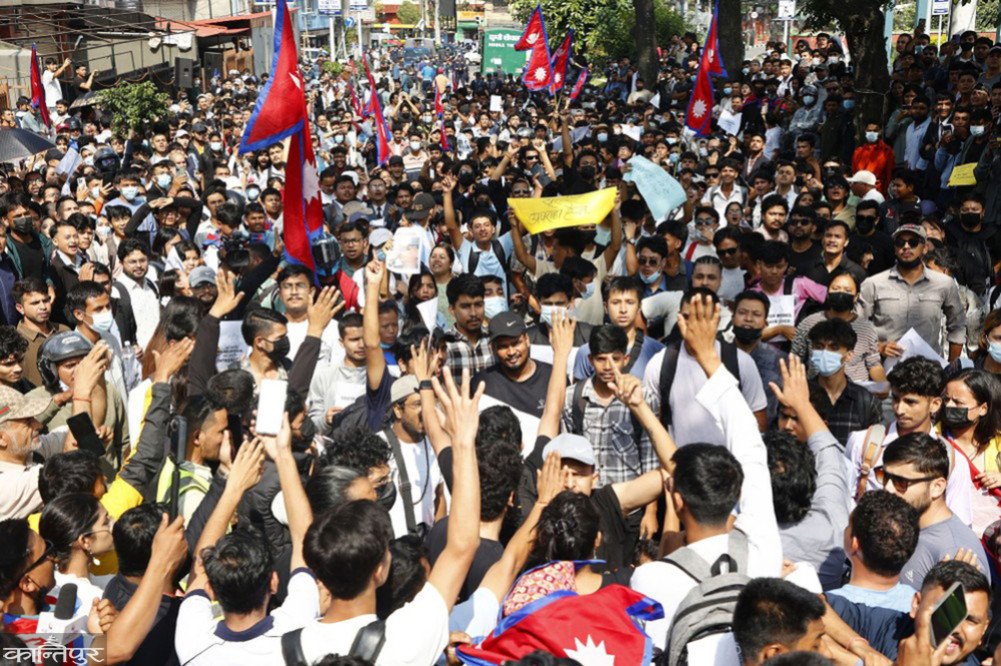
Now the reins of politics have broken free from the traditional party headquarters and have reached the citizens' mobile phones and 'servers'. This was not just a change of power, it was a successful 'surgical strike' carried out by technology against the 'syndicate' that had been entrenched for years.
We use Google Cloud Translation Services. Google requires we provide the following disclaimer relating to use of this service:
This service may contain translations powered by Google. Google disclaims all warranties related to the translations, expressed or implied, including any warranties of accuracy, reliability, and any implied warranties of merchantability, fitness for a particular purpose, and noninfringement.
The word ‘change’ is not new in Nepal’s political history. However, the tremors brought by the digital uprising of 2082 BS and the subsequent general election results have made one thing clear – now the reins of politics have shifted from the headquarters of traditional parties to the mobile phones and ‘servers’ of ordinary citizens. This was not just a change of power, but a successful ‘surgical strike’ carried out by technology against the ‘syndicate’ that had been entrenched for years.
The rise and end of a legacy
The foundation of democracy in Nepal was laid in 2046 BS. The Nepali Congress and the leftist parties fought against the Panchayat autocracy for decades and brought about a constitutional monarchy and a multi-party system. Less than a decade later, the 10-year armed insurgency of the Maoists began, which shook the unitary structure of the country. Through the 2062/63 BS people’s movement, the Madhesh uprising and the Constituent Assembly elections, Nepal entered a ‘federal democratic republic’.
The traditional parties were the ones who were the drivers of all these changes. But ironically, the democracy brought by those same parties gradually turned into ‘cartel democracy’. A ‘syndicate’ culture that fought during elections but then divided up every state body after the elections flourished. As Ian James Kidd explained in his research ‘Institutional Cynicism and Civic Virtue – 2023’, ‘When people see that state institutions are used not for themselves, but rather to support the relatives of those in power, then they become disgusted with the system itself.’ This ‘institutional disgust’ that had been building up for years had become a gunpowder in the minds of the youth.
Bhadra 2082: Cyber Uprising
The government itself set fire to that gunpowder of anger. In Bhadra 2082, the government decided to ban 26 social media platforms, including Facebook, TikTok, and Signal. Although the government called it ‘misleading information control’, the inner purpose was to suppress criticism of the government and the series of revelations of corruption. However, the government did not realize the truth that technology and the new generation cannot be ‘blocked’. Youth, oppressed by unemployment and corruption, had already exposed the luxurious life of the leaders’ children and the poverty gap of the common people through the ‘Nepo Kid Trend’. The use of ‘VPN’ in Nepal increased by 8,000 percent on the day the ban was imposed. This revealed the technical truth that the state can block physical roads, but it cannot block the digital sky.
Social media was not just entertainment for Nepalis. It was a ‘lifeline’ for migrant workers and online-based self-employed youth who send remittances, which account for 33 percent of Nepal’s gross domestic product (GDP). As the government cracked down on their livelihoods, young people were pushed away from mainstream platforms and entered the impenetrable chambers of ‘dark social’ (‘Discord and Telegram’).
In technical terms, ‘dark social’ refers to social communication that cannot be easily tracked by external ‘web analytics’ or government surveillance tools. When people exchange links, photos, or confidential information through private and ‘encrypted’ messages like Telegram, Signal, or ‘Discord’ instead of posting them on open walls like Facebook or ‘X’, it is called ‘dark social’. This has proven to be an impenetrable digital tunnel to evade state scrutiny and maintain the confidentiality of information.
‘Discord’: Where the plan to overthrow the throne was hatched
The old parties were still feeding their workers ‘meat and bones’ and flying flags at the crossroads, but ‘Gen-G’ had already weaponized ‘encryption’ and ‘algorithms’. As Lance Bennett and Alexandra Segerberg say in ‘The Logic of Connective Action’, this movement did not need a central face or leader.
The most tangible and historic result of this digital movement was seen on Bhadra 24, 2082. When the street uprising brought the then government to its knees, the struggle for power was not limited to the closed rooms or ‘bargaining’ of any political party. Instead, the ‘digital public opinion gathering’ on ‘Discord servers’ like ‘Hami Nepal’ and ‘Yuwa Hub’ determined the future direction of the country.
In this rare digital election in world political history, more than 7,500 active members voted directly to approve former Chief Justice Sushila Karki to lead the interim government. This was not a traditional party convention or a closed-door meeting of a power center, but a process where ‘algorithms’ ensured the privacy of voters and the security of votes. This event, where a virtual ‘server’ selected the country’s chief executive, established a new definition of democracy worldwide.
The power of data versus the politics of speculation
In the post-movement general elections, the old parties repeated the same mistake. They were claiming victory based on speculation, saying ‘our crowd is big’ and ‘we will win this many seats’. For them, using technology was just ‘boosting Facebook posts’ and advertising on social media.
Meanwhile, Naya Shakti identified the tricky issues of each constituency by analyzing thousands of Discord and Telegram conversations through ‘sentiment analysis’. The solid ‘data’ was telling them which areas had water problems, where the quality of education had deteriorated, or where unemployment was most severe. Based on this, they prepared separate ‘micro-target’ election agendas for each area. The data would have understood the psychology and expectations of the voters even before the candidates reached their homes.
As a result, a small, yet precise and personal message prepared by AI became more effective and credible for the voters than the grand and expensive rallies of the old parties.
Digital activists and ‘AI bots’
The rise of digital activists was the most interesting and unforgettable aspect of this election. While the activists of the old parties were busy burning the opposition’s flag, Naya Shakti’s ‘AI bots’ were deployed as loyal volunteers 24 hours a day. They fulfilled two main strategic responsibilities. First – fact checking. These ‘bots’ refuted the ‘misleading news’ and false allegations spread by the opposition within seconds and ‘exposed’ them on social media with evidence.
Second – voter education. Instead of waiting for the slow and traditional mechanism of the Election Commission, these ‘bots’ reached the mobile phones of each voter and personally taught them where their polling station was, what the candidate’s real ‘track record’ was, and how to vote correctly. As a result, there was no information gap in the election. Voters were fully informed about the vote they were casting and its importance even before they reached the polling station.
The election results of 2082 have proven forever that the center of power in Nepal is no longer just the closed rooms of Baluwatar. The real power has now shifted to those ‘servers’ on citizens’ mobile phones, where they freely organize and communicate directly. This is not just a political victory or a simple shift in power, but a historic technological victory of 'data' (facts and figures) over years of traditional superstition and old thinking, i.e. 'dogma'. It has given a clear message – now whoever has access to information and technology, the key to the future will be safe in their hands.