In some cases, the patient's condition becomes more serious and even death occurs on the way. Therefore, the biggest challenge today is not only to produce health workers, but also to create an environment where citizens of every geography can easily access health services through equal distribution. The Sudurpaschim government's provision of MBBS studies with full scholarships is a good option.
We use Google Cloud Translation Services. Google requires we provide the following disclaimer relating to use of this service:
This service may contain translations powered by Google. Google disclaims all warranties related to the translations, expressed or implied, including any warranties of accuracy, reliability, and any implied warranties of merchantability, fitness for a particular purpose, and noninfringement.
Comparing the data from a few decades ago and later, it is seen that the number of doctors in the country and the citizens' access to health services have also increased. However, such access has not been distributed evenly among different geographies and communities within the country. This is because health workers are concentrated in large cities, which has its own economic, social, political and professional reasons. Some doctors also migrate abroad.
In such a situation, it is difficult for citizens living in remote areas to get easy and immediate health services. Having to travel far for treatment adds to the financial burden. In some cases, the patient's condition becomes more serious and even dies on the way. Therefore, the biggest challenge today is not only to produce health workers, but also to create an environment where citizens of every geography can easily access health services through equal distribution. The Sudurpaschim government is providing MBBS studies on full scholarships.
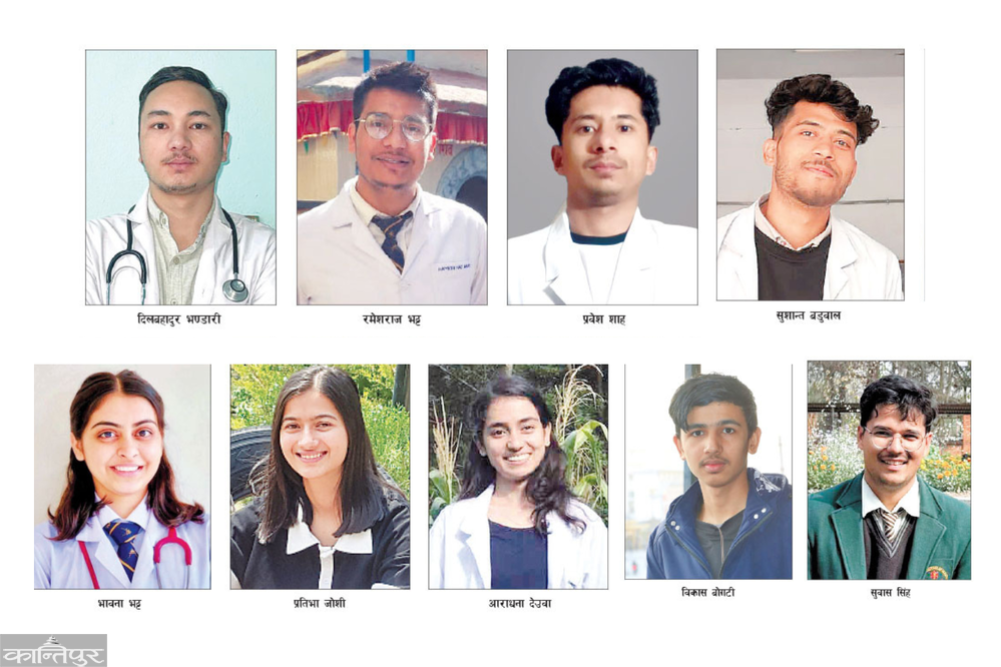
With the aim of reducing the existing problem of low number of doctors, the Sudurpaschim government is providing undergraduate (MBBS) education in the Faculty of Medicine by providing full scholarships to nine students every year. Currently, 53 students are studying under the scholarship program started in 2078. After completing MBBS studies, the first batch has to serve for three years and the subsequent batches for two years in government hospitals in the Far West.
The first batch of students admitted in 2078/79 is completing their studies in Ashar. The criteria set by the provincial government for receiving scholarships include passing the Integrated Entrance Examination conducted by the Medical Education Commission and having permanent residence in the Far West. Similarly, while there was no inclusive quota system in the first four batches, the guidelines have been changed and inclusive quota has been set from the fifth batch onwards.
The fee for MBBS studies is around 5 million rupees. Therefore, it is difficult for many students from families who do not have a strong financial situation to complete their medical education studies. This is why many students from families with weak financial conditions are forced to give up their dreams despite being diligent. Therefore, programs like the one of the Far West government are becoming a great opportunity for many. Through this, capable students get the opportunity to study. The country and society get qualified doctors.
They have to go to the area designated by the Far West government to serve, so they fill the shortage of doctors in remote areas, even if it is a small amount. On the other hand, if members of families with weak financial conditions study or become doctors, the students and their families will receive great relief. A positive message will be sent to society. For example, if a member of a poor Dalit family in the Far West becomes a doctor and serves his/her own village, the confidence of the Dalit community there will increase.
It may be relevant for the government to spend money on scholarships for a certain period of time. However, it is not appropriate to continue pouring money into one area that is focused on individuals for a long time. Instead, investment in public education should be increased. If school education in the Far West can be made excellent, it will bring multiple benefits at once. First, because they receive quality education at the school level, students from the Far West can nominate a maximum number of students for scholarships in the Integrated Entrance Examination conducted by the Medical Education Commission.
Second, currently, scholarships are available from the Far West government for MBBS, but such support is not available for those who want to go into fields other than becoming doctors. Because the criterion that those who want to become doctors will get support but those who study information technology, engineering or arts will not get it is not fair in a broad sense. If the government wants to strengthen the foundation of school education, it itself will strengthen its chances of admission in different fields with scholarships.
Similarly, the federal government has already made arrangements for scholarships in medical education. For example, 75 percent of students in government colleges and 10 percent in private colleges get scholarships. Overall, around four and a half hundred students get scholarships every year. Therefore, opportunities are available for diligent students right now. They also have to go and serve in remote areas for a certain period. However, this has not been implemented systematically. On the other hand, there is also a trend of going abroad after the period is over.
In such a situation, the scholarships provided by the Sudurpaschim government can lead to duplication. Thinking of it as a program for a few years only, it can be considered fair, but it is not a long-term option. Rather, the Sudurpaschim government should collectively improve education in a way that enhances the capacity of students. Students should be made competent. The millions spent on producing doctors should be spent on small and large projects that promote human development, job creation, and capital formation.