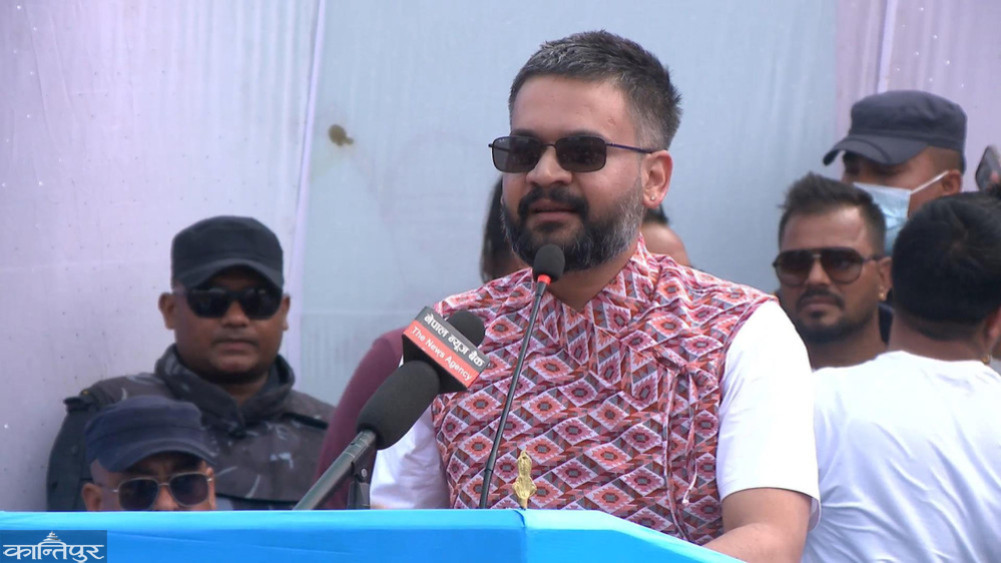
A strong Rashtriya Swayamsevak Sangh (RSS) government led by the young generation can build Nepal's national discourse. But for that, the foreign policy and diplomacy of previous governments must be reviewed and positive practices adopted.
We use Google Cloud Translation Services. Google requires we provide the following disclaimer relating to use of this service:
This service may contain translations powered by Google. Google disclaims all warranties related to the translations, expressed or implied, including any warranties of accuracy, reliability, and any implied warranties of merchantability, fitness for a particular purpose, and noninfringement.
The ruling parties like Nepali Congress, CPN-UML and Nepali Communist Party have been weak opposition parties in terms of seats, and how they will be in terms of influence in the House of Representatives remains to be seen. On the contrary, the Labor Culture Party led by Hark Sampang can play the role of a strong opposition, because it also has that moral strength. In the elections held on 20th Falgun, the National Independent Party (NISP) not only achieved historic success, but also set some unique domestic ‘records’. The political party, which was founded only four years ago, won two-thirds of the seats. The political pundit who said that no political party could win a majority through this mixed electoral system of direct and proportional representation was proven wrong. It also set a ‘record’ in the entry of youth into parliament. Through the elections, Nepal is electing its youngest ever Prime Minister, Balendra Shah, at the age of 36.
This public opinion can be compared to the 2015 general election, when the Nepali Congress won 74 out of 109 seats, while the Gorkha Council won 19 and the Nepal Communist Party won 4 seats. BP Koirala, who became the Prime Minister after the election, was 44 years old at the time. In that sense, apart from dynasty politics, the current cabinet is becoming a relatively young cabinet, in which Gen-G is also participating. The influence of political parties with a long political legacy has been limited.
The experienced parties like the Nepali Congress, CPN-UML and the Nepali Communist Party have become weak opposition in terms of seats, and how they remain in terms of influence remains to be seen in the House of Representatives. On the contrary, the Labor Culture Party led by Hark Sampang can play the role of a strong opposition, because he also has that moral strength. Let us hope that the Rashtriya Swayamsevak Sansthan Party will learn a lesson from the past political internal struggles and the politics disrupted by them and will begin historical development with this historical result. The NCP, formed after the Left alliance in 2074, had 174 seats, but due to the two captains of the NCP, the NCP plane could not land safely and crashed. This time, may the RSP government, led by Balen and Ravi, land safely, may the civilian passengers travel safely, and may the service cargoes reach the citizens' homes safely.
With this success in the election, the RSP has received congratulatory statements from various countries and the international community, including India, China, and the US. In which it is mentioned that the RSP government is willing to cooperate with it. It is natural to congratulate the Sushila Karki government for successfully completing the election. Because it was not without challenges. But before the full results of the election are officially made public by the Election Commission, statements from the powerful country with congratulations and aspirations for cooperation should not be kept within the bounds of courtesy. The tendency of powerful countries to strategically use Nepal's geopolitical sensitivity to expand their influence and control the influence of competitors is increasing, so the essence of congratulations, cooperation and partnership should be understood in that way. This article discusses the recent interests of neighboring powerful countries, the superpower America, and some aspects of the foreign relations of the now-forming RSVP government.
First, a relationship with cooperation
The role played by the Karki cabinet in the crisis political management of the Gen-G rebellion and destruction that captured the world's attention is commendable. In that sense, he and Home Minister Om Prakash Aryal are the real deserving of national and international congratulations for their role in strengthening democratic practices by holding elections on time. Aryal, who said he would return to the debate, would have been better if he had not announced that he had been nominated as a member of the National Assembly, perhaps it was a medal for successfully conducting the elections.
It can also be said that they have only shared the hopes and doubts that are simultaneously present in Kathmandu regarding the chemistry of Ravi and Balen and the results it will give. It is believed that bilateral relations will reach a 'new height' in the dialogue with both, this is diplomatic charm. However, it would have been possible without raising the burden of taking bilateral relations to a new height in the first telephone conversation. The interim government led by Muhammad Yunus, formed after the Gen-G rebellion in Bangladesh before Nepal, was able to hold the third election on February 12 only after postponing it twice. In Nepal, the election was held on time despite many doubts. Nepal's election received full support from its neighbors, including India, China, and the United States. India provided a large amount of 'logistics' to hold the election, including 650 means of transport. China provided 28 million Chinese yuan (580 million Nepali rupees). In that sense, it is natural for neighbors and powerful countries to be concerned that Nepal does not deviate from democratic practices. In fact, it is said that the solution within the constitution that President Ram Chandra Poudel came up with after the Gen-G rebellion and destruction had the support of the neighbors, which was in the interest of Nepal.
But the two statements made during the congratulatory speech seem a bit strategic. First, Indian Prime Minister Narendra Modi's congratulations on the phone to Rashtriya Swayamsevak Sangh (RSS) President Ravi Lamichhane and senior leader, i.e. the proposed Prime Ministerial candidate Balendra Shah, on Falgun 25. From a courtesy perspective, congratulating Lamichhane in his capacity as the party and its president for the election success would have been enough. But Modi also congratulated Balendra on the election success. Perhaps, he has given a sign that he is on an equal footing with two powerful figures from different backgrounds and positions within the RSS.
In other words, it can be said that he has only shared the hopes and doubts that are simultaneously present in Kathmandu regarding the chemistry between Ravi and Balen and the results it will give. It is believed that bilateral relations will reach a 'new height' in the dialogue with both, this is diplomatic charm. However, it would have been possible without raising the burden of taking bilateral relations to a new height in the first telephone conversation. Modi himself has made these conversations public through social media, which is also important. It would have been better if Chairman Lamichhane had made them public immediately after the talks, just as the message of congratulations and cooperation given by the Chinese Communist Party was made public by the head of the Rashtriya Swayamsevak Sangh (RSS) Foreign Affairs Department, Shishir Khanal. These diplomatic reciprocities will gradually come into practice. Lamichhane expressed his readiness for cooperation with gratitude on the same day in Modi's congratulations, and Balendra the next day on 26 Falgun. Diplomacy is based on reciprocity, and this is appropriate.
China's congratulatory statements are a continuation of courtesy. China usually expresses its readiness to cooperate with the expectation of development and stability in its congratulations to every political party and government, and this is the case this time too. However, the Chinese side does not immediately make its defensive position public as dissatisfaction. But the US government's statement on 21 March is more focused on common security. Nepal has been cooperating on issues of prosperity. Nepal has been adopting a policy of partnership for prosperity with India, China and the rest of the world and acting accordingly. This is welcome.
But the phrase 'looking forward to cooperating with the incoming government on the common security goals of both countries' is sensitive. This requires debate. What could be the common security goals of Nepal and the US? When there are no common goals, what could be the meaning of the US desire for cooperation in it? This should be discussed openly. Do the previously controversial State Partnership Program (SPP) and the Indo-Pacific Strategy (IPS) fall within the common security goals indicated by the US or not? If they do, can Kathmandu cooperate as Washington seeks? If cooperation in natural disasters and calamities, cooperation in peace missions and joint exercises are called SPP, then that should also be clear. If Nepal rejected the proposal saying that it would not be able to participate in the SPP in 2022, then Nepal has not become a part of the IPS. But Nepal should pay due attention to the frequent visits of American diplomats and the statements made by the incoming government regarding the SPP.
It is Nepal's declared policy not to participate in any strategic military alliance. If it has raised the issue of other security partnerships, Nepal should be clear about this. Nepal has been conducting joint military exercises not only with the US but also with China and India, for which no strategic alliance is necessary. But if another country targets a country and proposes a security partnership to Nepal, Nepal should reject it.
Exercise of strategic autonomy
Foreign relations are not just an issue of power and government, it is an issue of the state, which includes about 30 million Nepalis, including the opposition parties. That is, the issue of Nepal's relations with India, China, America and other countries is a matter of concern for all citizens. These congratulations and cooperation should be converted into mutual benefit. For that, the incoming government has got a historic opportunity. The Rashtriya Swayamsevak Sangh (RSS) should prioritize Nepal's national interest and advance its neighboring and external relations. In theory, all parties have a common opinion on protecting national interests, but in practice, it does not seem to be practiced.
Nepal should continue to use the main pillars of foreign policy such as independent foreign policy and non-alignment and make creative use of the three. The exercise of strategic autonomy should be the main mantra when making decisions in this regard. No neighbor or powerful country can forcefully use Nepal in its interests, if Nepal preserves its right to make decisions and puts it into practice. For example, Indian Prime Minister Modi and Foreign Minister Jaishankar are doing this right now. Since India is a powerful country, the scope of strategic autonomy it exercises is wide and strong. Nepal should exercise strategic autonomy to the extent of its ability.
Foreign relations are not only an issue of power and government, it is an issue of the state, which includes about 30 million Nepalis including the opposition parties. That is, the issue of Nepal's relations with India, China, America and other countries is a matter of concern for all citizens. However, due to political instability in Nepal, the boundaries of the joint government, etc., Nepal has not been able to stand united in the neighborhood and the outside world. A fragmented Nepal cannot promote national interests.
In that sense, a strong RSP government led by the youth can build Nepal's national discourse. But for that, the foreign policy and diplomacy of the previous governments must be reviewed and positive practices adopted. The diplomacy practiced by Donald Trump II has destroyed the rules-based world order and practiced global chaos to the extreme, the effects of which are seen not only in the Western Hemisphere but also in the East. This has been proven when it comes to Iran from the Panama Canal to Venezuela. In other words, Trump is restoring the Monroe Doctrine and forcefully advancing his own world politics, which has created a crisis for the existence of weak nations.
Keeping in mind all these developed diplomatic trends, the new government should advance foreign policy and relations. The RSP manifesto states that it will advance a policy of balance with its neighbors and build cordial relations with everyone. This is right. तर त्यही पार्टीभित्र बेलाबेला देखिने मुनरो ‘ड्रक्टिन’ का पक्षपाती, अखण्ड नेपालका अभियन्ता र छिमकीलाई सन्तुलनमा राख्न महाशक्तिको आड लिनुपर्छ भन्ने सोच विदेश सम्बन्धका लागि घातक छन् । यी तीनै सोच अतिवादी दृष्टिकोणबाट सिर्जित हुन्, यिनले राष्ट्रिय हित गर्दैनन् । यिनले अन्ततः शक्तिराष्ट्रलाई शक्तिको अभ्यास गर्ने जमिन उपलब्ध गराउने हुन् । त्यसैले व्यक्तिका अतिवादी सोचबाट होइन, पार्टीले निर्दिष्ट गरेका सिद्धान्तका आधारमा छिमेकी र शक्तिराष्ट्रसँग सम्बन्ध कायम र विस्तार गरेर सरकार अघि बढ्नुपर्छ ।
केही केही अभियन्ताले भूराजनीति केही होइन वा यसले अनावश्यक महत्त्व पायो भनिरहेका छन् । यो पूर्णतः गलत हो । आजको विश्व नै भूराजनीतिक र भूरणनीतिक विश्व हो, जसलाई सुरक्षा, महत्त्वपूर्ण स्रोतको नियन्त्रण र धार्मिक विश्वासले निर्देशित गरेको छ । अहिले विश्वमा भएका युद्धहरू यिनै तीन मुद्दामा आधारित छन् । रणनीतिक अवसर र चुनौतीको अवस्थिति, दैलेखमा पाइएको प्राकृतिक ग्यास र युरेनियमसहित ५० बढी ठाउँमा पाइएका प्राकृतिक स्रोतका कारण नेपालमा शक्तिराष्ट्रका चासो बढेका छन् । यी चासोले द्वन्द्वका रूप नलिउन् भन्नेमा नेपाल सचेत रहँदै प्राकृतिक स्रोतको दोहनमा घरेलु सामर्थ्य विकासमा लाग्नुपर्छ । नेपालको प्राथमिकतालाई ध्यानमा राखेर पारस्परिक लाभ हुने परियोजनामा वैदेशिक लगानी केन्द्रीकृत गर्नुपर्छ ।
पार्टीका सभापतिका रूपमा बोल्दा र सत्तारूढ पार्टीका सभापतिका रूपमा व्यवहार गर्दा, मेयरका रूपमा आफ्नो सरकारलाई अपमान गर्दा, छिमेकी र शक्तिराष्ट्रप्रति अपमानजनक विश्लेषण भिराउँदा र अहिले सरकारको नेतृत्व गरेर छिमेकीसँग व्यवहार गर्दा अपनाइनुपर्ने सचेतनाका बारेमा रवि र बालेन दुवै सचेत भएको हुनुपर्छ । जनताले शक्ति दिएका छन्, शक्तिको दुरुप्रयोग नहोस्, प्रतिशोधको आरम्भ नगरी विगतमा भएका राष्ट्रिय हितका बाह्य सहकार्यले निरन्तरता पाउन् ।