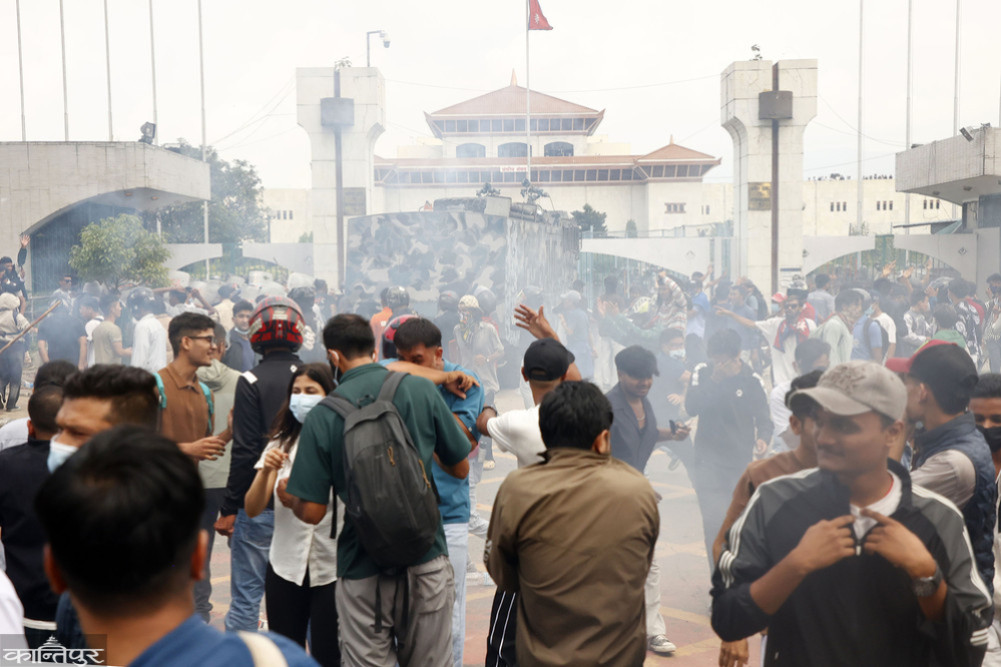
The political rise of Gen Z in Nepal is not just a youth movement - it is also a restructuring of power, morality, and political imagination. The new change is more of a generational rebalancing than a revolutionary upheaval. It should not be a complete demolition of the old political foundation, but a process of redefining it with new expectations and new energy.
We use Google Cloud Translation Services. Google requires we provide the following disclaimer relating to use of this service:
This service may contain translations powered by Google. Google disclaims all warranties related to the translations, expressed or implied, including any warranties of accuracy, reliability, and any implied warranties of merchantability, fitness for a particular purpose, and noninfringement.
Nepal's political 'frame' has now reached a point that many ordinary people or anyone could not have easily imagined a few years ago. The new generation (especially Gen-G), which was long considered 'politically indifferent' or 'digitally obsessed', has now pushed the country's political course in a new direction. From the recent youth-centric (bloody and violent) protests seen on the streets of Kathmandu to the new political upsurge seen in the last elections, the young generation has started establishing itself with unusual energy and confidence everywhere. For this generation, who grew up in a formally democratic republic but are struggling with unemployment, corruption and the compulsion to go abroad for employment, the basic promise of democracy feels unfulfilled.
The rapid rise of the National Independent Party (NISP), the popularity of Ravi and Balen (Balendra), etc., are not just ordinary fluctuations in election results. These events indicate a profound generational shift in Nepali political culture. In such a situation, it is not enough to look at the latest events alone to understand the current political environment. To understand its depth, it is useful to turn to the old but influential theories of (political) sociology. The ideas written by classical sociologists like Karl Marx, Emile Durkheim, and Max Weber more than a century ago still seem remarkably useful in understanding the political changes taking place in society today.
From their theory, the political rise of Nepal's Gen-G is not just the impulse of the youth - it is also a restructuring of power, morality, and political imagination. In this sense, social consciousness and thought also play an equally important role in political change. This article will discuss the construction of society and generational transmission by making the topics of those old, but still powerful social thinkers relevant.
Structural discontent and the search for new political alternatives
According to Karl Marx, social discontent does not arise suddenly. The contradictions within the economic and institutional structures of society gradually give rise to discontent. When people's aspirations increase and opportunities do not expand in the same proportion, that frustration eventually begins to express itself politically. Nepal's young generation is currently living a similar paradox. On paper, Nepal is a federal democratic republic—the constitution guarantees civil rights, representation, and participation. However, in practice, the daily experience of many young people is filled with economic uncertainty. Not only economic, but also social uncertainty is mixed in with it. Thus, the sun of the tumultuous inner world is shining everywhere.
There are few decent employment opportunities within the country. Therefore, millions of young people are forced to go abroad in search of employment every year. Although remittances are important to sustain families and the economy, it has raised a deep psychological question among young people—is our future not possible in this country? Universities are producing thousands of graduates, but many of them find it difficult to find work according to their abilities. The path to social progress is often linked to emigration. There is an atmosphere where deep questions are raised about the capabilities and social capital of families whose members have not gone abroad.
Looking at the political leadership, the influence of leaders who came from the old political process and movement still persists. The new parties that have recently emerged have broken those traditions. The old movements laid the foundation for democracy and republic, but with time, the feeling that those structures are becoming stable and entrenched has increased among the youth. Therefore, non-rooted parties that represent new ideas and times are becoming the darlings of the common people. The new ones blame those who come under the power of the old system, but the tendency to be self-righteous is dominant. The new ones who have come now also continue to criticize the old ones with great intensity. The common people who are angry with the old ones are applauding. However, we need to pay attention to making the system and public institutions more efficient than such weak issues. This issue is no less understood by the new leaders than the common people.
The youth who are used to getting fines in foreign countries when they violate traffic rules do not like to go to the transport office in Nepal and pay the fines, getting beaten up in lines for hours. In such a situation, it is natural to seek a remedy to alleviate suffering through new political alternatives. The emergence of a new political force like the Rashtriya Swayamsevak Sangh (RSS) should be understood against this backdrop. The popularity of the RSS has not only been built on the charm of its personality, it has also expressed growing dissatisfaction with the established party. The youth are angry at our crumbling public institutions and indolent political leadership. Leaders like Balen understood that general anger and became a reflection of the general anger. This psychology made the public trust him.
However, there is another side to this generalization. Many of the institutional structures that today's youth criticize—such as federalism, multi-party competition, constitutional rights—are all the results of past political struggles. The people's movement, the peace process after the Maoist war, the second people's movement, and the subsequent constitution-making—all these processes laid the foundation for the current republic. Therefore, the generational upheaval seen now cannot completely overturn those foundations. Instead, efforts should be made to force those structures to work in a new way. In other words, the aim of the new generational rise should not be to destroy the republic, but to redefine its functioning.
Collectiveism: Anger, energy and identity
Economic discontent is not the only reason for this movement. In recent years, a strong moral voice has also been heard in youth political activism. Youth anger at corruption, political protectionism and administrative inaction is not just an economic question, but also a moral question.
Emile Durkheim described the moral beliefs that bind society together as ‘collective conscience’. When these shared values are repeatedly violated, imbalances arise in society and people start to react collectively. This kind of collective discontent is evident in youth political activism in Nepal. Slogans like ‘clean politics’ or ‘accountable governance’ are not just demands for administrative reform, they are calls to restore the moral foundations of democracy.
When thousands of young people take to the streets or organize on social media, they are not just expressing protest – they are also building a kind of collective identity. A feeling that says – we are one generation and we must speak about the future of the country. Durkheim called this feeling ‘collective conscience’.
Durkheim had explained such moments as ‘collective effusion’. This is a moment when people, when they are collectively active, create an extraordinary energy and a sense of unity. A similar kind of energy can be seen in Nepal’s recent youth-centered political activities and the rush for change.
However, such moral energy does not always remain permanent. If the enthusiasm generated by the movement cannot be converted into long-term political reform, that energy can gradually turn into despair.
The boundary between charismatic leadership and generational change
Karl Marx explains structural discontent, Durkheim explains collective energy, and Max Weber clarifies the role of leadership in political change.
According to Weber, ‘charismatic authority’, i.e. leadership based on personal charisma, emerges in moments of great political change. Such leadership can also come from outside the traditional institutional structure. However, many scholars (for example, Pradeep Giri in Nepal's perspective) have also said that 'a society that seeks miraculous leadership is an unfortunate society'.
A similar trend is seen in the new political emergence seen in Nepal. People who come from the media, civil society or urban public life have gained popularity outside the traditional party structure. The attraction to them is often based on a promise - to break with old political practices. However, Weber also gave an important warning. Miracles can start movements, but miracles are not enough to govern. Over time, miracles must be transformed into institutional structures, otherwise that energy will not last.
Nepal is currently standing at this juncture. The emergence of new political forces has raised great hopes among the citizens. However, running a complex state structure like a federal democratic republic is not just a matter of winning elections, it requires administrative capacity, policy clarity and institutional stability.
Therefore, the real test of Nepal's Gen-G political emergence is still to come. The question is not just whether new faces will come to power. The question is—can they make it effective within the existing institutional structure?
From the perspective of classical sociology, this generational change in Nepal does not seem like a sudden event. It is the result of long-standing structural dissatisfaction, moral aspirations, and a new kind of leadership. Today's young citizens are demanding that the state be made more accountable, transparent, and responsive. However, they are making such demands within the same democratic structure that the previous generation struggled to build. Both of these things should never be forgotten.
In this sense, the change we are seeing now is more of a generational rebalancing than a revolutionary upheaval. It should not be a complete demolition of the old political foundation, but a process of redefining it with new expectations and new energy. Perhaps this is why the political moment of Nepal's Gen-G is important—it has opened up the possibility of imagining the future in a new way, not by rejecting the past.
(Aryal, a PhD in sociology, is working as the head of the Community Development Program at Kathmandu University)