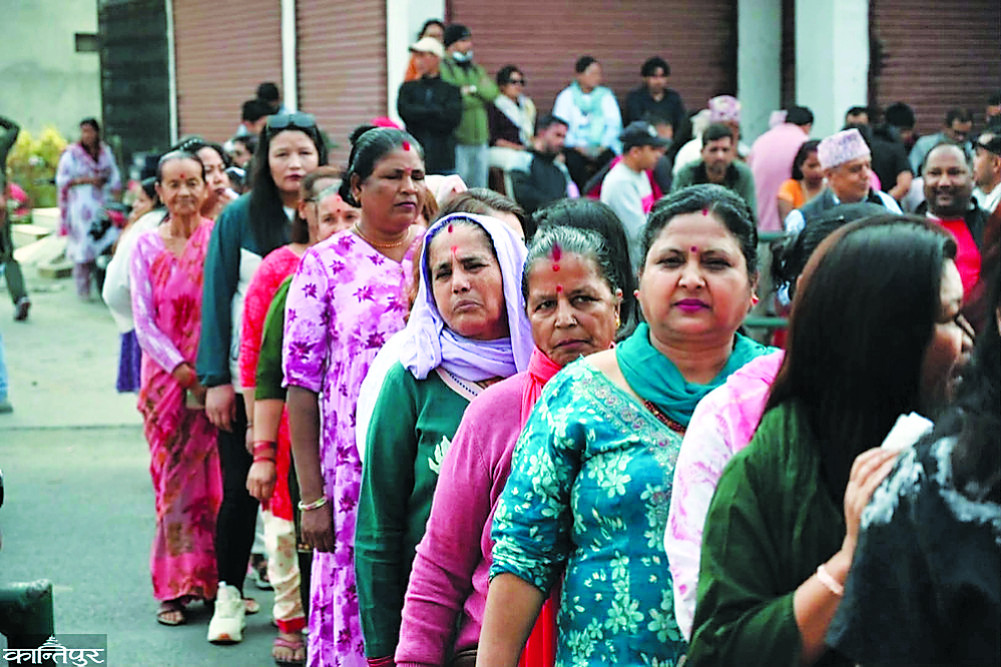
It would be an injustice to current politics if the National Independent Party were to come to the parliament, where the Congress and Communist parties have a majority, and explain that they are merely marginalized.
We use Google Cloud Translation Services. Google requires we provide the following disclaimer relating to use of this service:
This service may contain translations powered by Google. Google disclaims all warranties related to the translations, expressed or implied, including any warranties of accuracy, reliability, and any implied warranties of merchantability, fitness for a particular purpose, and noninfringement.
Whether we accept it or not, whether we like it or not, the history of mankind is a search for the formula, method, system, and practice of freedom and equality. It is not that there has not been the rise or regression of nations and leaderships that have exploited this truth and process to their maximum advantage from time to time. But then again, history is witness, all of them have been fleeting.
We are no different. Since the rebellion against the Rana regime, Nepali society and politics have been practicing the path of building a free and equal society in the style followed by many other countries of the world. Not only are there disagreements about what the method and process should be, but we also have fresh experience of different opinions leading to armed rebellion and civil war. In this sense, when analyzing major political developments, seeing where they are oriented in terms of the principles, policies, and practices of freedom and equality is perhaps the method and process that will most closely understand our politics.
Yes, certainly, although Eastern philosophy, knowledge systems, and our civilization are beautiful and great, it was not appropriate to get confused in the analysis method based on the experience and philosophy of Western countries. But when neighboring India and China, which are considered the source of Eastern civilization, or economically prosperous Japan and Korea in this region, are experiencing difficulties in adopting an analysis method centered entirely on Eastern philosophy, we too must take practical and sensible steps. In addition, life and
The truth that the ideas and methods developed in Western countries are dominating our views of the world cannot be underestimated. When we ourselves look for good leaders, we are not talking about Mahindra Malla, who did not eat until smoke came from the house of every subject, who was saddened by the death of every subject, but about European prime ministers who rode trains and bicycles to office.
The West refined its ideals and knowledge system, simplified it, created tools to measure the problems of daily life, and developed methods for analyzing facts and data. What is interesting is that people who went to Western countries from Asia, Latin America, and Africa to study have made a great contribution to this. They are the ones who went there to refine it and export it together.
Our current knowledge system is like a dress worn on a wedding invitation. Sometimes it is not satisfactory. But considering the time and expense involved in making one's own clothes, it is appropriate to start working with this cloth and quickly start sewing one's own clothes. In addition, our society and politics should also reflect on what kind of effort, cooperation and determination is required for this. In particular, this is an issue that should be a major topic of the new government's higher education policy.
There is only one reason for this long role. What kind of freedom and equality has Nepali society and politics tried to walk on the path of freedom and equality for the past few decades, what has been the identity or status of the path and practice that has been set, and the expectations of the general electorate who voted for the National Independent Party's election symbol, the bell, in this election, focusing on their ideas of equality and freedom is a basic method for understanding current Nepali politics. This article prioritizes the beginning of an intensive dialogue between us rather than presenting its concrete conclusions.
Election Results: Ending the Patron-Client Political Era
Politically, the era of the patron-client relationship that has prevailed between leaders and the public since the elections of BS 2048 and before seems to be coming to an end. Simply put, the legitimacy of an era of voting, asking for votes, and assuring votes by saying, "If you look at this physical aspect of me, I will vote for you or your party," i.e., if you vote for me or our party, I will look at the lower physical aspect of you (s), has been questioned.
In 2007, Herbert Kitchelt and Steven Wilkinson, in their book "Patron, Client, and Policies: Patterns of Democratic Accountability and Political Competition," defined patron-client relationships in politics as: "A direct exchange of a citizen's vote for direct cash payment or access to continuous employment, goods, and services." Many studies on elections since 2048 have concluded that such relationships are decisive in election results. The elections to the lower house of parliament, which were held in a peculiar context, seem to have ended such an era.
No one will now count the number of our votes and the number of votes of others by counting the number of households in a village and the population of adult citizens living in that house. No one will take a contract saying that the responsibility of that house is mine, that the responsibility of that village is mine. No one will now say that even if we raise our stick or stick, we will win. In other words, we have bid farewell to a long era. If it is explained that the National Independent Party has come to the parliament, where the Congress-Communist parties have a majority, and they have only shrunk, it would be an injustice to current politics.
In fact, there have been many studies around the world on how the increase in remittances and the development of the private sector weaken the old patron-dependent relationship in politics. With the change in the economic situation, education and civic awareness, citizens' access to information increase, political and social freedom increases, and citizens gradually have the opportunity to exit the old political network. Without such networks or organizations, there is no major difficulty in social life, so networks are less attractive. Such a hypothesis has been studied from many perspectives, focusing on Latin America, including Mexico. The analysis of Nepali politics since 2006-07 has strongly reinforced the view that the Nepali political and social environment is fundamentally different from that of other countries in the world, and therefore requires a separate analysis. As a result, we have paid little attention to comparative studies. As a result, we have not been able to find a way to change our politics and society.
However, we must be clear here. One era has ended, but another new era has not yet begun. Italian philosopher Antonio Gramsci called such a situation a state of ‘interregnum’. The old world is dying. The new world is struggling to be born. In the interval/intermediate period, various unhealthy symptoms appear. In the recent elections, the profound questions that have been raised in Nepali politics for the past decade have been approved. Such questions were raised not only by a specific party or character, but by the entire society.
The need for a national ‘course correction’ in building a just society and state was widely voiced. Questions in this vein have been approved. Hidden within such approvals are expectations for the latest solutions. Politics must approach the people with possible answers to transform such expectations into reality and engage in dialogue. Our politics should never forget the price we paid for missing the opportunity to build a common answer in 2048, 2064, and 2074.
Equality: Comparative (in)equality and economic democracy
The results of this election have raised serious questions about our values, beliefs, and methods for reducing inequality. The focus of our debate, which has focused on social and political inequality, has shifted to economic inequality. From 2062/63 to the drafting of the constitution, Nepali politics had drawn a conclusion over a decade: since the cause of the widespread social and economic inequality in Nepal is political inequality, only by making it inclusive can laws and policies be formulated and programs formulated that empower citizens of marginalized classes or communities. This process reduces economic and social inequality over time.
During the election, our politics has come to focus on the argument presented by American theorist T. M. Scanlon in his book ‘What We Owe to Each Other’ published in 1998, questioning the above-mentioned method based on the theory of modern liberal theorist John Rawls. According to him, we should not only look at the size or level of inequality, but also its cause and context, as well as the impact that inequality has on the individual. In other words, we should not only look at the moral aspect and consequences of inequality, but also at the method or process of continuation of inequality.
Within the politics that was supposed to end inequality, there used to be continuous dialogue among ordinary citizens about issues such as increasing inequality, the lifestyle of the rich and the poor, and the incomparable standard of living despite the reduction of poverty nationally. Dissatisfaction had increased about that. In other words, the attention of Nepali society was focused not on the quantitatively decreasing poverty or inequality figures, but on the qualitative difficulties that were visible before our eyes about the complexity of the lives of the middle class, lower middle class, and the poor. And, here was a clear conclusion: Comparative inequality has increased in Nepal.
Meanwhile, a forced narrative was established in Nepali society: There is an unnatural relationship between big business and politics in Nepal. Economic opportunities are limited and individual-centered. The inequality in Nepali society and economy cannot be eliminated unless our economy is made democratic. There was a loud voice: New rules are needed to ensure the management and fairness of the market. Due to such a market-centered forced debate, the issue of a redistribution-centered progressive or left economy, which has been popular in every election since 2048, could not gain ground, and it worked to shrink the communist and fundamentalist parties.
But a bitter reality is that our conclusion from around 2062/63 was correct and its justification has never been exhausted. The situation of members of certain castes, regions, and communities is still painful. Special laws, policies, and programs of the state are needed to make them equally capable and productive as other citizens. Failure to do so risks increasing comparative inequality. Let us ask: Will the management of the market and ensuring fairness end our centuries-old inequalities?
Freedom: From the community or region to the individual level
Looking at the results of this election from the outside, it seems that for the time being, individual freedom is being prioritized. A psychology similar to the sentence in Martin Luther King Jr.'s 1963 speech 'I Have a Dream', 'I have a dream that one day this nation will realize the true meaning of its founding ideals and will practice the doctrine that all men are created equal,' seems to be prevalent among Nepali voters. Again, this is only a preliminary conclusion. Nevertheless, the form this preliminary conclusion takes will define the debate on freedom in Nepali society and chart a new course for politics.
Again, we have to go back to 2062/63. The Nepali conclusion at that time was that the main reason why many citizens here are not able to exercise their freedom is the lack of capacity. The argument of the Indian economist Amartya Sen – that development should be understood as the process of expanding the real freedoms enjoyed by people and that these freedoms depend on the ability of people to do various things and make a living – was largely accepted. Even then, the conclusion was that group or community capacity is the main problem of our freedom and development. In this sense, negative liberty is freedom from external interference, while positive liberty is the freedom to control one's own life and realize one's potential.
In the absence of a decade of experience in the development of community capacity, where the debate on individual-centered freedom can lead us, a careful consideration is needed. It is time to reflect on whether the idea that you should personally take responsibility for every success or failure is appropriate for our civilization, culture, history, and current structure. The debate on 'meritocracy', which sounds appealing when heard
, should also be considered in connection with this. In the same context, let's summarize this article by presenting the essence of the tyranny of meritocracy, a book published by American philosopher Michael Sandel in 2020: We are now in the era of meritocracy, an era in which the success of every citizen is solely due to his talent and hard work. But this makes successful people feel arrogant and those behind feel humiliated. This is also the reason for the anger of those behind
. Again, every success and failure has a social environment and causes. Now, to move forward from such a situation, educational, economic, social, political, and labor policies are necessary to inspire our thinking system, collective interest, and social psychology to motivate unity. Only when we determine such policies through broad dialogue among citizens will the problems of our democracy be solved.